
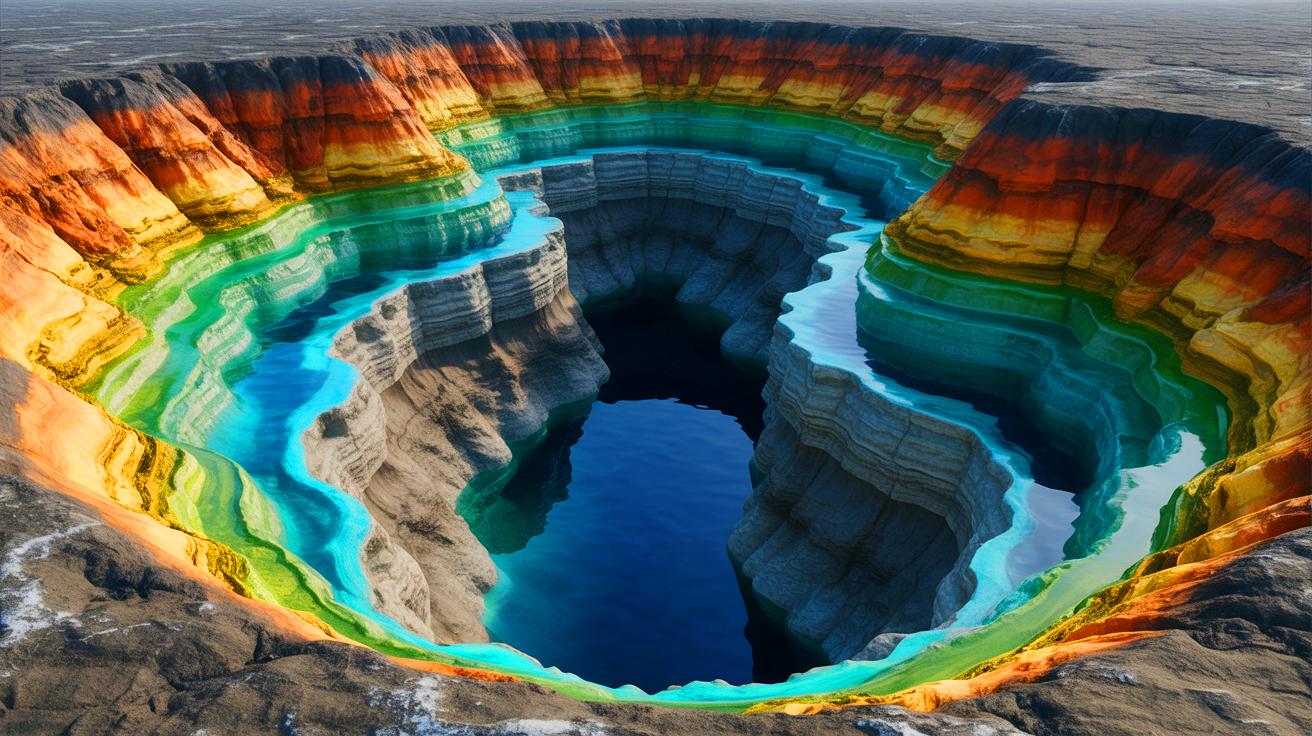
Beneath our feet, Earth hides a colossal reservoir that challenges what we thought we knew about the planet’s water. Deep in the mantle’s transition zone, water is locked inside minerals rather than sloshing as a vast sea. The scale is staggering, potentially rivaling—and perhaps exceeding—our surface oceans, with some estimates pointing to a capacity as large as three times the global seas we can see.
A hidden ocean in the mantle
The key to this subterranean “ocean” is ringwoodite, a high-pressure form of olivine stable around 410–660 kilometers deep. In this region, water exists as hydroxyl groups bound within the crystal lattice, turning the mineral into a geologic sponge. It is not liquid in caverns, but structurally incorporated, molecule by molecule.
Because the water is trapped at the atomic scale, the mantle’s rocks can hold astonishing amounts without forming lakes or rivers. The cumulative volume across the transition zone may approach or surpass the sum of Earth’s surface oceans. This reservoir likely waxes and wanes over geologic time as plates subduct and mantle material moves.
How scientists detected the signal
Researchers mapped this hidden water using the planet’s own earthquakes. Seismic waves speed up or slow down depending on rock composition, temperature, and the presence of water. In the transition zone, wave patterns showed anomalies consistent with water-bearing ringwoodite, revealing a diffuse but immense storehouse.
Laboratory experiments then tested ringwoodite under mantle pressures and temperatures. These studies confirmed the mineral can host significant hydrogen, validating clues seen in seismic tomography. In rare cases, tiny gems transported by deep volcanism carried ringwoodite inclusions that hinted at water-rich mantle domains.
“It’s a bomb beneath our feet,” one geophysicist remarked, capturing the scale—and the surprise—of what lay hidden for so long.
Why this changes the water cycle
A deep reservoir alters our view of Earth’s hydrosphere, extending the water cycle far beyond clouds and seas. Subduction drags oceanic crust and hydrated minerals downward, feeding the transition zone. Later, mantle upwelling and volcanism can return water to the surface, closing a deep loop.
This invisible circulation helps explain long-term stability in sea levels and climate across geologic ages. Water profoundly influences rock viscosity, melt generation, and plate dynamics. Even small shifts in deep water content can shape volcanism and seismic behavior.
Water reduces mantle rock viscosity, altering convection patterns and plate motions.
Hydrous minerals lower melting points, fueling magma generation beneath volcanic arcs.
Deep fluids weaken fault zones, affecting earthquake initiation and rupture styles.
The transition zone may buffer ocean volumes over eons, stabilizing surface environments.
Clues from deep water guide our search for habitable worlds beyond Earth by reframing “ocean-bearing” planets.
Sorting signal from sensation
Sensational headlines suggest a literal ocean, but the reality is more subtle. The water is chemically bound, not a free-flowing sea waiting to be tapped for drinking. Yet the sheer capacity—possibly up to three times surface oceans—is a legitimate scientific revelation with profound implications.
Uncertainties remain about how much of the transition zone is hydrated, how evenly water is distributed, and how quickly it cycles in and out. Seismic imaging still has limits, and laboratory constraints must be extrapolated to real mantle conditions. Future missions, denser seismic arrays, and refined models will sharpen our picture.
What comes next
Deep water reframes questions about planetary formation and long-term habitability. If Earth’s mantle can store such volumes, similar reservoirs may exist on other rocky worlds. That possibility expands our criteria for “water-rich” planets, especially those without obvious surface oceans.
At home, understanding this reservoir may improve hazard forecasts by clarifying how fluids influence faults and magma plumbing systems. It also reminds us that Earth’s largest systems are often the least visible—and that the planet still keeps secrets in the dark, high-pressure depths of its mantle.