
Editor’s note: This story has been updated to correct Kevin Mahoney’s title.
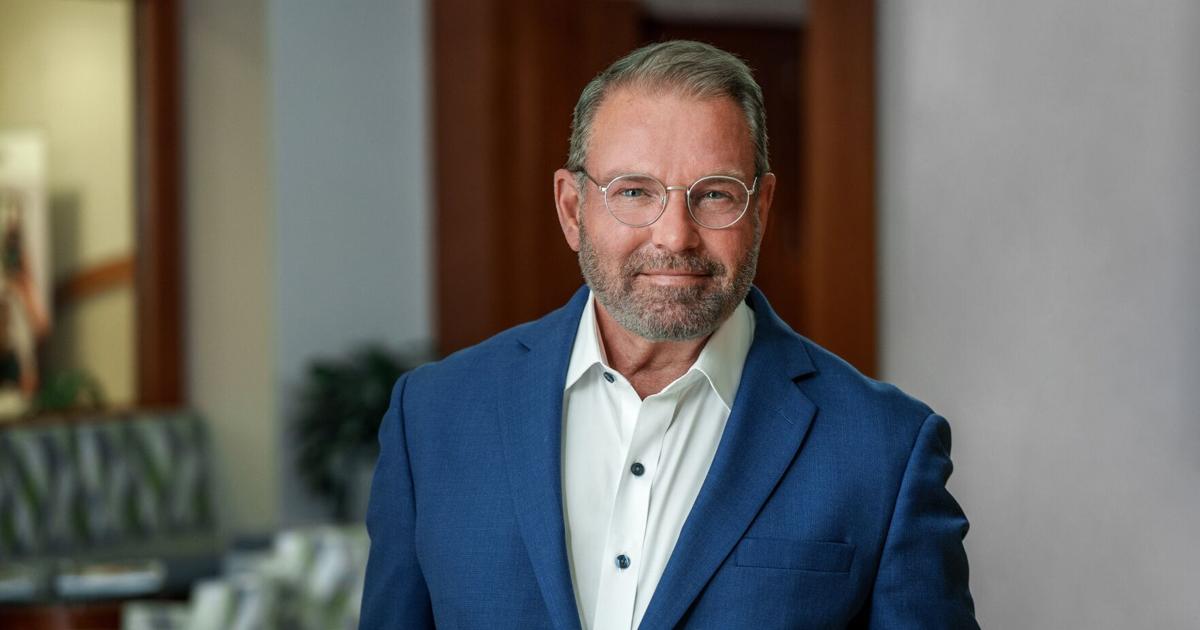
Michael D. Barber, a seasoned hospital executive, has been chosen to lead Penn Medicine Lancaster General Health, Lancaster County’s largest health system and employer, following a nationwide search.
Barber, 64, was named interim CEO last June following the resignation of John Herman, who accepted the position of president of Tufts Medical Center in Boston. The announcement of Barber’s appointment to the CEO position came Thursday.
Barber began his tenure in Lancaster as chief operating officer at LG Health in 2023, following 27 years of experience serving in senior leadership roles at Penn Medicine Chester County Hospital.
Penn Medicine leaders screened dozens of candidates for the position, said Kevin Mahoney, CEO of University of Pennsylvania Health System, the parent health system of LG Health.
“We saw great interest from across the country to lead this great hospital in a great community, but we realized the ‘candidate on the inside’ was the right choice,” Mahoney said.
As the top leader for LG Health, Barber will be responsible for overseeing Lancaster General Hospital and Women & Babies Hospital, the downtown and suburban outpatient pavilions, several other outpatient and urgent care services, and a network of more than 500 primary- and specialty-care physicians in more than 40 offices in Lancaster, Lebanon and Chester counties.
Barber’s salary “is not publicly disclosed at this time,” Marcie Brody, associate director for regional communications, said. Herman’s total compensation during the 2023 fiscal year was $1,083,243, according to a tax filing available through ProPublica.
Prior to coming to Lancaster, Barber served as chief operating officer at Penn Medicine Chester County Hospital where he oversaw a $290-million expansion of a patient tower with 100 new private rooms and increased surgical and cardiovascular services.
Barber earned a master’s degree in health administration from Saint Joseph’s University and a bachelor’s degree in business administration from Virginia Commonwealth University. He is a native of Danville, Virginia, and currently lives in Thornbury Township, Chester County, with his significant other. He plans to move to Lancaster County when he sells his house and finds a new home.
The following conversation has been edited for length and clarity.
What unique value do you bring to this position?
I have about 27 years of operating experience in health care, and since I’ve been at Lancaster for three years as the current chief operating officer, I’ve got a good sense of our strategy and operational efficiencies. We will continue to move on our strategy we’ve put in place years ago.
What strategy is that?
We have a strategy map we initiated three years ago with strategic imperatives. We want to become the destination Lancaster General Health, meaning we want to leverage and position ABBCI (Ann B. Barshinger Cancer Institute) as the premier destination offering highly differentiated oncology services.
We want to establish the heart and vascular institute as the top cardiology vascular program in Central Pennsylvania, and we want to develop a state-of-the art neuroscience institute.
Those are at least three of the imperatives that fall under becoming the Destination Lancaster for health care. And then we’re working on extending our reach in our primary market and in the secondary market. We’re also going to reinforce our core services — what we provide today — and to have easy access for our patients.
READ: Flu prompts mask mandate at health system with Lancaster County operations
What are some of your short-term goals?
We’ll continue to position ourselves for growth in the area. We’ll continue to look at operational efficiencies internally. We’ll continue to uplift our community by providing initiatives in the community, such as lead-free housing and food banks, and we’ll continue to develop our employees.
We’ll continue to work with Penn Medicine as our system to make breathtaking discoveries and put them into work. That could be short-term and long-term.
Can you give me an example of what an operational efficiency might be?
It could be looking be looking at periop (perioperative) services. We have about 36-40 ORs (operating rooms) across our system.
So, taking a look at the surgical cases — what should be done in a hospital setting; what can be moved to an ambulatory setting to make it more efficient for our patients and more efficient for our physicians and providers.
What do you see as some of the greatest strengths of LGH?
Being a Level 1 trauma center; we are Level 3 NICU for our NICU babies; we have Women and Babies Hospital; we do close to 4,000 births (per year). We offer proton therapy (cancer treatment) . We’re the only ones in our area. We have patients that travel 90 miles away for proton. We also provide CAR- T (cell) therapy (a personalized form of immunotherapy).
Our board is very involved in the community. They’re very involved in Penn Medicine LGH in terms of what we provide and what we’re going to focus on strategically. I have a good relationship with the board. I’ve been working with them for the past three years as the chief operating officer, and now I’ll continue to build that relationship as the CEO.
READ: New measles case reported in Lancaster County
With more than 3,000 residents dropping their Affordable Care Act coverage in the county and likely going uninsured, how do you expect this will affect the bottom line at LGH, and what/if any changes does LGH expect to make to address this?
I think that is one issue we need to spend some time investigating and putting our heads together to think about how we’re going to continue to care for those patients.
We don’t turn any patient away, based on the ability to pay, especially in our emergency room and even if they need to be admitted to the hospital. We really need to play this out and see what type of programs we may need to create.
What do you mean by “play this out?”
We really don’t know the impact it’s going to have on us financially.
We know hospitals deal with a shortage of medical professionals nationwide. However, we are also aware of the layoffs and unionization of some of your staff members last year. How is the state of staffing and labor relations at the hospital?
I feel it’s well. We did have a RIF (reduction in force) in the past, and it has helped us to be more efficient operationally. And again, we are positioned to continue to grow. We put a lot of emphasis on recruitment and retention. In terms of recruiting health care professionals, there are several disciplines that the demand is higher than what we have out there. But we are managing, and we put a lot of emphasis on retaining our staff.
With three other hospital systems having a presence in the county, how will competition impact your strategy as a leader?
It will always impact the strategy. You used to plan for a strategic plan for five years. Now a strategic plan lasts two years or less because you’re always changing based on the market dynamics and competition.

Success! An email has been sent to with a link to confirm list signup.
Error! There was an error processing your request.