
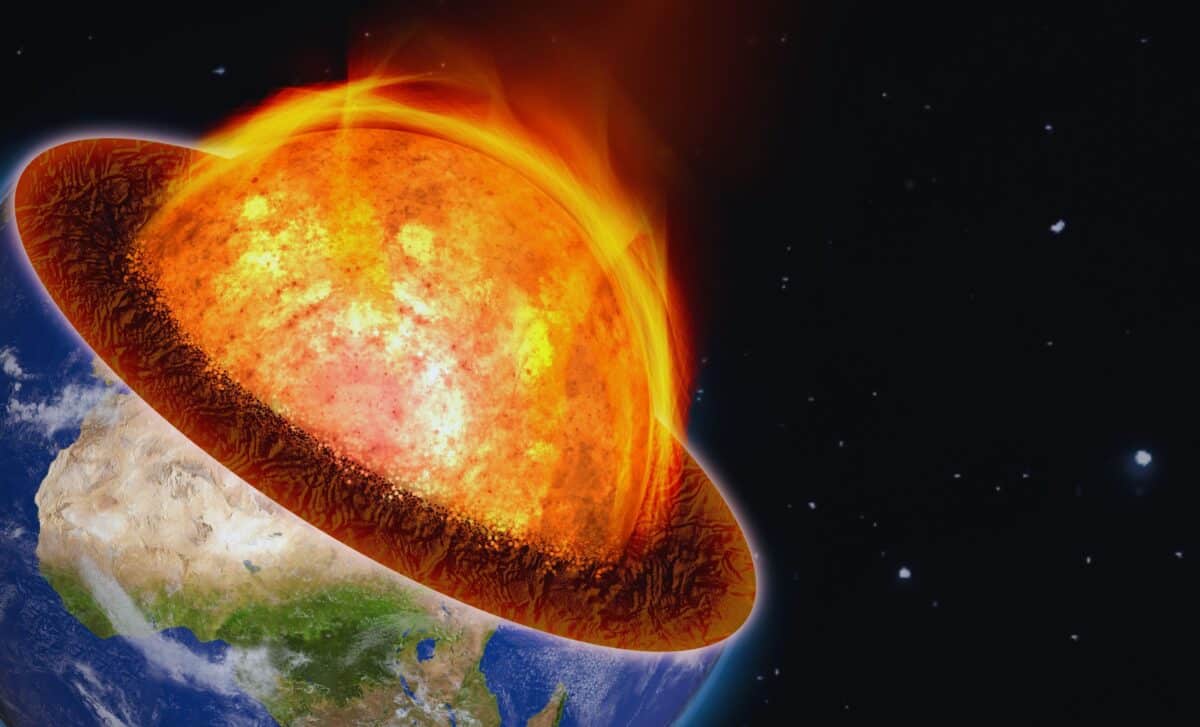
Earth’s largest hydrogen reservoir may not be in its oceans but deep within its core. Laboratory experiments suggest that the metallic heart of the planet could contain up to 45 times more hydrogen than all surface water combined.
The study, published in Nature Communications, pointed to a substantial quantity of hydrogen locked into iron under extreme pressure and temperature. The findings offer new insight into how Earth formed and where its water may have originated.
Hydrogen is abundant across the universe, yet on Earth it appears mostly bound to oxygen in water. That apparent scarcity may be misleading. Beneath the crust and mantle, conditions during the planet’s early molten phase may have allowed hydrogen to be incorporated directly into the forming core.
Recreating The Birth Of The Core In The Lab
Direct access to Earth’s core remains impossible, so researchers rely on simulations. According to the study, a team led by Dongyang Huang at Peking University used a diamond anvil cell to replicate extreme interior conditions.
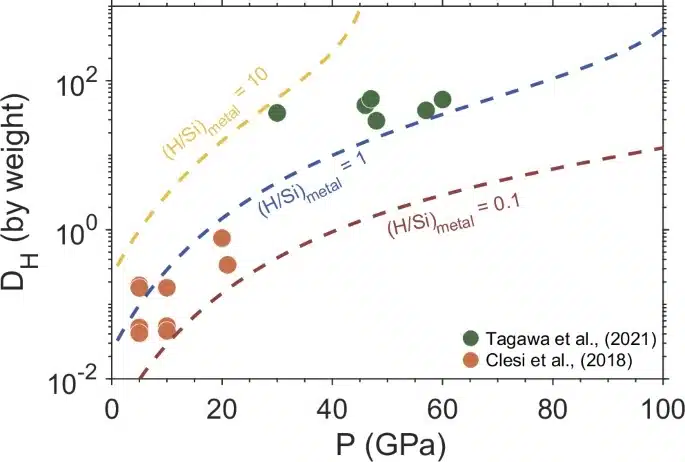 Hydrogen partitioning increases with pressure under core-like conditions. Credit: Nature Communications
The scientists compressed a small iron sphere encased in hydrated silicate glass to pressures of 111 gigapascals and heated it to roughly 5,100 kelvins. Earth’s core begins at around 136 gigapascals, with temperatures estimated between 5,000 and 6,000 kelvins, placing the experiment within a comparable range.
Under these conditions, the materials liquefied completely. Iron, silicon, oxygen, and hydrogen mixed freely. The team observed that hydrogen dissolved readily into molten iron and bonded with silicon and oxygen, behavior that could mirror what happened when Earth’s core formed billions of years ago.
Measuring The Hidden Hydrogen Fraction
Seismic observations have long indicated that the core is not pure iron; its density is slightly lower than expected. Previous analyses have suggested that between 2 and 10 percent of the core’s weight may consist of silicon.
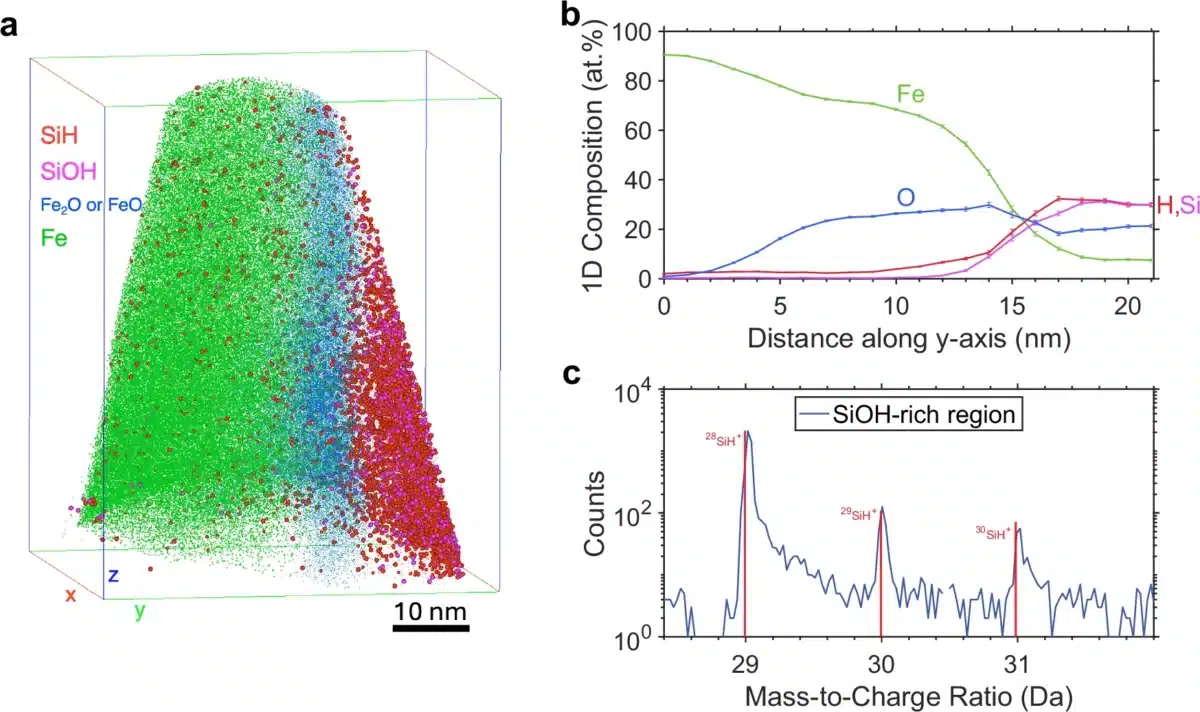 Atom probe analysis showing hydrogen-bearing species across an iron-silicate interface. Credit: Nature Communcations
Using those estimates and their experimental results, the researchers calculated that hydrogen could represent between 0.07 and 0.36 percent of the core’s total mass. As reported in the latest research, this amounts to approximately 1.35 to 6.75 sextillion kilograms of hydrogen.
By comparison, Earth’s oceans contain about 150 quintillion kilograms of hydrogen. The core’s potential inventory would therefore equal between 9 and 45 times the hydrogen found in all ocean water combined.
Where Did Earth’s Water Really Come From?
The research team wrote that such an amount of hydrogen would “require the Earth to obtain the majority of its water from the main stages of terrestrial accretion, instead of through comets during late addition”.
Scientists have suspected for years that hydrogen may be stored in the core, but estimates varied widely. This study provides experimental backing for a substantial internal reservoir, narrowing the uncertainty.
Understanding how much hydrogen is sequestered in the core also helps researchers trace how water has been stored and possibly recycled over geological time.