
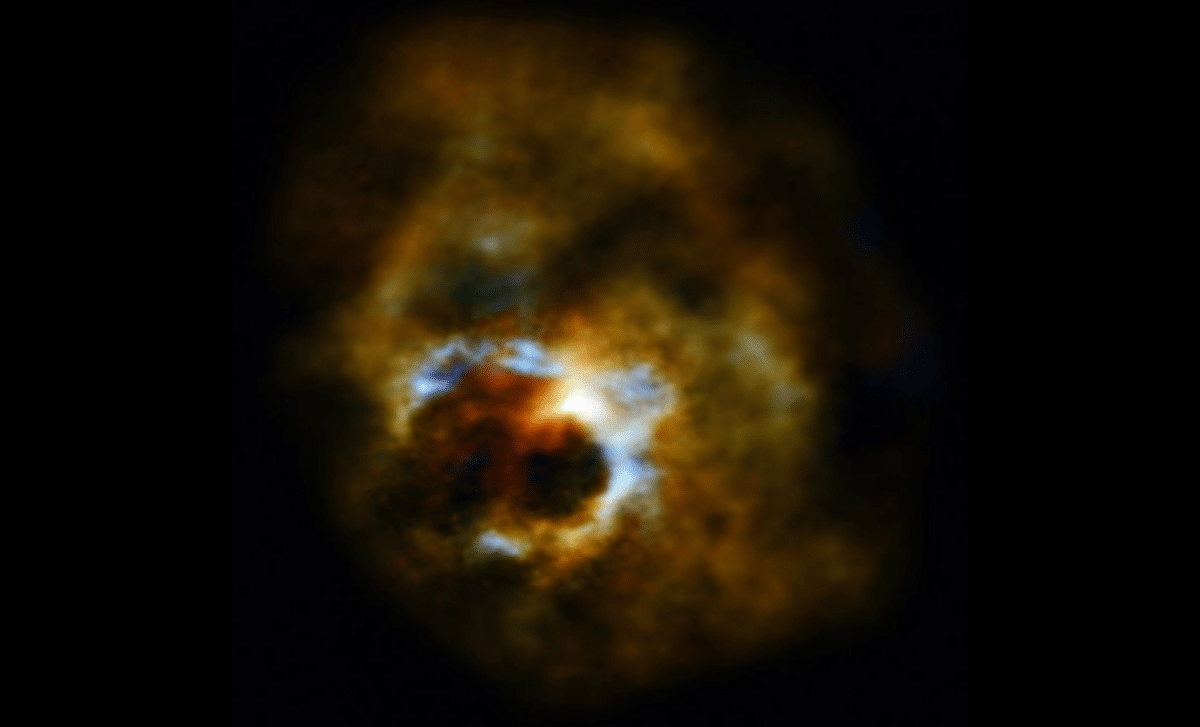
In a remarkable discovery that’s bound to capture the imagination of space enthusiasts and scientists alike, the star Mira A, located about 300 light-years from Earth, has released an extraordinary heart-shaped cloud of gas and dust. This astonishing event was revealed in a study led by Theo Khouri, astronomer at Chalmers University of Technology, and is currently available on the arXiv preprint server, soon to be published in Astronomy & Astrophysics. The ejected material from Mira A, approximately seven times the mass of Earth, defies expectations, raising new questions about the behavior of aging stars and their mass-loss processes.
A Surprise Heart-Shaped Ejection
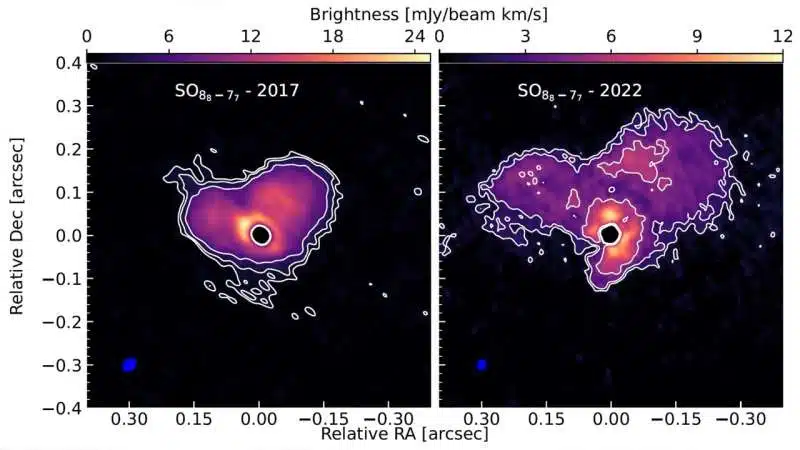
Mira A, a well-known red giant star in the final stages of its life, has consistently fascinated astronomers due to its periodic outbursts of gas and dust. However, the discovery of a heart-shaped cloud expanding around the star caught researchers off guard. The team led by Khouri was taken aback by the sheer volume of material, about one hundred times more than expected. This colossal ejection is a striking example of the unexpected behaviors of dying stars. Khouri and his team’s detailed study of the event, spanning from 2015 to 2023, revealed not just the unusual shape of the cloud, but also the immense scale of the material ejected.
“We were very surprised to see this structure. We also see that the star’s illumination of the surrounding dust varies in an unexpected way, which implies that the star acts like a lighthouse—illuminating its environment unevenly,” says Khouri.
This observation challenges our understanding of the processes occurring in Mira A’s final stages and could have broader implications for the study of mass loss in other aging stars.
 Gas forms a heart-shaped cloud around the star Mira A, while dust seems to be confined almost exclusively to the outer edges. Credit: Chalmers University of Technology
The Role of Gas and Dust
The heart-shaped cloud that Mira A has formed is not just a visual spectacle; it offers significant insights into the physical processes at play. Researchers used a combination of observations from the VLT (Very Large Telescope) and ALMA (Atacama Large Millimeter Array) in Chile to study the star and its surrounding material in both visible light and radio frequencies. These observations revealed that gas fills the heart-shaped structure, while dust is concentrated mainly along the edges, creating a glowing outline around the gas. This arrangement suggests that the ejected dust is being pushed out further than the gas, possibly due to the interaction of stellar winds with the surrounding material.
The study currently available on the arXiv preprint server, suggests that the uneven distribution of the gas and dust could be the result of the star’s fluctuating luminosity. “We know that stars like Mira lose mass as they age, but we did not expect it to happen in such large and sudden bursts,” explains Khouri. This sudden release of material is something that had not been anticipated, providing new clues about the mechanisms of mass ejection in red giants.
Implications for the Study of Stellar Evolution
The discovery of Mira A’s heart-shaped cloud is more than just a captivating image, it represents a critical moment in the study of stellar evolution. As stars like Mira A approach the end of their lifecycles, they begin to shed their outer layers, enriching the surrounding space with gas and dust. This material eventually contributes to the formation of new stars, planets, and other celestial bodies. Understanding how this mass loss occurs, especially in such large and sudden bursts, can offer astronomers deeper insight into the fate of red giants and the larger processes of stellar evolution.
The study of Mira A’s mass loss is significant because it shows that the process is not uniform. Instead, it can be chaotic and sudden, as evidenced by the sheer volume of material released in this event. The heart-shaped cloud also serves as a vivid reminder of the dynamic and unpredictable nature of the cosmos. As Khouri notes,
“We will keep monitoring the expanding cloud around Mira A, as it is becoming so large that it may start to affect its companion star, the white dwarf Mira B. It is already gathering some of the material ejected by Mira A.”
Ongoing Monitoring of Mira A
As the heart-shaped cloud continues to expand, astronomers will keep a close eye on its evolution. One particularly intriguing aspect of this discovery is the interaction between Mira A and its companion star, the white dwarf Mira B. The material ejected by Mira A is already starting to be pulled in by Mira B, and this interaction could lead to further changes in the behavior of both stars. Scientists plan to monitor the cloud’s expansion to see if it will have any significant effects on the surrounding environment, including the fate of Mira B.
The continued study of Mira A and its companion offers valuable opportunities to observe how stars in their final stages influence their surroundings. The ongoing research into this phenomenon will likely yield more discoveries about the complex interactions between aging stars and the material they expel into space. “We will keep monitoring the expanding cloud around Mira A, as it is becoming so large that it may start to affect its companion star, the white dwarf Mira B,” says Khouri, highlighting the importance of tracking this evolving event.