
Step aside, rats. There’s a new, bigger pest in town.
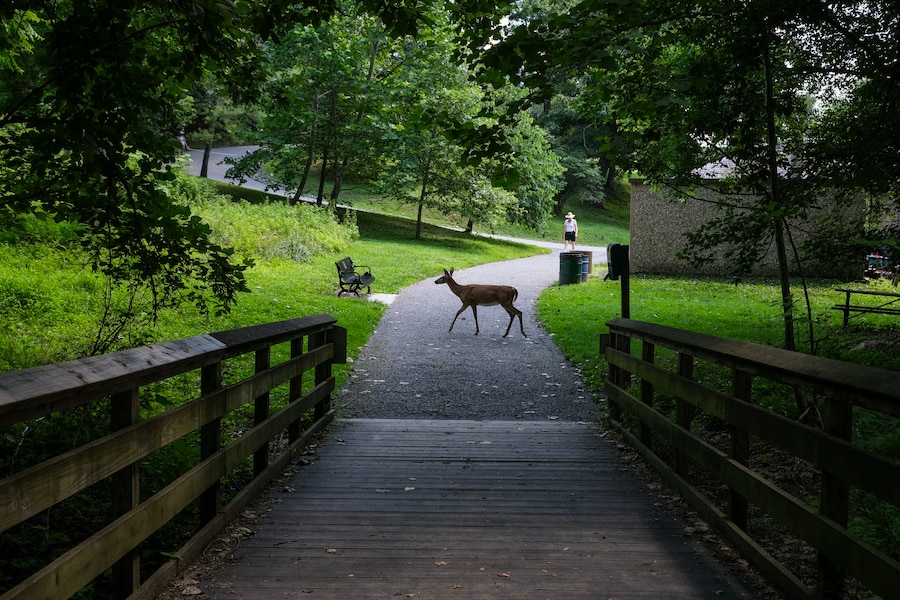
They munch on gardens and ruin hydrangeas across Baltimore neighborhoods. Herds stroll through the city’s leafy parks, chewing forest plants to their nubs. They dart into traffic, causing wrecks.
Baltimore’s white-tailed deer are seemingly unperturbed by people or city life. In 2019, one young buck broke into a Southwest Baltimore home through a window, tore up furnishings and made a graceless escape out the front door.
These cosmopolitan ruminants have made themselves at home in Baltimore — until now. The city’s Department of Recreation and Parks is striking back with a purge planned for Druid Hill Park and Gwynns Falls/Leakin in West Baltimore and Herring Run Park in Northeast Baltimore.
Starting in mid-March, trained sharpshooters will enter these three parks after dark with silenced weapons and night vision gear, conducting shoot-to-kill operations. The sharpshooters, a specially trained team with the U.S. Department of Agriculture, will aim to eliminate as many as 271 deer before April 15.
If successful, said Shane Boehne, the deer management program lead for Recreation and Parks, this quota would bring deer in those three parks down to a sustainable population density of about 20 per square mile.
Wildlife managers still would be a long way from culling the deer population citywide.
With no natural predators, the city’s deer have overrun its parks and forests. According to a December survey, deer density in Druid Hill Park is about 159 per square mile, about eight times the level recommended by the Maryland Department of Natural Resources.
The most densely populated green space, Powder Mill Park on the western border, had 21 times the recommended density, or 422 deer per square mile — a level Boehne describes as “insane.”
Baltimore’s least-overrun park is Fort Armistead at the city’s southern tip, where deer are estimated to be three times the sustainable level.
The city’s spending board is scheduled to vote Wednesday on the $110,422 USDA contract. That cost doesn’t account for additional expenses needed for parks staff to manage the program, Rec and Parks spokesperson Alex Silverman said.
Using sharpshooters isn’t new.
Suburbs and other densely populated cities such as Philadelphia and Washington have deployed them to cull their deer populations for years, though not always to unanimous approval.
Some have protested shooting Bambi’s parents as inhumane, including with a recent petition circulated in Arlington, Virginia. A group of D.C. residents sued the National Park Service in 2012 over culling in Rock Creek Park but lost.
Boehne, who studied wildlife biology and urban deer management at the University of Georgia before coming to Baltimore, said the city doesn’t want to eliminate deer. Instead, the program aims to reduce the population to a more sustainable level for the health of new trees, forest ecology and the animals themselves.
He hopes the program will help protect residents: 311 data analyzed by Rec and Parks shows that deer likely are involved in hundreds of car accidents each year.
Deer seen through infrared technology in Powder Mill Park. (Baltimore City Recreation and Parks)
Councilman Ryan Dorsey, who has watched deer wreak havoc on Baltimore’s ecosystems for years, is encouraged to see the city responding.
“We’re so wildly, wildly in excess,” said Dorsey, whose district includes Herring Run. “It’s pretty easy to recognize that there’s something really out of balance with respect to our deer population.”
Surrounding jurisdictions such as Howard and Baltimore counties also have government-led sharpshooter programs, while hunters in rural areas help keep deer populations in check. Hunting isn’t a viable option for Baltimore; residents can hunt in the city but only on private property, with bows, and at least 150 yards from an occupied building, which is tough to find in the densely populated city.
Although Baltimore’s deer are ubiquitous, it isn’t quite Nara — the Japanese city where hundreds of deer bow on command and eat rice crackers out of tourists’ hands. But Dorsey speculated the region’s deer have adapted to take refuge in Baltimore’s city limits.
“We’re like a safe haven for deer,” the councilman said.
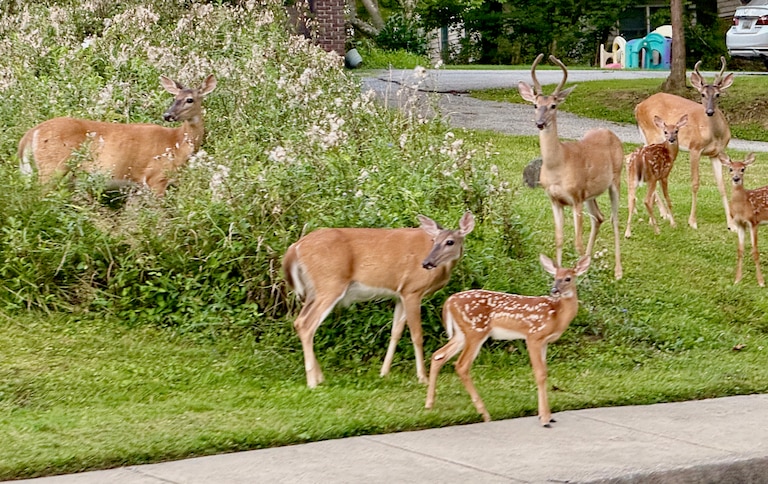 Deer are seen along Cross Country Boulevard in Mount Washington in July. (Jerry Jackson/The Banner)
Maryland’s total deer population surged by about 100,000 from the late 1980s, peaking at around 300,000 in 2002, according to the state Department of Natural Resources, but has hovered around a relatively stable 240,000 in the last two decades.
In Baltimore, though, huge numbers persist. The earliest records showing an overpopulation date to 1999, Boehne said.
To ensure no one is in the line of fire during culling operations, city officials plan to close parks to visitors starting at 4 p.m. before shoots, said Ashley Bowers with the city forestry division. They’ll close roads, post signs at all entrances and perform sweeps to ensure no homeless encampments are in the area.
The USDA sharpshooters, many of whom Boehne said are ex-military, will use thermal imaging that allows them to spot and distinguish wildlife — and people — in the dark. State law requires shooters cannot fire within 150 yards of occupied residences, including homes, schools and businesses.
Such lethal tactics have proven safe in other places. Boehne cited Montgomery County, where a sharpshooter program has killed 25,000 deer since 1997 without public safety problems.
Even so, it’s grisly work.
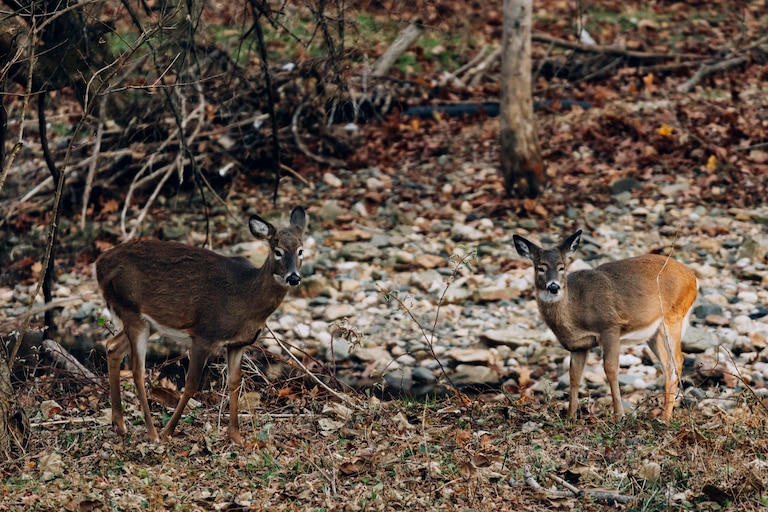 Two of many local deer graze on the banks of Maidens Choice Run in Baltimore in 2025. (Wesley Lapointe for The Banner)
Rec and Parks officials promise it won’t leave Baltimore’s beloved parks soaked in deer carnage.
The USDA team will make efforts to minimize blood splatter and other evidence from the killings, an overview of the USDA contract states. When cleanup isn’t possible, the document says sharpshooters should alert the city so that parks officials can take care of the mess “prior to sunrise the next morning.”
All these deer carcasses, meanwhile, will go to a good cause.
The spending board agreement notes that Rec and Parks could donate deer remains to the Maryland Food Bank, schools or even the zoo, located inside Druid Hill Park.
Most will go to a processor, which will butcher the animals and package their meat for city food pantries.
If the sharpshooters hit their quota this year, Boehne said, these deer could provide 40,000 servings of venison for Baltimore residents.