
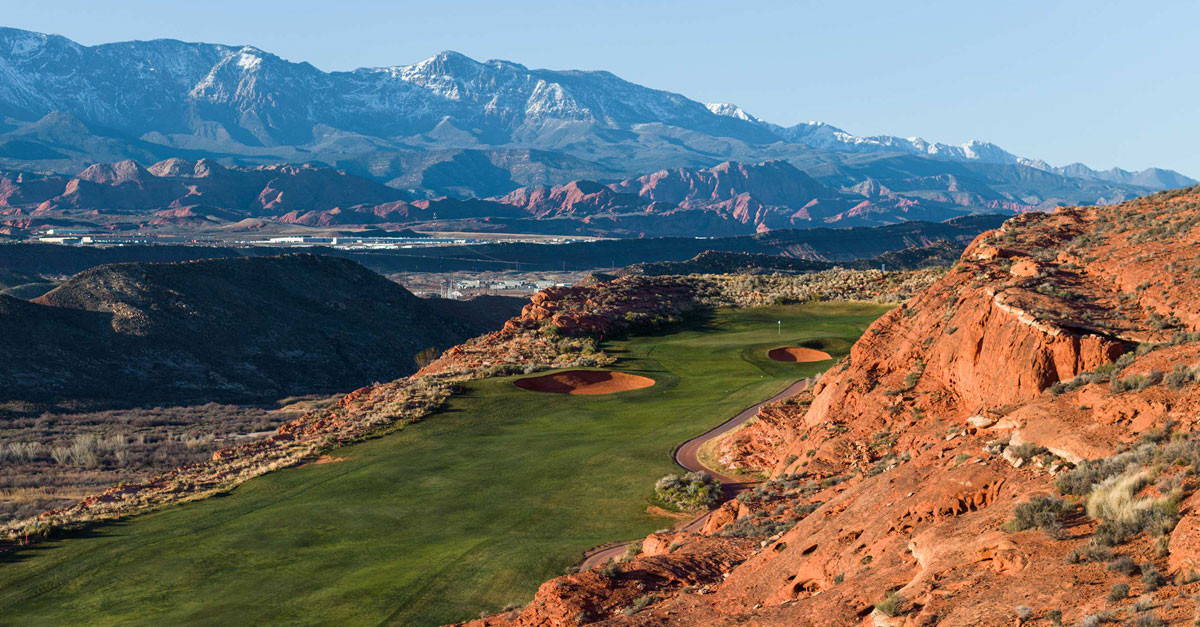
Favorite Hole
No. 13, par 4, 320 yards
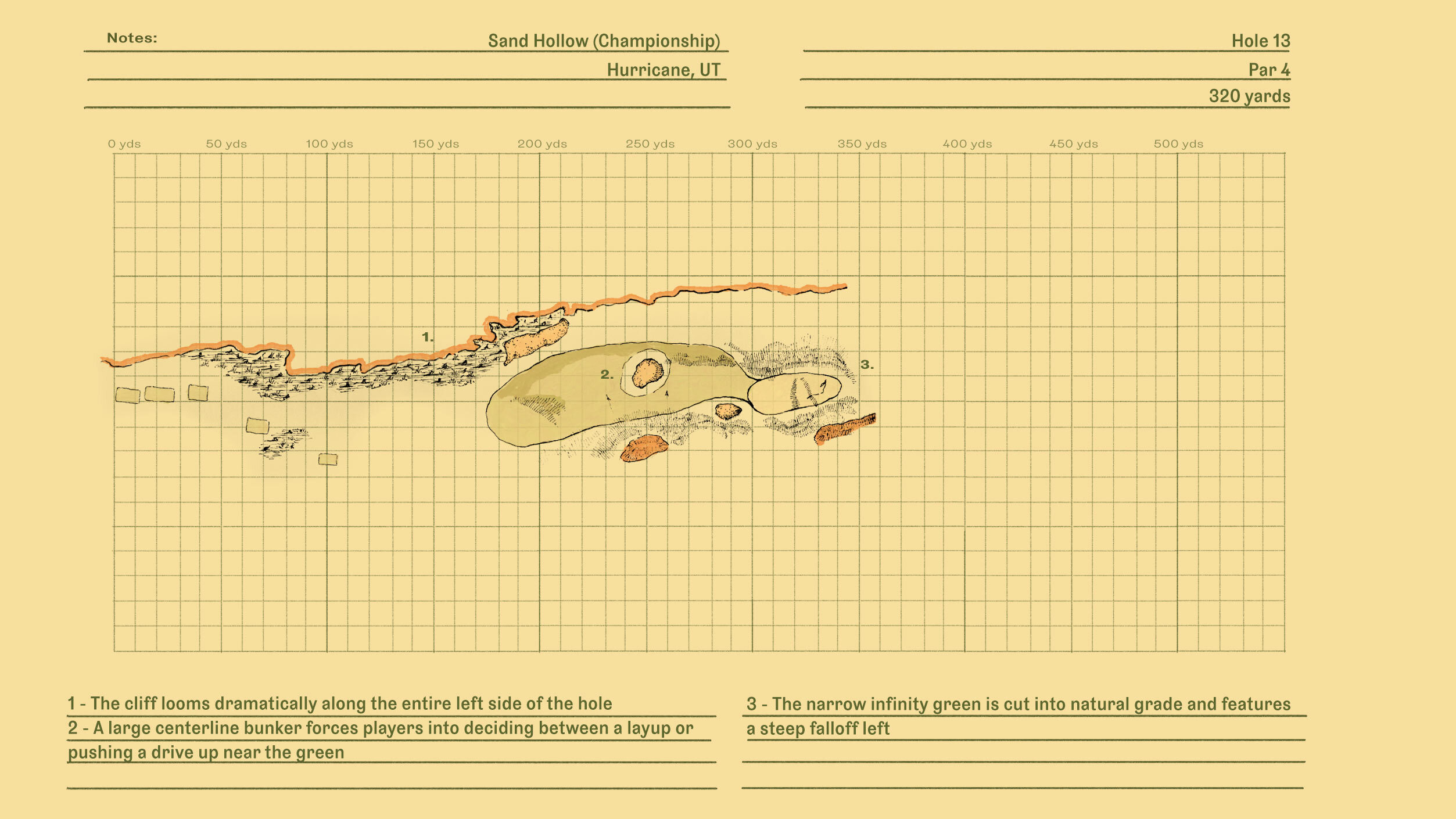 Illustration by Cameron Hurdus
I tried challenging myself to pick a hole that wasn’t on the cliff edge, but I kept getting drawn back to the conundrum presented on the 13th tee. This hole hugs the cliff most closely, and its perched green creates an infinity look, inciting fear and a desire to leave driver in the bag. A carry bunker on the left and a large, centerline bunker mean a lay-up requires careful consideration. This is where my mind went back to the driver and the pursuit for all the marbles.
The slender green is tough to find off the tee but a hidden reprieve will gather shots slightly offline, saving them before trundling to the bottom of the river valley. Approaches from the right are more difficult due to the tilt of the green and forced carry over the greenside bunker. All told, the 13th does a great job at baiting you into being a hero while leaving room for safe play, making for a thoughtful and strategic golf hole with a captivating setting.
{{sand-hollow-championship-favorite-hole-13-gallery}}
Overall Thoughts
When you first see images of the Championship Course at Sand Hollow, you’ll be mesmerized by the snow-capped mountain scenery and cliff-edge holes. You may venture to guess those cliff-hangers are the sole attraction of the course, but that’s not the case. Sand Hollow is a wonderfully varied design that builds to the heroic climax of holes 11-15 and then gracefully coasts to the finish.
Desert golf in general can tend to be repetitive and a little stale. That’s because the environment can be too severe to traverse easily and isn’t suited to maintain turfgrass. To make the most of the site at Sand Hollow, Staples skillfully routed the course around some prominent rock outcroppings before tiptoeing along the red rock cliff edge. If you analyze the site before golf was built, you can see three distinctive points of interest. The two massive rock outcroppings where the clubhouse, first, ninth, 10th, and 18th play to and from, the long rocky ridge in the middle of the front nine, and the aforementioned cliff edge. The rest of the property is fairly featureless with moderate undulations that are far from terrific in terms of golf land. When you look at the before and after on Google Earth, Staples’ approach to the routing becomes quite clear.
{{sand-hollow-championship-routing-gallery}}
To maximize interest, Staples incorporated the protruding rocky areas for most of the holes on the front nine, all four holes playing to and from the clubhouse, and placed as many holes on the cliff as possible. The first plays down the hill towards the rocky spine, the second along it, the fourth along the backside, the seventh and eighth back towards it, and the ninth back up the hill and towards the rock feature next to the clubhouse. The 10th then plays down off the hill and the 11th creates a long, unobstructed view into the river valley and mountains beyond. If the routing hadn’t directed the players’ attention towards the attractive rock formations, the homes around the perimeter of the front nine would feel much more intrusive. In this case, the rocks provide a great framework and cohesiveness that builds to the peak in the middle of the back nine. To round it all out, the design duo created four very different and compelling holes on the cliffs, as well as one last hooray on the 17th with its intriguing Great Hazard feature.
{{sand-hollow-championship-rocky-areas-gallery}}
Coincidentally, the more I’ve peered over the photos and reminisced on my experience at Sand Hollow, I’ve realized the design is more intricate and sophisticated than I first thought. The shaping in and around the greens is engaging with bolder application on the more subtle land and simpler implementation on the captivating holes. According to Staples, hardly any earth was moved outside of the dramatic cliff stretch because there was about two feet of blow sand covering the plateau above the cliff edge. This provided the perfect medium for the construction team to elegantly tie the holes into the environment, as well as shape dynamic ground features. Additionally, the decision to use native red sand bunkers and the minimal disturbance of vegetation allows the design to feel like it was always meant to be there.
MORE SAND HOLLOW: Before/after photos and insights from Andy Staples
A few downsides include the ever-expanding real estate component and the resort’s desire for lush green grass. While I have no doubt that this is a very difficult place to grow grass (just look around, there’s no natural turfgrass anywhere), a more rustic presentation that sews the course into the muted tones of the desert landscape would fill me with delight. It appears that the brash contrast of green grass and the red rocks is a key marketing play to captivate prospective golfers. Additionally, the housing development that has been planned from the start is beginning to expand to the back nine. To put it lightly, it looks frightening. Be sure to make your trip to Sand Hollow soon, because the cliff-edge holes could very soon be shadowed by real estate.
1 Egg
The combination of quality land use and varied design gives Sand Hollow its Egg. There are really only three holes that feel slightly bland, and two of those come after the infectious high of the cliff holes. While we were strongly dissuaded by staff from walking, I think the course is walkable, even with a few moderate hikes along the cliffs that are well worth the effort. If the course was browned out and consistently firm and fast, it could inch its way to 2-Egg status, but I’m afraid the impending real estate will forever hold it back. After all, there aren’t any homes in Zion National Park.
Course Tour.webp.webp) Illustration by Matt Rouches
Illustration by Matt Rouches
{{sand-hollow-championship-course-tour-01}}