

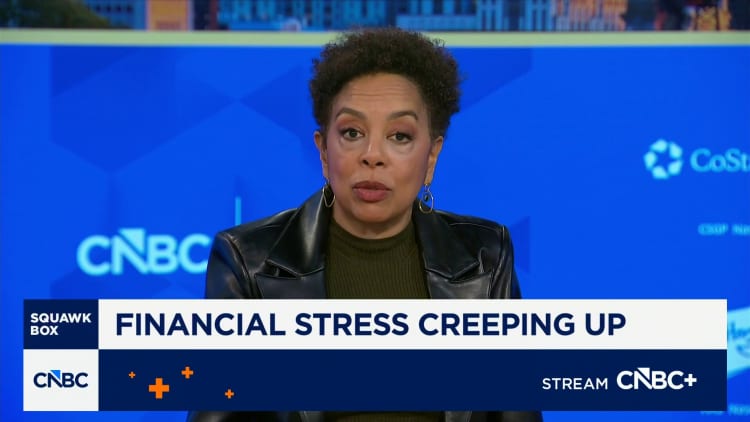
Signs of rising financial stress, particularly among middle-income Americans, are warning flags about the U.S. economy’s health in 2026, experts say.
Spending growth for higher-income Americans remained relatively stable between January 2025 and January 2026, according to internal transaction data from Bank of America Institute released this week. However, spending growth slowed for lower- and middle-income households during that period.
In the so-called K-shaped economy, lower-income households are struggling, while those with higher incomes have strengthened their financial positions, mostly through stock gains and homeownership. Now, as middle-income consumers are showing signs of stress, the “K” shape is widening and beginning to look “more like the jaws of a crocodile,” said David Tinsley, senior economist at the Bank of America Institute.
Zoom In IconArrows pointing outwards
“What we’re increasingly seeing is a divergence between higher- and middle-income households in terms of their spending growth,” said Tinsley, who added that the difference between middle-income and higher-income spending is the largest it has been since early 2022.
Financial stress at a ‘tipping point’
New data compiled by the National Foundation for Credit Counseling also shows that an increasing number of counseled consumers are struggling to stay afloat. The NFCC’s quarterly forecast projects that financial stress will reach an all-time high in the first quarter of this year, based on consumer behavior data from its national network of financial counseling agencies that serve more than 1 million clients.
There’s “a tipping point,” said NFCC CEO Mike Croxson, where consumers don’t have enough free cash flow to make regular, fixed payments to systematically reduce their outstanding debt. “That issue is simply creeping up the income and age ranks,” he said.
Financial stress is affecting more middle-income consumers ages 45 to 60, who can no longer borrow to fund their lifestyle, Croxson said.
“They would take on more credit to keep this spending going, but they can’t access it,” he said. “They have reached their capacity.”
Tax refunds may boost spending
Larger tax refunds may help prop up consumer spending, experts say. The Tax Foundation estimates the average tax refund could be $300 to $800 higher compared with a typical year.
That may help some people who are struggling to pay higher prices for everyday items.
However, some economists expect the impact will be short-term. “The underlying picture with these divergences will certainly reassert itself in the second half of this year,” Tinsley said.
More from Your Money:
Here’s a look at more stories on how to manage, grow and protect your money for the years ahead.
A key factor in closing the divide will be job growth, he said. The most recent Department of Labor report showed unexpectedly strong job growth, even as tech and other companies have announced layoffs.
“It could be that the labor market reaccelerates and, you know, sort of keeps the show on the road, but, you know, there is a risk. We’re really flagging the risk,” Tinsley said.
SIGN UP: Money 101 is an 8-week learning course on financial freedom, delivered weekly to your inbox. Sign up here. It is also available in Spanish.