
It was hard to resist running my fingers over the velvet carpet of moss that smoothed the drystone wall’s jagged capstones. Six months ago, after four heatwaves and prolonged drought, these same mosses resembled brown, wizened threads of dried tobacco. Today they were an inch-tall emerald forest again, studded with yellow moss bell toadstools, saturated with overnight rain.
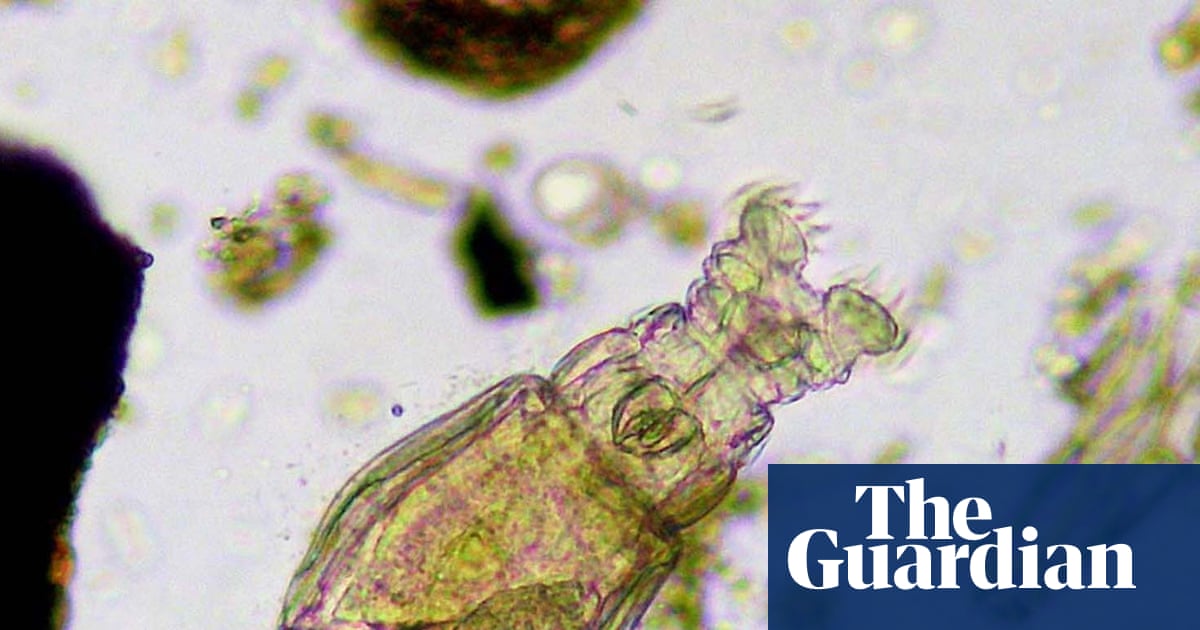
Wall-top mosses are resilient, and so is the microscopic life that thrives on them. I collected a few soggy green cushions to investigate later, for “here be monsters”, though most are less than a millimetre long.
Tardigrade: the ubiquitous drought-tolerant inhabitant of wall-top mosses. Photograph: Phil Gates
It’s more than 60 years since I first encountered moss microfauna. After l lost an eye in an accident, my parents bought me an inspired gift: a beginner’s microscope, to while away my days of recuperation. Casting around for something to look at, I mounted some moss in a drop of water on the glass slide – and stumbled into the world of what Victorian microscopists called infusoria: life forms that materialise when dead vegetation is incubated in water; anhydrobiotic organisms that can survive prolonged drought, often as cysts, until revived by rain.
Back home today I squeezed a drop of mossy water on to a microscope slide, then watched and waited. Soon, a water bear – a tardigrade – lumbered into view, equipped with stubby legs and hooked toes for clambering through moss forests. Then, the beast I’m most fascinated by – a rotifer. Its transparent body extended, telescopically, from a vase-shaped tube, then deployed two lobes fringed with rhythmically beating hairs that created the mesmerising illusion of spinning wheels. I watched as they generated vortices, as deadly as the mythological whirlpool of Charybdis, sucking minute food items into a pair of constantly chewing jaws.
A wall top carpet of moss, with moss bell toadstools. Photograph: Phil Gates
In 1874, in his Evenings at the Microscope, the celebrated Victorian naturalist Philip Henry Gosse described even the simplest microscope as “a key which unlocks a world of wonder and beauty, which one who has gazed upon it can never forget, and never cease to admire”. Amen to that. Try it, and you’ll see moss for what it really is: a miniature rainforest, teeming with diverse life forms that exist beyond the unaided human eye.
Under the Changing Skies: The Best of the Guardian’s Country Diary, 2018-2024, is available now at guardianbookshop.com