
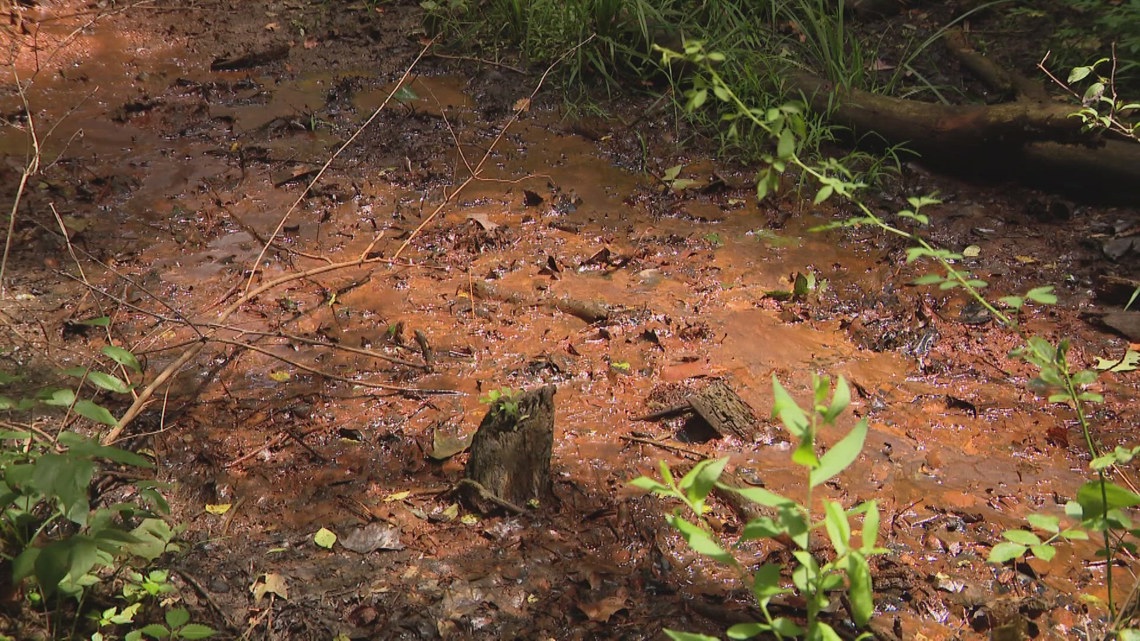
A Missouri bill would give the state power to clean up abandoned landfills while dissolving solid waste districts and shifting how recycling grants are handled.
ST. LOUIS — A bill moving through the Missouri legislature would give the state new authority to clean up abandoned landfills, but it would also dissolve Missouri’s solid waste management districts — a proposal that has drawn sharp criticism from environmental groups and district leaders who say it could disrupt recycling programs and cost jobs.
The legislation, Senate Bill 1586, is sponsored by State Sen. Ben Brown and aims to address Missouri’s estimated 29 abandoned landfill sites, many of which lack a legally responsible owner.
Brown said the problem has gone largely unnoticed for years.
“This has kind of been one of Missouri’s best kept dirty little secrets — that we have 29 of these throughout the state,” Brown said.
Expanding DNR’s authority
Brown said current law ties enforcement and cleanup authority to landfill owners — a problem when no owner exists.
“What wasn’t anticipated is the situation we have now, where we have nearly 30 sites that do not have an owner,” Brown said. “With the absence of the owner, DNR has no authority or ability to go in and actually do anything to remediate the problem.”
The bill would give the Missouri Department of Natural Resources the authority to “assess, investigate, test, remediate and manage abandoned solid waste disposal areas.”
Funding shift at the center of controversy
To help pay for that work, the bill would eliminate Missouri’s 20 solid waste management districts and shift administration of landfill tipping fees and grants directly to DNR.
Brown said solid waste districts currently receive about 61% of landfill tipping fees, while DNR receives the remaining 39%.
“I wanted to formulate the bill in a way where it would preserve that funding, but eliminate the often over 50% overhead costs that these solid waste districts are utilizing,” Brown said.
Brown argued that eliminating district overhead could free up $4 to $5 million annually, allowing the state to both preserve environmental grants and begin addressing abandoned landfills.
“At no point in time did this bill ever eliminate those grants,” Brown said. “I even went further and added language that ensures that funding’s preserved.”
He said the revised bill locks in a minimum level of grant funding based on the average amount awarded by solid waste districts over the previous three years.
“That amount becomes the floor,” Brown said. “So not only does it not eliminate those grants and programs — if anything, it provides more and guarantees that you can’t receive anything less than what you’ve had in previous years.”
What solid waste districts do
Eric Larson, executive director of the solid waste management district serving St. Louis city, St. Louis County, St. Charles County and Jefferson County, said districts provide critical support to nonprofits and local governments.
“Nonprofits come to us and we help guide them, get them into programs and help support them,” Larson said.
He said the district has funded household hazardous waste programs and expanded recycling access across the region.
“In Jefferson County specifically, it actually opened up a recycling spot that had never been there,” Larson said.
Over the past 33 years, Larson said his district has awarded more than 1,500 grants.
“We have a huge impact,” he said. “Everybody knows who we are and they know what we’re able to do and help solve issue-wise for diversion in our district.”
Concerns about eliminating districts
Larson said dissolving the districts would cause “a lot of heartburn and a lot of lost opportunities,” especially for nonprofits that rely on annual grants.
“If we weren’t able to help them annually, they would be severely at a loss for revenue,” Larson said.
He also questioned whether DNR could realistically manage grant oversight statewide.
“You have about 20 districts in the state with 20 professionals such as myself, and we know what matters in our local areas,” Larson said. “Unfortunately, Jefferson City’s not going to know what’s an impact and what’s going to work for them.”
Larson emphasized that solid waste districts were never created to clean up landfills.
“We were created in 1993 by a Senate bill that said we want to divert stuff going into the landfill,” he said. “Our 33 years of existence have removed tons and tons and tons from the landfills.”
Cleanup costs remain a major question
Larson said landfill remediation costs could dwarf available funding.
“Westlake, for example — that’s upwards of $400 million for one landfill remedial,” he said. “There’s 29 of these.”
He added that cleanup requires extensive testing and long-term monitoring.
“We don’t know what’s in that landfill,” Larson said. “So it’s a guessing game until you get in there, and then years after you’re still monitoring it.”
Environmental nonprofits warn of ripple effects
Jessica Watson, executive director of Earth Day 365, said her organization receives funding from the St. Louis-Jefferson Solid Waste Management District to support composting and recycling at large events and to run its Green Dining Alliance program.
“The St. Louis-Jefferson Solid Waste Management District provides funding for us to implement programs that keep waste out of the landfill,” Watson said.
She said the funding supports staffing and sustainability work at more than 40 events each year.
“That program alone keeps more than 13 million pounds out of the landfill every year,” Watson said.
Watson called the grants a significant portion of the organization’s funding and questioned the need for change.
“I think that the current program is working extremely well,” she said. “If the system isn’t broken, why try to fix it?”
She also warned of economic consequences.
“I think it would have a huge economic impact to change the system,” Watson said.
Brown pushes back on job loss concerns
Brown said eliminating districts does not mean eliminating environmental work — or workers.
“There’s nothing to prevent the city or county from hiring that same person on,” Brown said. “I’d like to see those people continue on — the people that are doing good work.”
He said grants could go directly to municipalities, which could then hire staff without an additional layer of administration.
“The more layers of government you have, the more layers of bureaucracy you have to go through,” Brown said. “Usually you lose something every step along the way.”
What happens next
Brown said the Senate version of the bill will have a committee hearing next week and that additional changes are still possible.
“I want to make absolutely sure that we get this right and that it doesn’t have any unintended consequences,” Brown said.
For now, the proposal has sparked a growing debate over how Missouri should finally address abandoned landfills — and whether eliminating the local system that funds recycling and waste reduction is the right way to do it.