
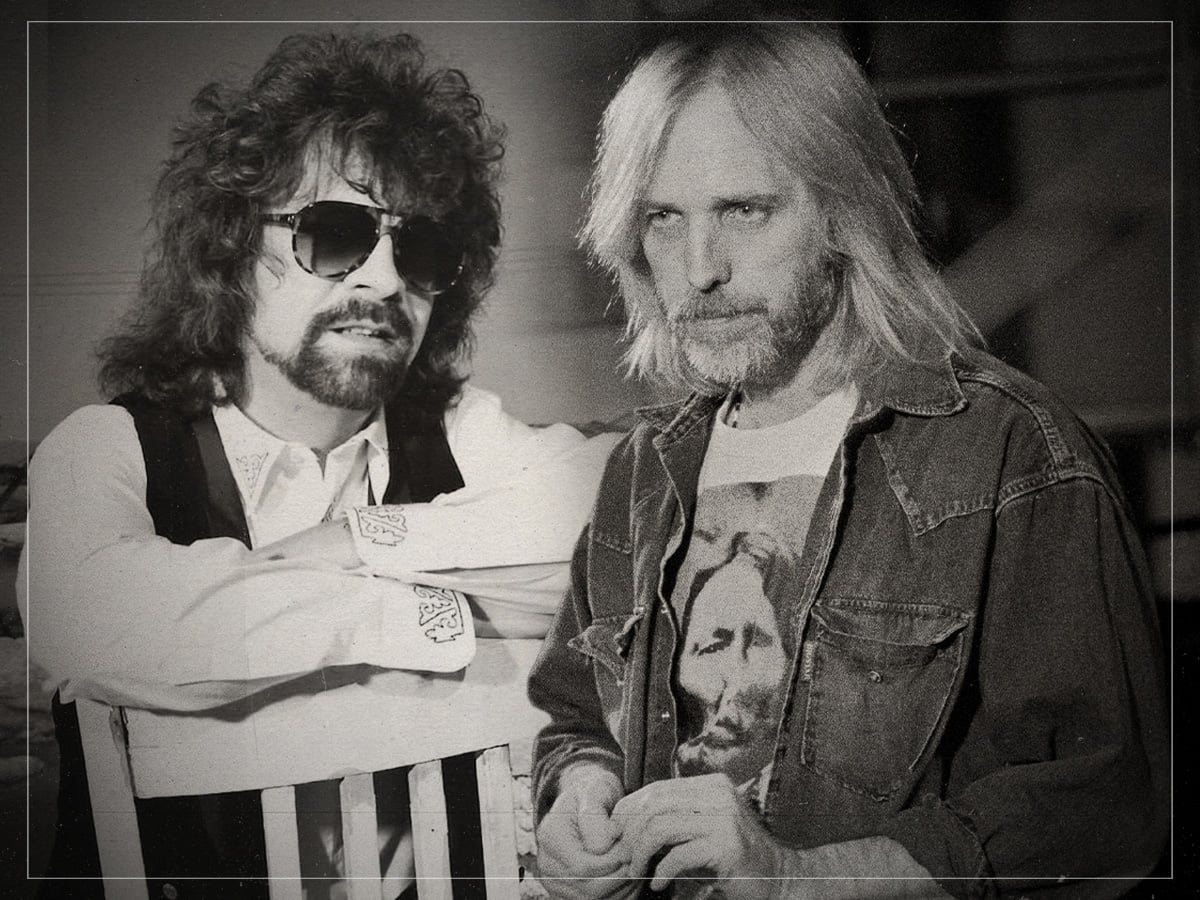
(Credits: Far Out / Jeff Lynne / Tom Petty)
Fri 13 February 2026 21:00, UK
When the Traveling Wilburys came together in 1988, it immediately became the most anticipated supergroup experiment in rock history: Bob Dylan and a Beatle, together, playing alongside one of their mutual heroes, Roy Orbison, one of the most successful hitmakers of the next generation, Tom Petty, and there was also Jeff Lynne.
Poor Lynne, always noted as the ‘fifth Wilbury’, as if the group were a quartet. Perhaps understandably, the Electric Light Orchestra frontman’s inclusion in this line-up raised a few more eyebrows than the others, simply because his name recognition was a few tiers below that of some of the biggest names of all time.
The truth was, of course, that Lynne was very much the engine of the Traveling Wilburys, having hatched the idea with George Harrison while working together on the latter’s solo album, Cloud Nine.
Lynne and ELO had rarely received the same love from music critics that his Wilbury cohorts had, largely because the ELO were unfairly dismissed, by some members of the media at least, as a sort of Beatles tribute band that wrote their own songs.
Among his fellow musicians, however, his skills as a songwriter, musician, and producer were highly respected, and in the late ‘80s, arguably no collaborator was in higher demand. Between 1987 and 1989 alone, Lynne worked on solo records by Harrison, Brian Wilson, and Randy Newman, as well as Roy Orbison’s wonderful comeback album Mystery Girl and arguably the biggest album of Tom Petty’s career, Full Moon Fever.
It was Petty who also shared some wisdom with Lynne about why critics might have been harsh on ELO for all those years. As a man with no shortage of radio hits himself, and a pattern of sometimes getting overlooked as a ‘serious’ songwriter, Petty felt he had the situation pretty well sized up.
“Tom Petty made the best rationale,” Lynne told The Quietus in 2015, “I always had too many hits! Too many hit singles. And people don’t like that. Writers, they just don’t forgive you for that. If you have too many, they think there’s gotta be something wrong with you. You must be like Perry Como, know what I mean? And it’s just a weird thing that happened. But now they’re starting to realise: these songs are still hanging around. So it couldn’t just have been a fluke, with novelty tunes and that. You know?”
It’s odd to think of having loads of hits as something critics would find off-putting, especially if The Beatles were a logical comparison point. In the 1970s, though, when ELO were getting constant radio play out of singles like ‘Evil Woman’, ‘Livin Thing’, ‘Strange Magic’, and ‘Mr Blue Sky’, a lot of the critical lens was aimed at albums, rather than singles, as complete statement pieces, be it a California singer/songwriter affair, a New York art rock experiment, or a politically minded UK punk record; you know, ‘cool’ shit.
“I don’t think I was ever cool,” Lynne said, “It’s weird, I know. Because the albums I did, they used to sell millions. So it’s a double-edged thing. Anyway, [the idea of too many hits], that’s what Tom thought, and I’m beginning to agree with him.”