
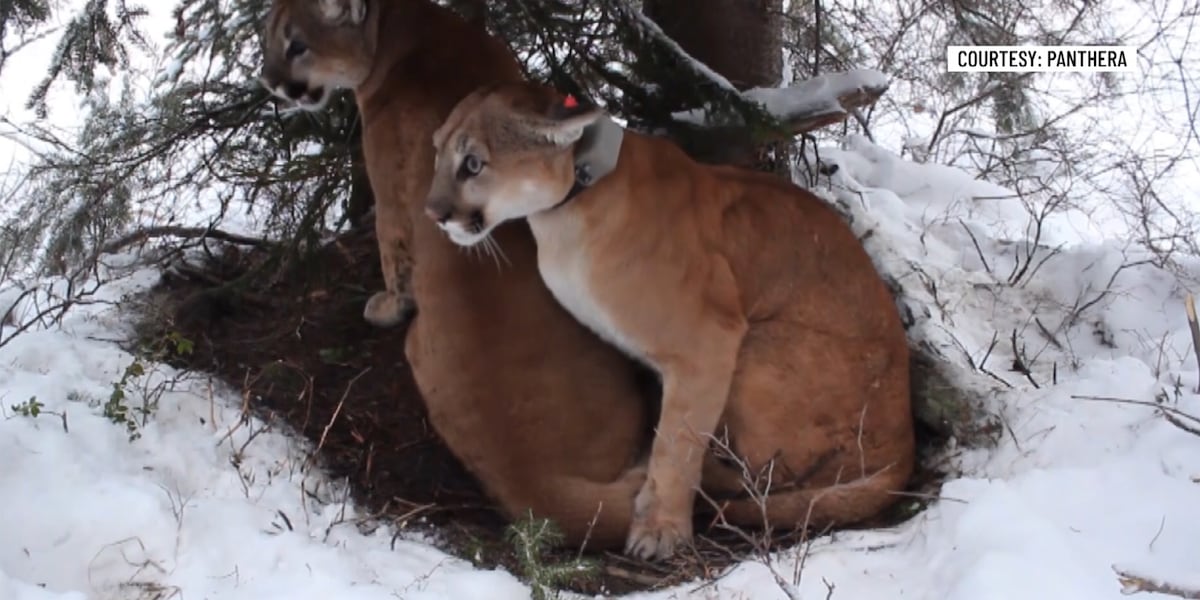
SOUTH BURLINGTON, Vt. (WCAX) – There’s another push to get the iconic catamount back to Vermont sooner rather than later, but wildlife experts don’t want to rush it.
Catamounts have officially been absent from the Green Mountains for roughly 150 years due to deforestation and overhunting. The closest breeding population is in the Black Hills of South Dakota.
The global environment-focused group Mighty Earth wants to see them in the Northeast once again, but that would not be a simple process.
“Catamounts are kind of one of the last missing puzzle pieces of our forests,” said Renee Seacor, the Northeast rewilding director of Mighty Earth.
Seacor is spearheading Mighty Earth’s Bring Catamounts Home initiative. She says they know what an undertaking this would be, reintroducing an apex predator. But they want to kickstart the process and make Vermont’s heavily connected forested landscape the anchor.
“We’re aspirational that catamounts could be back on a shorter time frame and we don’t have to wait decades to see their return,” Seacor said.
However, Vermont Fish and Wildlife biologists say “slow down.”
“It would have to be a collaborative, regionwide effort,” said John Austin, the director of wildlife for Vermont Fish and Wildlife.
Austin says they’re open to the idea, but animals don’t adhere to man-made borders, and every single state and Quebec would have to be completely on the same page, and every detail fine-tuned.
“We don’t want to go and capture cats somewhere, bring them back to the Northeast, release them, without the high level of confidence they would be successful,” Austin said.
Declan McCabe, a biology professor at St. Michael’s College, acknowledges concerns with having these big cats around Vermont’s outdoor recreation and agriculture areas.
“You have to make sure you minimize the conflict between, in the case of an apex predator and the human population and the livestock population. So, there’s a lot involved,” McCabe said.
All details that Mighty Earth hopes to iron out sooner rather than later.
“A timeline really needs to be set. One, by responsible science, and two, by the people of Vermont and the interest in seeing this species restored,” Seacor said.
But for wildlife experts, not too soon.
“No one is being dismissive of the idea of bringing it back, but there’s still these larger questions that have to be considered,” Austin said.
The Massachusetts Wildlife Department said they are involved in these conversations. Wildlife departments in New York and New Hampshire were not available for comment.
Copyright 2026 WCAX. All rights reserved.