
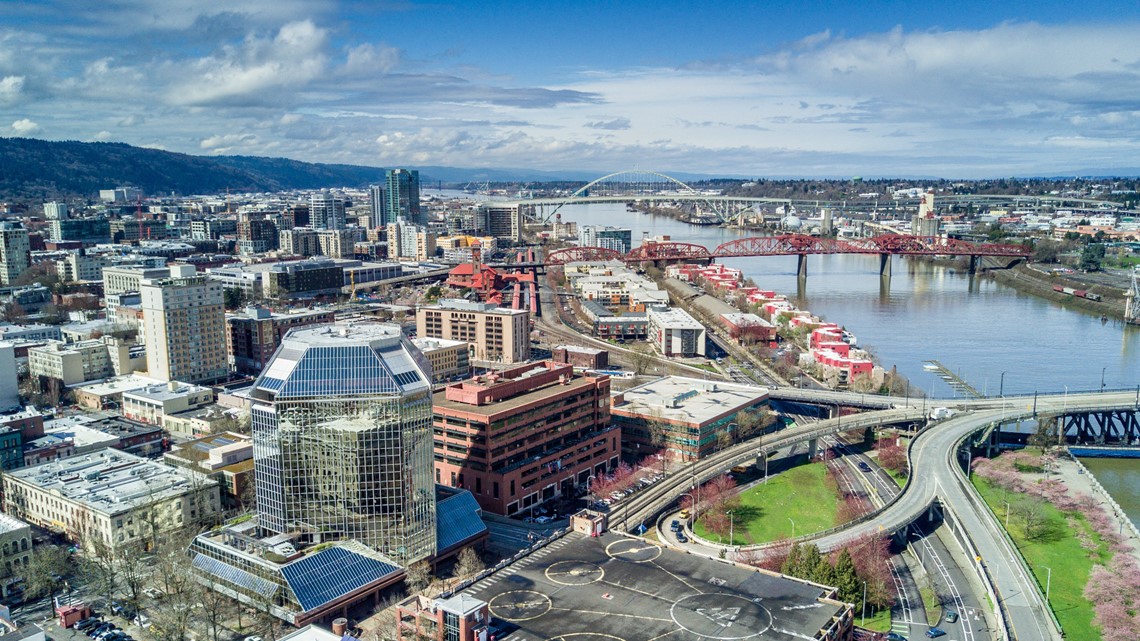
A new economic outlook for Portland suggests that returning to pre-pandemic ways may not be possible — or even the right goal.
PORTLAND, Ore. — A new economic outlook for Portland shows the city’s commercial real estate patterns have fundamentally shifted — and that returning to pre-pandemic, office-centered demand is no longer a realistic expectation. Instead, a “new normal” is taking shape, and Portland’s economic future depends on how well it can adapt.
Anyone who has walked through downtown Portland lately and felt it looks different than it used to is not imagining it. A new report from the Portland Metro Chamber, released Thursday, says the way people use downtown has changed in a big way — and it’s not just a slow recovery from the pandemic. It’s a shift that may be here to stay.
The business organization has published economic indicators for Portland since before the pandemic but began issuing more formal “state of the economy” reports in 2020. For the past six years, those reports used “recovery” as a benchmark, measuring how close downtown Portland was to returning to its pre-pandemic patterns.
The new report suggests that return may not be possible — or even the right goal.
The chamber’s 2026 State of Downtown and the Central City report shows office leasing in the city’s core dropped to one of its lowest levels on record last year. On average, about 252,000 square feet of office space was leased each quarter in 2025 — far below what was typical before 2020. At the same time, more than 10 million square feet of office space sat empty, the highest level ever recorded.
In simple terms, there is a lot of office space downtown and not nearly as many companies filling it.
That does not mean downtown is empty. Foot traffic has rebounded to about 86% of what it was before the pandemic. But the people walking around are not necessarily office workers commuting five days a week. The report shows residents and visitors are playing a bigger role in keeping downtown active, while traditional 9-to-5 office presence remains well below past levels.
Even if more workers returned full time, the report suggests it would not fully restore downtown to its old rhythm. This reflects lasting changes in how people work and spend their time, the report said.
RELATED: Downtown Portland’s foot traffic shows promising improvements
Among top 50 U.S. big metros, Portland Metro Chamber President and CEO Andrew Hoan said Portland ranks “either last in all the things you don’t want to be last in, like employment or housing creation, or first in things that you don’t want to be first in, like office vacancies and recovery in foot traffic, or in some cases, taxes.”
“So, the big takeaway this year is that we are at the bottom amongst every single region in the nation,” Hoan said.
Taking a look at the Portland metro economy, Hoan said that the story gets worse. In the chamber’s recently published 2026 State of the Economy report, it shows that regionally much of the growth has been concentrated in Clark County in Washington, which has seen 114% job growth compared to 2020. Multnomah County’s job growth remains far below pre-pandemic levels. Overall, the region lost 8,800 jobs over the past year — more than any other U.S. metro area, except Milwaukee, Virginia Beach and Washington, D.C., according to the report.
“Our policy choices, we have chosen the path that we are on here on the Oregon side of the river, and we are seeing the consequences play out. Therefore, it is time to make… I should say radical change,” Hoan said. He pointed to the fact that Portland has the highest businesses taxes in the U.S. and is among the top cities with the highest personal income tax.
The report says current economic indicators are flashing “clear warnings” if the region does not take steps to reverse course.
If downtown Portland hopes to regain its footing, the report says it will need to find more ways to attract visitors. Ultimately, it concludes that a better mix of workers, residents and visitors downtown will matter more than a simple return to old commuting patterns.
For decades, downtown revolved around office towers filled with employees who grabbed coffee in the morning, ate lunch nearby and ran errands after work. Hybrid schedules and remote work have changed that pattern. Fewer daily commuters mean fewer predictable customers for restaurants and retailers that once relied on weekday crowds.
If there is one clear takeaway from the chamber’s report, it is this: Portland cannot count on things going back to the way they were.
Still, the city is not starting from scratch. More people are living in Portland’s Central City than before the pandemic, including downtown, the Pearl District, Goose Hollow, the Central Eastside and South Waterfront. That has helped support grocery stores, nightlife, restaurants and neighborhood businesses. Events and tourism have also been bright spots for downtown foot traffic.
Rather than focusing only on filling office buildings, the report points to the need for a broader mix of activity — housing, entertainment, small businesses and attractions that bring people downtown at all hours and on weekends, not just during the workday.
Not all of that will be easy. Housing affordability challenges remain widespread across the metro region. Because housing affordability and job growth go hand in hand, when wages and job opportunities do not keep pace with housing costs, it becomes harder for people to move to or remain in the region.
RELATED: Poll finds Portlanders highly concerned about affordability but see gains on homelessness and safety
To turn things around, Hoan said it will require attracting investors.
“I think it starts with just a general culture of trying to attract business, attract investment, having a real conversation with business,” he said, in addition to accelerating building permits and cutting red tape.
Currently, a $600 million proposal to fund upgrades to the Moda Center is moving through the Oregon Legislature. The funding is considered key to the long-term future of the Portland Trail Blazers in Portland. Hoan suggested it could also signal to the rest of the country that Oregon is serious about supporting major investments in the Rose Quarter.
“It’s more than about keeping our home team,” he said. “This is about investing in what we have and growing its ability to be successful. The contemplation of what we might do around the Moda Center is not just to keep a team here; it’s about growing our ability to have more events, more activities there, and I think if there’s a core message that has to land is that everybody needs to get behind supporting their local business community, keeping what we have, investing and growing it right here at home.”