
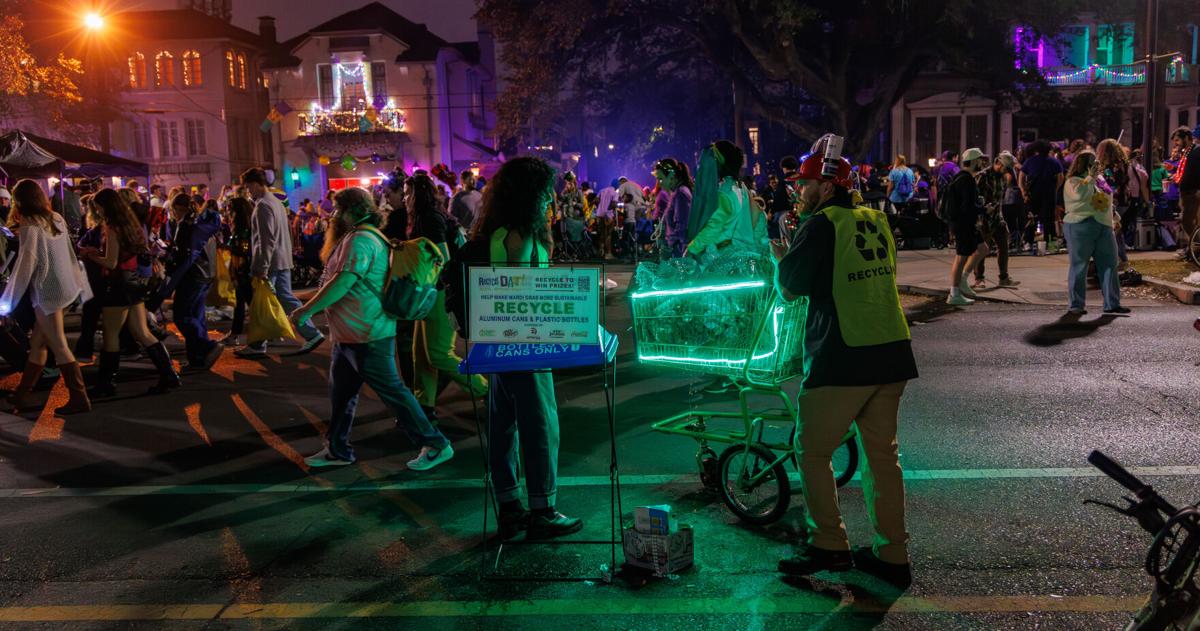
Lit-up shopping carts and bedazzled soda cans are probably not what comes to mind when you think of trash collection, but strange days call for strange ways.
And Mardi Gras season, of course, is among the strangest of days.
Those unconventional methods are how the Re-Cyclists Marching Krewe gathered nearly 140 pounds of reusable waste during Krewe Bohème this year. Members of environmental groups and recycling advocates donned costumes like Marie Can-toinette and Recyclopse as they urged paradegoers to hand over their empty cans and bottles.
“We try not to encourage them to chug it, but that does happen a lot,” said Brett Davis, founding director of the nonprofit Grounds Krewe, which has been on a mission to make Mardi Gras greener.

Recycling on the Muses parade route in New Orleans, Thursday, Feb. 12, 2026. (Staff Photo by David Grunfeld, The Times-Picayune)
STAFF PHOTO BY DAVID GRUNFELD
Grounds Krewe and the Re-Cyclists are part of a larger effort, combined with city help, aiming to put a dent in the mountain-sized problem of Mardi Gras waste. They are pressing ahead this year despite the loss of funding due to a budgeting crisis that Mayor Helena Moreno’s new administration is scrambling to address.
Last year, the 12-day parade period produced over 2.4 million pounds, or over 1,100 tons, of trash sent to the landfill, according to the city. It’s also a problem for the city’s drains, with 93,000 pounds of beads found across five blocks in New Orleans’ drainage system in 2018.
Grounds Krewe’s parade marchers — formerly called the Trashformers — play only a small role in the organization’s broader Mardi Gras sustainability initiative, which includes selling sustainable throws and offering recycling stations along the Uptown parade route through a partnership with the city and other local groups.
Since 2023, when the RecycleDAT! collaboration began, the impact of the effort has exponentially grown. Last Carnival season, the groups recycled more than 70,000 pounds of parade waste, more than four times the yield of their first year.
This season was supposed to be even larger, in response to the positive reception of the programs, Davis said, but the city’s budget deficit and deep staffing cuts to its climate office impacted some of those plans.
Recycling on the Muses parade route in New Orleans, Thursday, Feb. 12, 2026. (Staff Photo by David Grunfeld, The Times-Picayune)
STAFF PHOTO BY DAVID GRUNFELD
The New Orleans City Council had allocated $200,000 for this year’s recycling initiative, but none of those funds were distributed, confirmed Keristen Holmes, a spokesperson for Moreno. The city’s climate office had allocated $50,000 for Carnival recycling in previous years.
“Despite the lack of direct funding this season, the city has continued to support the program operationally through planning participation, permit fee waivers and coordination with NOPD for parade recycling sweeps,” Holmes said.
Stumbling blocks
The additional funding would have helped the city recycle more bottles and cans left along the parade route itself, before sanitation workers send off the heaps of garbage to the landfill, Davis said.
“They’re picking up this trash very manually after every parade with leaf blowers and rakes and everything,” Davis said. “Why not send out a first wave crew that’s getting tens of thousands of aluminum cans off the ground and plastic bottles?”
The Corner of St. Charles and Napoleon avenues after Muses in New Orleans, Thursday, Feb. 12, 2026. (Staff Photo by David Grunfeld, The Times-Picayune)
STAFF PHOTO BY DAVID GRUNFELD
The coalition still conducted smaller sweeps over a portion of the route after the King Arthur parade and will do the same after the NOMTOC parade on the West Bank. But the original plan, Davis said, was to do these sweeps after the most waste-producing Uptown parades in the final days before Mardi Gras.
Franziska Trautmann, the founder of the glass recycling nonprofit Glass Half Full, another partner in the Carnival recycling initiative, noted that staffing cuts at the city’s climate office also impacted coordination for this year’s recycling efforts. The office lost around half of its staff, including the director.
“All the progress that we’ve been making is threatened now because we don’t even know who’s in charge of what,” Trautmann said.
The city did not respond directly to questions on how cuts to the climate office were affecting parade recycling this year.
‘Desperately needs it’
Despite these hurdles, a glass recycling program with local bars is significantly upping the season’s recycling numbers. Throughout Carnival, Glass Half Full and its partner groups are offering free glass and aluminum recycling to bars near parade routes. The nonprofit typically charges establishments a recycling fee for glass pickups, which is crushed into sand for Louisiana coastal restoration efforts.
The recycling initiative generated over 40,000 more pounds of glass last year with the addition of the bar program, than the 2024 season.
Trash cleanup at the corner of Magazine Street and Napoleon Ave after Muses in New Orleans, Thursday, Feb. 12, 2026. (Staff Photo by David Grunfeld, The Times-Picayune)
STAFF PHOTO BY DAVID GRUNFELD
Dominic Hernandez, the owner and operator of the Double Club in the French Quarter, started participating in the free program this season and plans to keep up the glass subscription after Mardi Gras.
Beyond the environmental considerations, he said that the glass pickups, on top of the trash pickups four times a week, help keep the establishment clean.
“I know that paying to recycle is not the most obvious answer for business owners,” Hernandez said. “But I think [these programs] can help expand the presence of recycling in a place that desperately needs it.”
Where can I recycle along the parade?
You can recycle parade throws and aluminum, glass, or plastic containers at staffed recycling stations on Napoleon Avenue and St. Charles Avenue during weekend day parades. Check out the map of locations here.