
Deep down, Sam Fairbairn knew her son, Andre, was about to receive a devastating diagnosis as they sat before a consultant neurologist.
Over the previous two years, her young son’s behaviour had undergone a dramatic decline, with doctors initially suspecting autism may be the cause.
But the agonising demise in his health that had led to this moment made what followed no less shocking.
Andre had frontotemporal dementia (FTD), they were told, a form of the disease caused by a gene mutation that led to a build up of toxic proteins in his brain. Unlike Alzheimer’s, it tends to affect sufferers’ behaviour and language first, rather than their memory. And, cruelly, it is early onset, typically beginning between the ages of 45 and 65.
But Andre, who loved music and motor racing and watching Peaky Blinders with his mum, was just 22.
‘We were told if he lived to 30, he’d be lucky,’ recalls Sam of that devastating meeting in June 2024.
By this stage, her son was too ill to understand the diagnosis. ‘But I cried, in a daze, heartbroken, trying to process what I’d been told before going home and making the phone calls to tell family that my son Andre had dementia. It felt surreal.’
Andre died in December, aged just 24. Sam’s grief is understandably still mixed with shock. ‘I feel I’m on the outside, looking at myself,’ she says. ‘I sit on my phone and go through endless photos and videos of him. I’m overwhelmed.’
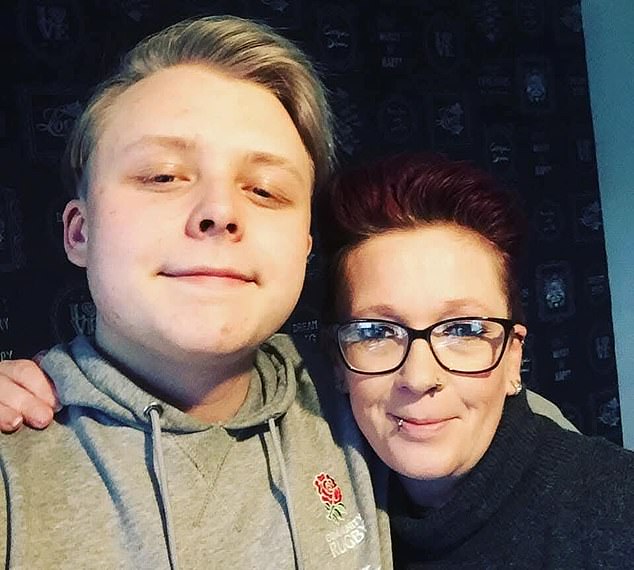
Andre loved music, motor racing and watching Peaky Blinders with his mum, Sam. He died aged just 24 after receiving a devastating diagnosis
Before Andre died, Sam, 49, made the decision to donate her son’s brain for research to Addenbrooke’s Hospital in Cambridge, whose specialist Memory Clinic he was treated at. ‘If it helps one family get an extra few years with their loved one it will have been worth it.’
Speaking to the Mail from her home in Dereham, Norfolk, where she lives with her husband Alastair, 62, and younger son Tyler, 23, Sam swallows back tears that are tempered with disbelief.
‘Like most people, we thought dementia was something that happened to older people,’ she says. ‘I never thought it was something that could happen to my son.’
‘Andre was very much a mummy’s boy,’ says Sam, who had been a single parent for most of her sons’ lives. ‘We’ve always been a very open family. The boys could talk to me about anything.’
As a child, Andre loved gaming and spending time outdoors. ‘He was always at the park, out on his bike,’ she smiles.
Although he’d struggled with reading and writing at school, it wasn’t until November 2022 – at her wedding to Alastair, a bus driver she’d met at work two years earlier – that she started to worry about her son, then aged 21. Andre had excitedly bought a new suit for his mum’s big day, at which he and Tyler gave Sam away.
But throughout the day he grew quiet and announced he was leaving the reception at 9pm. ‘We were taken aback but thought perhaps he wasn’t feeling well,’ she says.
Over the following weeks, Andre’s behaviour changed. ‘He didn’t want to go to work. He didn’t have much enthusiasm for anything and sat in his room most of the day,’ Sam recalls.
After he lost his job at a car manufacturer for not turning up, she tried to find the cause of his lack of motivation. ‘He’d say, “I dunno,” or “I couldn’t be bothered,” she says.
At first, she told herself Andre was behaving like ‘a typical young lad who needed a push in the right direction’. But then Andre started repeating what he was being told. ‘I’d tell him his tea was ready, and he’d say, “Tea’s ready, Mum”.
‘He started ending every sentence with “then” – “Are you all right, then?” or “Can I have a drink, then?” ’

Andre struggled with reading and writing at school, but Sam had never worried about him – until, at age 21, he started displaying increasingly unusual behaviour

Sam, who had worked with adults with learning disabilities before, started to suspect her son Andre (pictured) could be autistic; he scored ‘very highly’ in preliminary tests for the condition
He became forgetful, going to the local shop for one thing and coming back with something completely different. Once, after nipping out, he took a bus into Norwich. ‘Tyler found him at the bus stop, not knowing which bus to take home.’
Yet Andre didn’t seem fazed, she adds. ‘He never asked why he was forgetting stuff. He didn’t seem to understand, even early on.’
Sam, who had worked with adults with learning disabilities before becoming a coach driver, started to suspect Andre, then 21, could be autistic. She took him to their GP in June 2023.
‘We told him he was going for tests and we thought he might have autism,’ she recalls. ‘He said, “All right then, Mum.” It looked like he took it in his stride.’
But, she now realises, ‘he didn’t, because he didn’t understand’.
In preliminary tests he scored ‘very highly’ for autism. ‘It did explain a lot,’ says Sam. ‘He could display challenging behaviour when he was younger but wasn’t a naughty child.’
With an NHS autism diagnosis expected to take years, Sam and Alastair pursued a private diagnosis, which they received that September. But as they waited, Andre’s condition worsened, and any relief that they had pinpointed the problem was tempered with a mounting fear there was something else wrong.
‘I knew it wasn’t just autism,’ says Sam, who took Andre back to the GP several weeks later. He was referred for an MRI scan ‘as an extra precaution’.
In the meantime, she says, ‘it was becoming apparent he wasn’t safe to be left on his own. He’d make himself some soup, for example, and put the whole can in the microwave. Luckily I got there before he pressed start. I was on edge the whole time. If I heard the slightest noise I’d think, “Where’s Andre?”
‘He’d help himself to a can of Coke, put it on the table. Five minutes later he’d come back with another he’d opened. In his bedroom there’d sometimes be ten cans of drink, hardly drunk.’
That summer, Sam gave up her job to care for him. In October, a month after his autism diagnosis, their consultant called them back for the results of the MRI scan.
‘He sat with his notes in his hand and said, “If I didn’t know Andre’s age, I would have thought I was looking at a 70-year-old with frontal atrophy, which is an indication of dementia”,’ recalls Sam. ‘There were signs his brain was already starting to shrink.’
But the idea of dementia seemed absurd. ‘I was shocked,’ says Sam. ‘He was 22.’

Sam says she struggled to come to terms with Andre’s dementia diagnosis at such a young age. A doctor told her that he had the brain of a 70-year-old, despite being just 22
As she struggled for words, Andre seemed impervious. ‘He was just smiling, looking at his phone, oblivious.’
Alastair adds: ‘The consultant said if it was an older person they’d be able to cope. But they’d never had any experience with someone that young.’
Andre was referred to the specialist Memory Clinic at Addenbrooke’s, as the family grappled with the news. ‘Tyler was very upset, and said, “What does this mean?”’ says Sam. ‘I said, “I don’t know”. We didn’t know what the future held.’
Soon, Andre needed constant surveillance. ‘We put a baby monitor in his room with a camera. He was getting up, wandering about at night. We were frightened he could walk out of the front door,’ she says.
The emotional toll was huge. That November, Sam was hospitalised with pain down her left side, suspecting she was having a stroke. ‘It was stress.’
In February 2024, Andre had blood tests and a series of drawing and writing tests. Asked to identify pictures of animals, he mistook a crocodile for a dog.
‘When it came to copying a shape with a pen, his was just a squiggle,’ says Sam. ‘They told us he could have a type of dementia but couldn’t tell us more until the blood tests came back.’
Fearing Andre’s time was limited, the family created a bucket list of his favourite activities. A motoring and wrestling fan, they took him to car rallies and a live match. They visited the zoo and at home, Sam watched Andre’s favourite TV shows with him on repeat.
‘I could sit for a week watching back-to-back episodes of Peaky Blinders,’ she says. ‘My life became what made Andre happy, what settled him.’
During the day, he paced their bungalow. At night, he’d fall out of bed. ‘I had to bathe him,’ says Sam. ‘I thought, “I shouldn’t be doing this”.’
Before he became ill, Andre would tell Sam he loved her constantly. ‘It’s been a year and a half since I last heard him say it,’ she now says quietly.
While his speech continued to deteriorate, he always recognised his family. ‘He’d say, “Oh there’s Mum, woohoo.” He starting saying, “woo” a lot. Over time the words got less, and the woos got more.’
By the time of his FTD diagnosis that June, Andre’s only words were ‘yes’ and ‘no’.
The neurology team warned Sam that Andre would continue to lose mobility as his brain stopped being able to control his movement. ‘They didn’t sugarcoat anything, for which we were grateful.’

Neurologists warned that Andre would continue to lose mobility as his brain deteriorated. But his mother was grateful he was not able to understand his shocking diagnosis
So, too, was she grateful that Andre didn’t understand his diagnosis at all. ‘He never cried. We told him everything, but he didn’t seem to understand.’
Tyler was as heartbroken as his mum. ‘Like us, he felt he was grieving his brother while he was still alive.’
FTD is a rare type of dementia, affecting one in 20 sufferers. About 15,000 people in England are believed to have it, although only 3,000 have a formal diagnosis, with thousands more thought to be unaware.
Between 30 to 40 per cent of cases of FTD are genetic. There’s no history in either side of Andre’s family that Sam is aware of. She has so far declined testing to see if she carries the gene.
‘I know it wouldn’t be my fault, but if that test came back and I carry it, I don’t think I could forgive myself.’
While the couple believes FTD made Andre’s autism symptoms more pronounced, it is possible much of his problematic behaviour since childhood was caused by dementia.
The only treatment on offer was antidepressants, which Andre took for a couple of months to take the edge off his manic pacing. A distraught Sam tried to focus on the positives. ‘I thought, “We’ve still got six years – let’s make them the best for him.’
Yet they were starting to lose Andre. Alastair explains: ‘You would see a little bit of him slip away. There could be a change in Andre within the space of a week. It was so quick.’
Meanwhile, his failing mobility meant he grew harder to care for, and last September he was moved to a nursing home. Within a month he was in a wheelchair.
After losing the ability to chew he was rushed to hospital in December after food got stuck in his windpipe, causing a chest infection. In the Acute Medical Unit, Sam was taken aside and told Andre was nearing the end of his life. ‘I wasn’t expecting it to be that quick,’ she says. ‘I said, “The only thing I ask is I don’t want him to be in any pain”.’
If Andre developed another infection, she decided, nature should take its course. ‘Andre wouldn’t have wanted to be pulled and prodded about.’
On December 18 he was moved to a hospice. Sam sat by his bedside every day, and occasionally he would give her a little smile. ‘That used to break my heart,’ she says. ‘Knowing he was still there.’
Her last words to him were on Christmas Day, when she referenced her own mother who had died of cancer when Sam was 19.
‘I said, “If you want to go, you go. Your nanny will be waiting and she’ll take care of you”.’
She was in bed at 5.50am on December 27 when a nurse called to say Andre had died.
‘I screamed. I remember shouting, “I wasn’t there for him”.’
In the hospice, Sam held her beloved son’s hand. ‘I kissed his head and said, “We’ll always love you.” Losing Andre, I feel I’ve lost a part of myself.’
Andre had been too ill to understand his family’s decision to donate his brain after his death. ‘But we all agreed he would have wanted us to do it,’ she says. ‘He’d have been happy to know he was helping. I got a call from the Brain Bank at Addenbrooke’s to say thank you. It was a comfort.’
One day, she hopes to set up a charity to raise awareness and help other families affected by early-onset dementia make memories, as she did.
‘It made me realise time is precious. I want to make sure his legacy lives on.’