
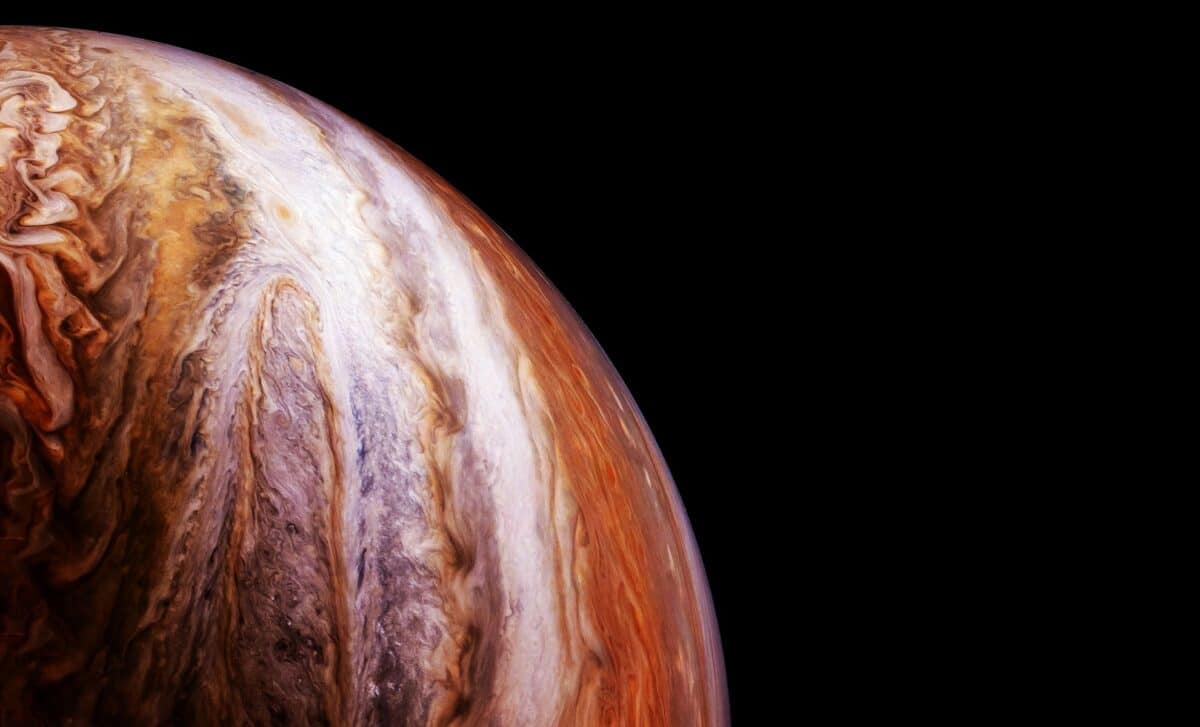
Jupiter, the largest planet in our Solar System, has just gotten a bit smaller, at least according to the latest data. New measurements reveal that the gas giant is slightly narrower at the equator and flatter at the poles than previously believed.
For decades, scientists relied on measurements from NASA’s Voyager and Pioneer spacecraft to estimate Jupiter’s size. These early calculations were based on a technique called radio occultation (RO), which used the bending of radio signals as they passed through the planet’s atmosphere.
While this data was groundbreaking at the time, recent advancements in technology, alongside NASA’s Juno mission, have provided a more detailed and accurate picture of Jupiter’s dimensions.
Jupiter’s New Dimensions: A Subtle Shift
The most recent findings reveal that Jupiter’s equatorial radius is 71,488 kilometers (44,421 miles), while its north pole radius measures 66,842 kilometers. As stated in a NASA report, this means the planet is 8 kilometers narrower at the equator and 24 kilometers flatter at the poles compared to previous estimations.
“These few kilometers matter,” said Eli Galanti, a planetary scientist at the Weizmann Institute of Science in Israel, highlighting that such small shifts in radius are crucial for refining models of the planet’s interior. The improved measurements help align gravity data and atmospheric readings more closely.
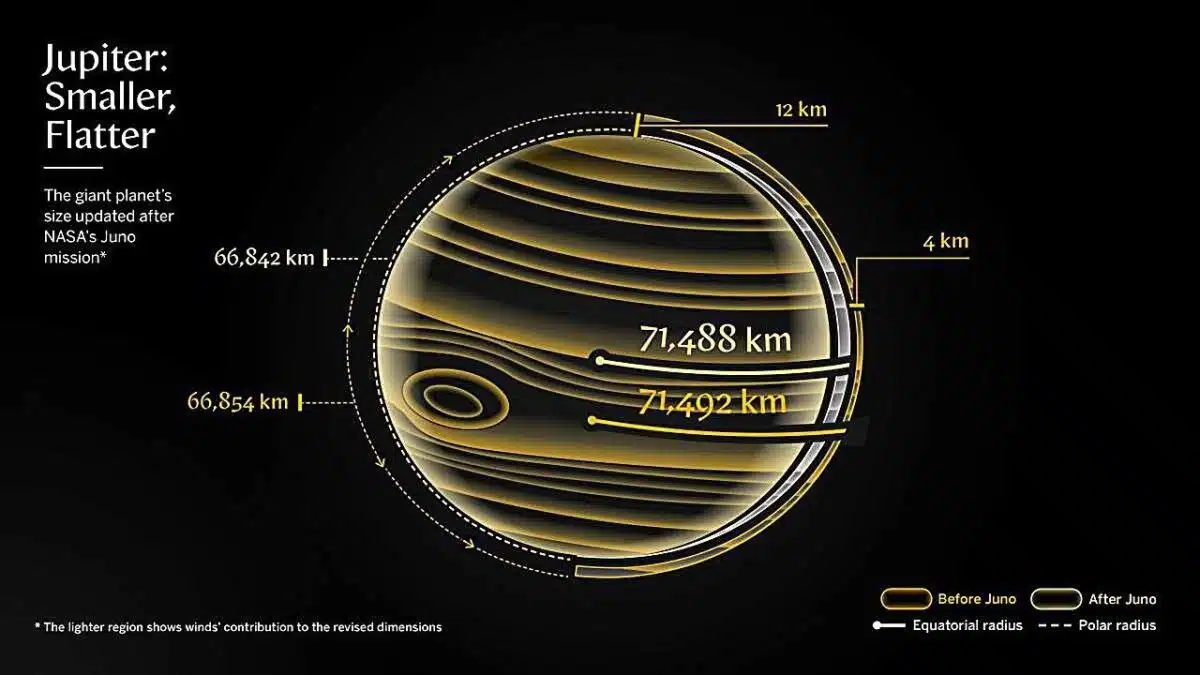 Updated size of Jupiter based on NASA’s Juno mission. Credit: Weizmann Institute of Science
The Juno Mission’s Clear Findings
Research published in Nature Astronomy showed that the accuracy of these new measurements comes from NASA’s Juno mission, which has been orbiting the gas giant since 2016. In 2021, Juno was repositioned into a new orbit that allowed it to pass behind the planet from Earth’s perspective, providing a clearer view of the gas giant than ever before. This new position enabled the collection of more frequent radio occultation data, improving the precision of size calculations.
“We tracked how the radio signals bend as they pass through Jupiter’s atmosphere, which allowed us to translate this information into detailed maps of Jupiter’s temperature and density,” explained Maria Smirnova, a planetary scientist at the Weizmann Institute.
This process has produced the clearest picture yet of Jupiter’s size and shape.
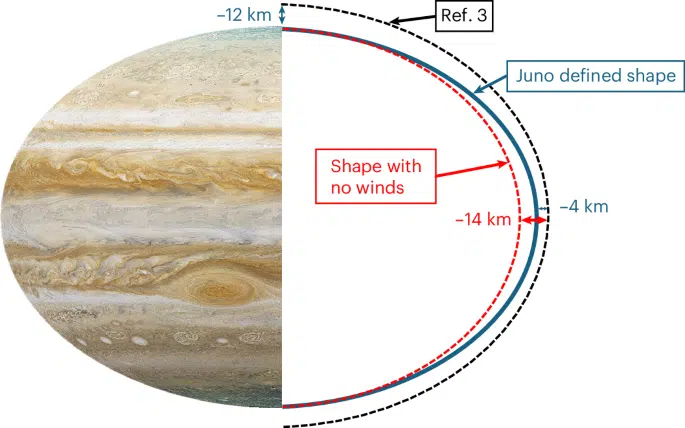 Comparison of Jupiter’s shape before and after wind effects, with a 14 km polar difference. Credit: Nature Astronomy
Atmospheric Phenomena Driven by Winds
In addition to refining the planet’s dimensions, the latest study also took Jupiter’s powerful winds into account. Previous models had to ignore the impact of these high-speed atmospheric currents when calculating the planet’s size.
However, recent studies of the planetary behemoth’s weather systems allowed scientists to incorporate the effects of these winds into their calculations. By factoring in how these winds influence the planet’s structure, the research team was able to achieve a more accurate set of measurements. He emphasized the importance of this integration, noting that including wind data significantly improved the precision of their calculations.