
BY ANDY WALGAMOTT, NORTHWEST SPORTSMAN MAGAZINE
Is it déjà vu all over again for Washington black bear hunters still smarting from the loss of the spring season several years ago?
A sentence buried deep in the Washington Fish and Wildlife Commission’s unanimously approved Game Management Plan update raises the specter of some fall bruin hunts being pushed out past Labor Day Weekend so as not to conflict with other recreationists in the woods and mountains in late summer.
To be clear, the GMP is a guidance document for WDFW, advice as it manages bears and other big game, small game, upland bird and waterfowl species. Any real change to opening day of the bear hunt – currently August 1 or 15, depending on the unit – would actually come via the annual rulemaking process that sets the seasons and includes public comment opportunities.
But that will give little solace to some bear hunters and others stirring uncomfortably in their dens as they recall how suddenly the spring special permit hunt in the Blue Mountains, Northeast Washington and select other game management units fell by the wayside as a result of the commission’s tie vote in November 2021 that put a “pause” to the 2022 season, and which has never come back.
That episode led to a serious erosion of trust in the citizen panel that oversees WDFW policy and hires and fires its director, a bazillion fruitless petitions to reinstate the spring hunt, and a lawsuit over commissioner behaviors that saw the governor hire an investigator to look into it.
And the years of overfocus on Washington’s robust black bear population is no small part of the reason it took so long to update the 2015-21 GMP, a process that began back in 2022 and wrapped up with this morning’s commission vote.
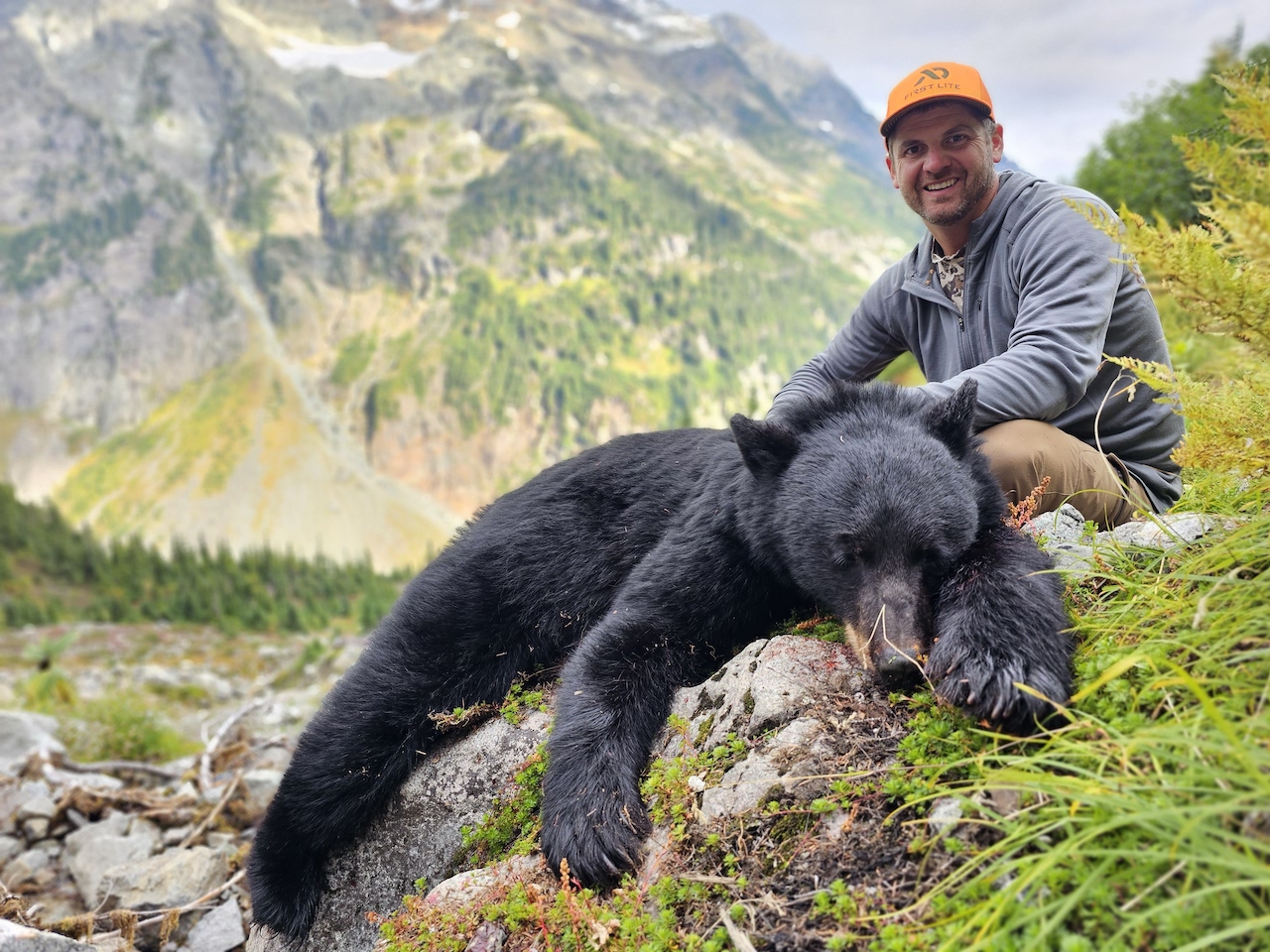
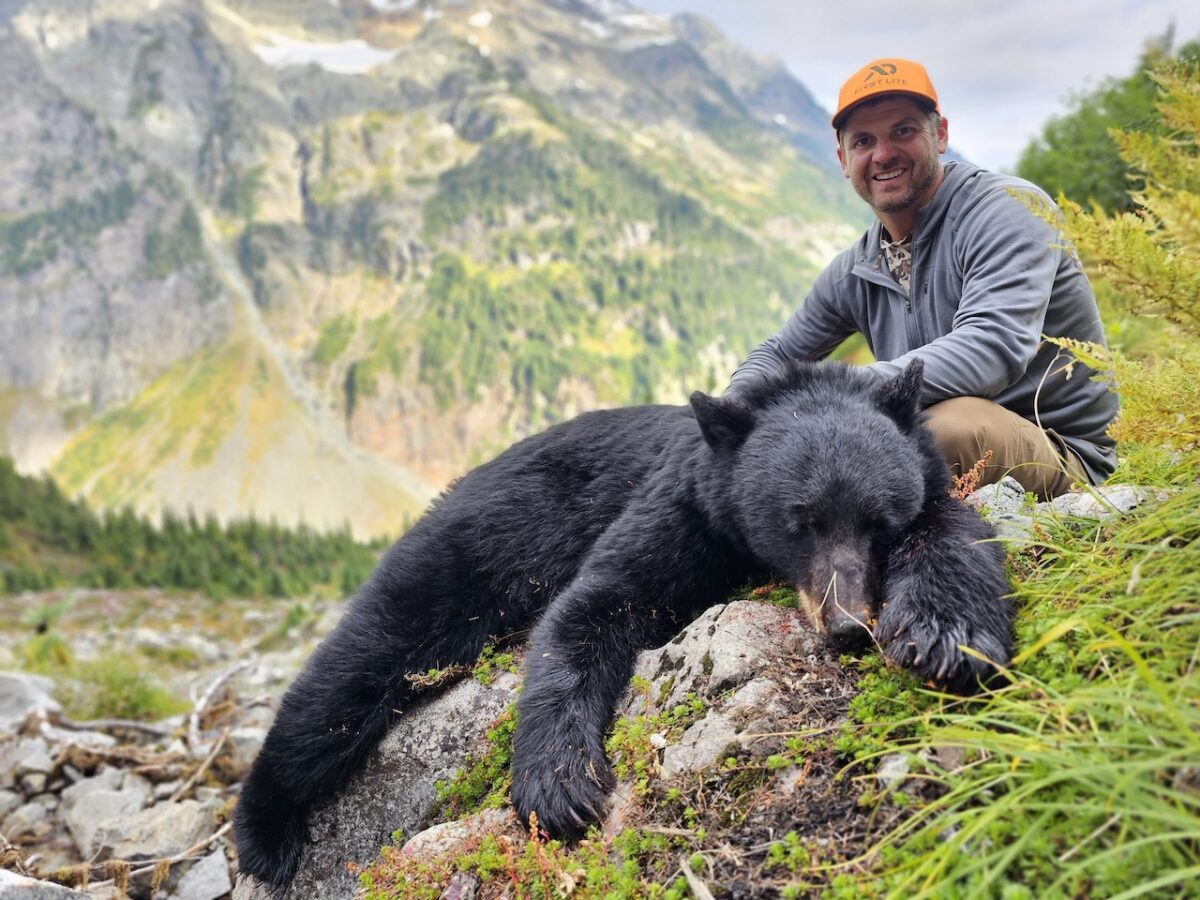 CHAD SMITH SMILES OVER A BLACK BEAR TAKEN IN THE NORTH CASCADES DURING THE 2023 SEASON. (KNIFE PHOTO CONTEST)
The sentence in question can be found on page 149 of the 215-page document, and it’s the very last thing in the entire black bear chapter, in a section that talks about balancing hunting, wildlife viewing and ecological integrity of the species.
Specifically, it’s part of a strategy wrapped around the goal of WDFW highlighting the various values of black bears. To wit:
“Consider later hunting start dates (e.g., after Labor Day) in areas where black bear viewing is popular and conflict between user groups is likely to occur to balance competing uses.”
The language appears to have first surfaced last June in the draft GMP that underwent State Environmental Policy Act review. While “wildlife viewing” is not a foreign concept in the previous plan or this one – here the phrase is mentioned no fewer than 35 times across most if not all hunted species – laying the groundwork to potentially shift hunting seasons so as to privilege critter watchers over hunters or prevent arguments in the woods is a new one.
It didn’t sit well with Douglas Boze, a Skagit County resident and president of the state chapter of the American Bear Foundation, who otherwise supported the final GMP.
“Depending on where these areas are deemed to exist in the state, this could be a reduction of season length of three to five weeks, and who knows how large of an area?” he told the Fish and Wildlife Commission this morning during public comment. “Who is to say where black bear viewing is popular? Heck, I’ve been on popular hiking trails surrounded by hikers, and none of them had a clue that there were black bears 300 yards off the trail until I pointed it out to them with my spotter scope. My point is, the possibility of further reduction of seasons for no scientific reason other than someone else doesn’t like my hunt is yet another coil of restriction around the general hunting public’s neck.”
In raising the alarm this evening, Conservation Coalition of Washington said the idea had been defeated in last year’s bear season rulemaking only to “quietly” reappear here. Among their concerns – “It treats legal hunting as a ‘conflict’ instead of a normal use of public land.”
This afternoon, WDFW Game Division Manager Anis Aoude defended the sentence in the GMP, saying the concept “should be something we consider if those places exist” and that it “is intended to prompt us to consider other users whenever possible.”
Asked if there were similar prompts in the GMP for deer, elk, mountain goats and other hunted species – there aren’t – Aoude called it a “fair question.”
“All the species have a section related to non-hunting recreation that fits how those species are managed,” he continued. “Deer and elk are more abundant, and people see them more readily, so restrictions on seasons may not be needed or even feasible. Many ungulates are readily visible during winter during closed hunting seasons when bears are hibernating.”
“Mountain goats are different, and we may want to decrease the number of people recreating in their habitat, as this may be displacing them from important resources,” Aoude said, adding that further research was also needed on that front.
“Bears are on the landscape (visible) seven to eight months of the year, and we hunt them for half of that time,” he said. “WDFW welcomes all the perspectives, and one-size management does not fit all species.”
The GMP sentence drew a knowing nod from Brian Lynn, the Spokane-based vice president of marketing and communications for the Sportsmen’s Alliance, whose lawsuit prompted the governor’s investigation of commission records.
“I think it’s the continued erosion of proven wildlife management and the planned destruction of hunting in Washington by bigoted individual commissioners who have engaged in collusion, corruption and illegal activity in order to advance their own ideology,” Lynn said. “Wildlife management and Washington citizens will continue to be hurt by these biased commissioners until Governor Ferguson takes real and meaningful action on our petitions, and the ongoing investigation, and removes these offensive commissions who do not represent Washingtonians.”
A story out this evening from longtime reporter Jerry Cornfield of States Newsroom and headlined “WA Fish and Wildlife saga deepens with claims of collusion” provides an update on that investigation.
Back to the new Game Management Plan, this morning Fish and Wildlife Commission members commended WDFW staffers’ work on the document, as well as that of the Wildlife Committee, where it was also worked on. Committee Chair Lorna Smith, a bear advocate, said it wasn’t perfect in her opinion, but “we all working together did get some important changes in this document that I think had not been in there before, so I think we are definitely ahead of the game.”
During public comment, the plan was blasted by preservationist interests because, in part, it “reduces wildlife mainly to head counts,” doesn’t take into account climate change and was supported by a “hollow” environmental determination of nonsignificance.
“I think you should know that we are exploring legal challenges to it because we don’t think this would stand any serious judicial review,” threatened Francisco Santiago-Avila of Washington Wildlife First.
At the end of the day, this lone sentence in the vastness of the GMP is just that, a collection of 30 words directing WDFW to ponder something. It doesn’t mandate that black bear season in, say, the Okanogan management unit be pushed back from August 15 to September 15 so people can watch bears scarfing berries in the Pasayten.
But Washington bear hunters will see a nose snuffling under the tent, and they may not be wrong, if recent history is any indication.
At the very least, vigilance is called for. With the GMP now over to WDFW for use as it sets future seasons, any attempt to claim hunters are conflicting with wildlife watchers should be met with the challenge, show me the sheriff’s or game warden’s reports, and hunters should also be mindful that at the very edge of the realm of possibility, some may look to use this one sentence to effect change in seasons, and so they should act in a way that can’t be used toward that end.
As WDFW’s Aoude pointed out, “Where the rubber hits the road is during season-setting rulemaking.”