
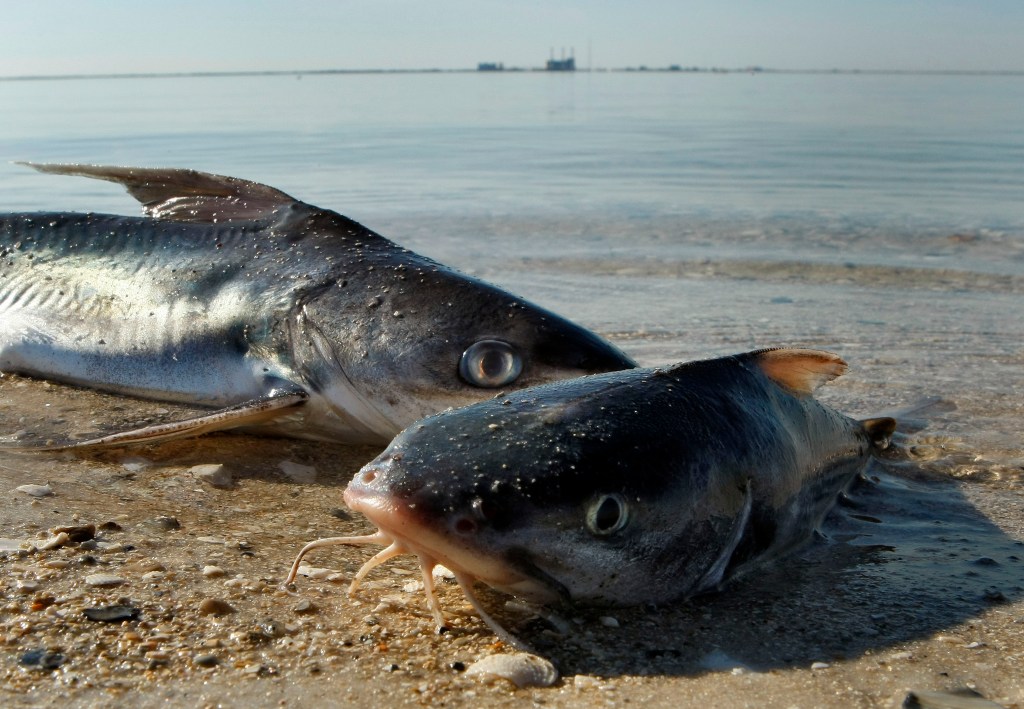
The record-breaking arctic blast that hit Florida earlier this month may have sent humans scurrying for winter coats, but it sent wildlife scurrying, swimming and slithering for their lives.
Some of those animals were native, some were invasive. Some survived. Thousands of others did not.
The benchmark for cold snaps in Florida is the 2010 freeze, which killed manatees, crocodiles, iguanas, thousands of snook and goliath grouper, and caused 50% to 90% of invasive pythons to die in some areas.
The recent cold snap had similar temperatures, with overnight lows in the 30s, and it was deadly for many invasive species from the tropics. Wildlife watchers fretted about a repeat of 2010. But some key differences made the freeze less lethal for some cherished native animals.
The most startling element of the 2010 freeze were massive fish kills, when thousands of snook and Goliath grouper, both native to Florida but vulnerable to cold water, perished in the shallows. Snook are one of the state’s most cherished game fish and Goliath grouper populations are still recovering from 20th century decimation due to overfishing and mangrove habitat loss.
Studies in Everglades National Park after the freeze showed a 90% drop in juvenile Goliath grouper catches.
Snook die-offs in 2010 were so severe that the Florida Fish and Wildlife Conservation Commission took the unusual step of closing the snook season for three years on the west coast and until September on the east coast.
Deeper water is more thermally stable, but many snook were caught in the shallows, where water temperatures dropped to below what snook could tolerate, around 50 degrees, for at least two days.
This year, biologists and anglers were concerned when they saw the forecast for the Feb. 1 bomb cyclone that spun arctic air our way.
Dead fish started to turn up quickly. “All the creeks just had tons of deceased tarpon and snook,” said saltwater fishing influencer and content creator Aaron Benzrihem after hiking around some of mosquito ponds on Hutchinson Island north of Stuart.
“I saw at least 100 (juvenile) tarpon that day … and at least a couple dozen snook.”
But the Goliath grouper and snook die-offs were not nearly as bad as 2010 for a few crucial reasons.
Alexis Trotter, who studies snook for the FWC, said that since 2010, snook have moved north, to areas such as Cedar Key in the Big Bend region of Florida. She expected those northern fish to struggle with this year’s cold snap, but was surprised with their resilience.
She said the research team only saw minimal snook die-off this time compared to 2010. “We did see small kills, but nothing like what we expected,” she said.
As for Goliath groupers, “northern Florida Bay seems like it got hit this time,” said Robert Ellis, a lead Goliath researcher at the FWC. “They’ve had a few dozen Goliaths that they’ve been able to actually capture in sample, ones that were dead and floating, but generally this one didn’t seem too bad for Goliaths.”
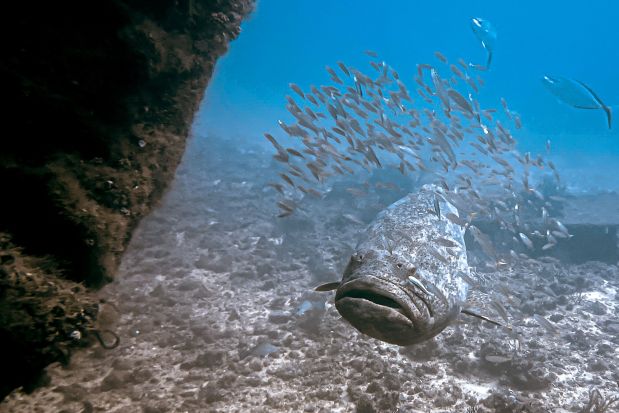 Adult Goliath grouper, like this one swimming near Boynton Beach, Florida, are less vulnerable to cold snaps than younger fish that live in shallow estuaries. (Jesus Olarte/AFP via Getty Images)
Ellis said that juvenile Goliaths live in shallow water. “They’re most susceptible when they’re in the juvenile stage and they’re inshore, and much less so when they’re larger and offshore.” Once they move to deeper water they can grow to up to 8 feet long and weigh 800 pounds.
Speed freeze
It’s not just about how cold the water is, it’s about how fast the temperature drops, said Trotter. “A lot of the times when we do see fish kills, and I think this is what occurred in some areas this time, it’s less that the temperature reaches a lethal temperature, it’s that the temperature changes so abruptly that reaching that lethal temperature may not even be necessary. That change is so fast that it stuns the animal.”
Trotter said that the 2010 freeze was the first cold snap of that winter season, “So the fish had not experienced colder temperatures throughout the winter and weren’t prepared, weren’t in safer areas,” she said.
By contrast, the 2026 freeze occurred after several other cold snaps had occurred, priming the fish.
Another factor that made 2010 more deadly for snook and Goliath grouper was that it lasted for nearly two weeks, whereas the 2026 freeze was two or three days.
‘Crazy’ snook with different genetics
Trotter said that freezes like the 2010 freeze, though brutal, can prompt certain fish to seek new frontiers while others stay put.
“Major events like the 2010 freeze can cause your crazier individuals, your more robust, adaptable fish (to move).”
“Some individuals might be more risk-taking, might be more apt to move,” said Ellis. “A lot of times the group that moves in after a big disturbance, like those snook that first showed up (in Cedar Key), they were just a little bit more extroverted, risk-taking, adaptable.”
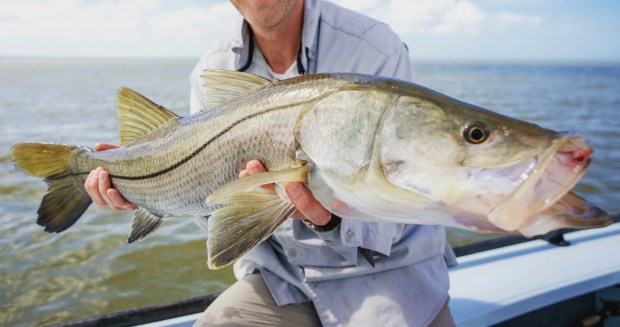
Trotter said that new research suggests that adventurous snook that headed north to the Cedar Key are now genetically distinct from Florida’s other snook populations.
Another surprise: “Snook in the range-expanding population are slightly more tolerant of cold temperatures,” she said.
An arctic blast’s silver lining
Though native species such as snook and Goliath grouper fared better than in 2010, the 2026 freeze took a toll on invasive fish.
After the cold snap, Ben Friedman, an outdoor influencer, took a drive through the Everglades posted videos on social media of dozens upon dozens of cold-killed invasive catfish and Mayan cichlids.
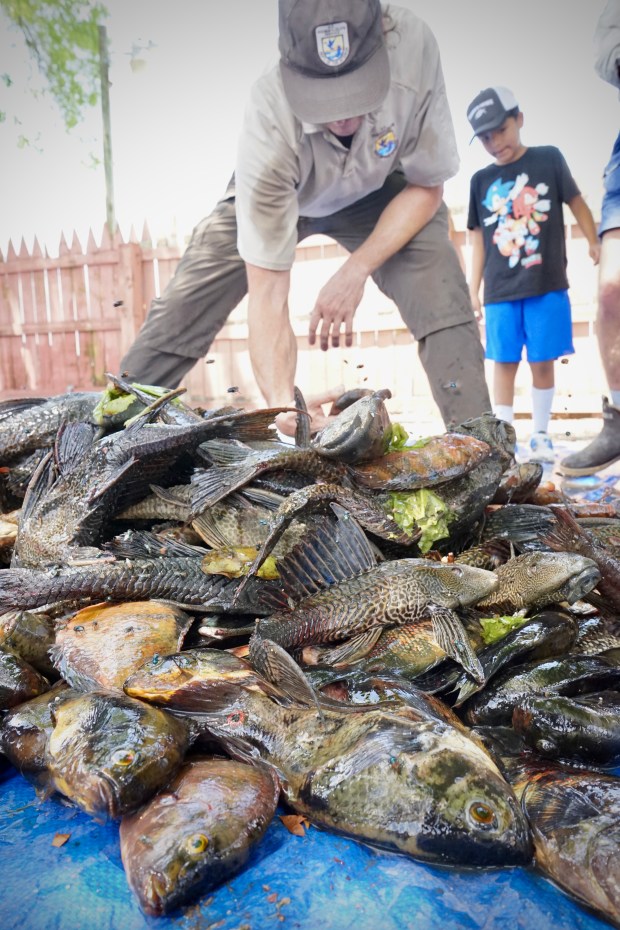 A wildlife officer sifts through dozens of species of nonnative fish caught in the Miccosukee Tribe’s 5th Annual Removal of the Swamp Invaders Fishing Tournament. (Bill Kearney/South Florida Sun Sentinel)
According to the U.S. Geological Survey, there are more than 30 nonnative fish species living in the larger Everglades system, most of them dumped pets. The invasion is so severe that the Miccosukee Tribe holds an annual invasive fish tournament to highlight the issue and cull fish, so natives such as largemouth bass and gar have more room to flourish.
“The Miccosukee Tribe’s Fish and Wildlife Department has reported localized fish kills in areas most impacted by the cold weather,” wrote lead biologist Marcel Bozas. “Exotic invasive fish such as the Mayan cichlid, oscar, and African jewel fish were just some of the species most impacted by the cold because of their tropical origin and poor cold tolerance,” he wrote. “These cold snaps function as a filter to reduce or set back many of the invasive species’ populations.”
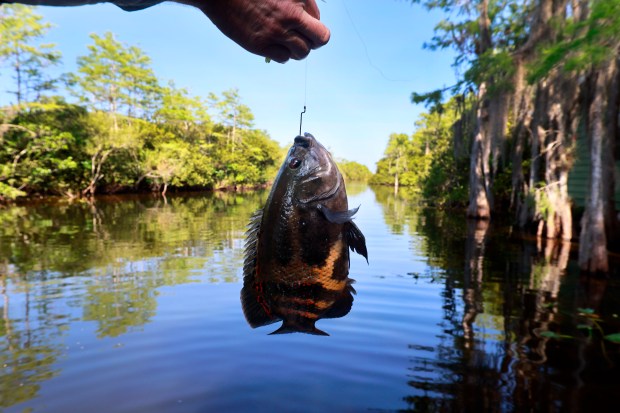 An invasive oscar caught during the Swamp Invaders Fishing Tournament presented by the Miccosukee Tribe of Indians of Florida, (Mike Stocker/South Florida Sun Sentinel)
Some of the freshwater invasive fish die-offs were so large and stinky that they attracted scavengers.
A horde of vultures gathered at a pond in the Circle B Bar Reserve in Lakeland, between Orlando and Tampa, to feast on hundreds of floating fish, mostly invasive tilapia, that had died during the sudden cold snap.
“You see a lot of floating fish. Thousands and thousands of fish,” park visitor Jeff Lash told WPTS Tampa. “This smell — it just smells like dead fish, but it’s not overpowering.”
Overnight temperatures in Lakeland dropped into the mid-20s and the tilapia, a tropical species, just couldn’t handle it.
Coral victory
Marine biologist Colin Foord runs Coral City Camera, an underwater video livestream situated about 10 feet deep on an urban coral reef in Government Cut, Miami Beach.
During the freeze this year he dove at Government Cut and at the natural reefs off Miami Beach.
“I was uncomfortable,” he said about the nippy water temperature, which was between 60 and 63 degrees, “but I did not see any cold water stress impacting any of the coral species, whether it was endangered staghorn corals, or some of the more basic weedy corals.”
He was surprised by what he saw on the camera livestream, too. “I expected the fish to slow down … but if you were just looking at the camera you’d have no idea that the water was 63 degrees.”
The camera showed dolphins under a full moon on Feb. 1, the night the cold snap hit, and has since shown manatees, parrot fish, lemon sharks and spotted eagle rays.
Foord said that during the cold snap, the camera was close enough to the inlet to receive a flow of warmer ocean water on the incoming tide. Areas farther into the shallows of Biscayne Bay would be colder, he said.
Foord said he hasn’t seen water this cold in South Florida since 2010, when he was diving in the Keys.
“2010 was a different animal … that was the single most devastating thing I’ve seen in the marine environment,” he said. “In 2010 I saw all the corals die in shallow water. It was devastating — soft corals, stony corals, there was dead fish. It smelled disgusting. Snook and tarpon got hit really hard.”
Sunning snakes
During the 2010 cold snap, hundreds of invasive Burmese pythons died from exposure. It was unclear if this year’s cold snap would have the same deadly impact.
None of the biologists the Sun Sentinel contacted found dead snakes, but cold weather can drive the snakes to bask once the sun comes up.
“We saw an uptick in Burmese python removals by our Tribal biologists,” said Bozas. “They took advantage of the cold weather to find these typically elusive snakes basking in open areas in hopes of collecting the little bit of warmth the sun’s rays would bring.”
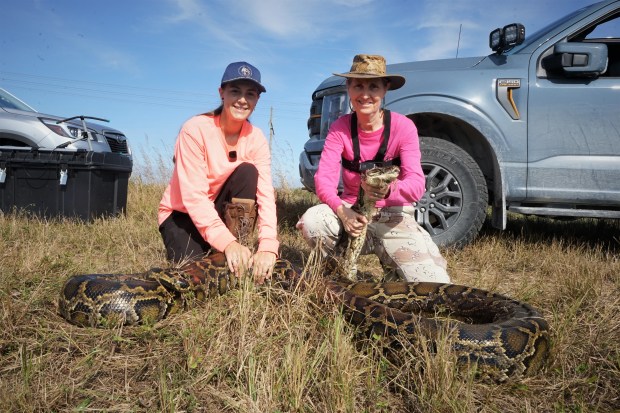 Professional python hunters Tanya Toutant, left, and Donna Kalil pose with a large female Burmese python that they both captured and released for a telemetry study conducted by the University of Florida. (Bill Kearney/South Florida Sun Sentinel)
On the west coast, biologists with the Conservancy of Southwest Florida have radio trackers implanted in 40 male pythons in the wilderness east of Naples. “All of our pythons survived the cold snap and most took shelter in underground refugia,” lead biologist Ian Bartoszek said in a text message.
In years past, some of the Conservancy’s snakes have been attacked during cold snaps, presumably by native predators such as bobcats, who may have taken advantage of the snakes being lethargic.
There are 50 professional python hunters employed by the Florida Fish and Wildlife Conservation Commission. The FWC said in an email that their hunters caught 2.1 times as many snakes in the week following the cold snap compared to the week leading up to it – a possible sign that basking behavior helped lead to more snake captures.
Lucky
Since 2010, FWC biologists have learned a great deal about how Florida’s wildlife, particularly the coveted snook and Goliath grouper, deal with arctic blasts.
Trotter said that the duration matters. Three days of freezing temperatures can spike mortality. The rate of change — how fast the cold front hits and drops temperature — also matters.
Thirdly, the water temperatures need to reach the lethal temperatures associated with each species. “You sort of have to combine all three of them,” she said, “And this winter I think we got lucky.”
Bill Kearney covers the environment, the outdoors and tropical weather. He can be reached at bkearney@sunsentinel.com. Follow him on Instagram @billkearney or on X @billkearney6.