
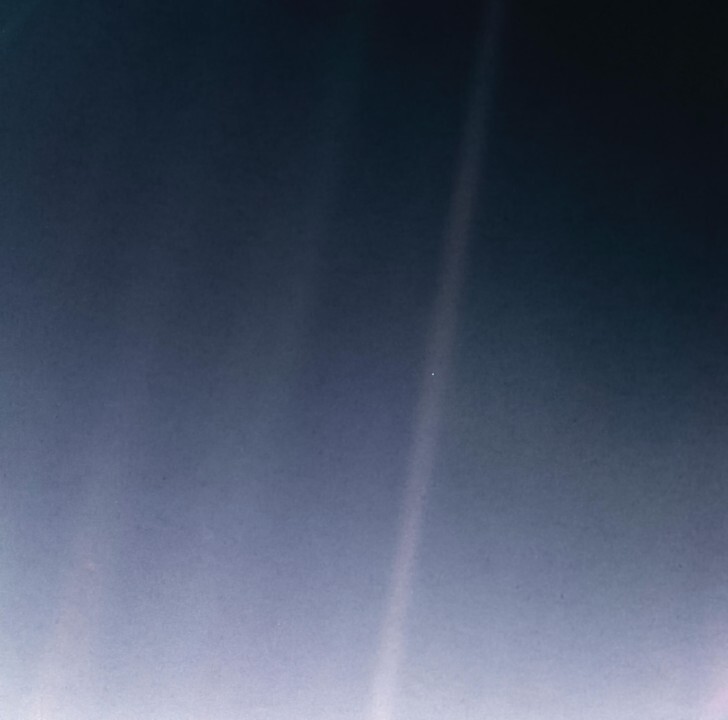
It was 36 years ago, on Feb 14, 1990, when the NASA Voyager 1 spacecraft took this image of the “Pale Blue Dot” from 6 billion km away, minutes before its cameras were permanently shut off.
Carl Sagan, who played a key role in the Voyager mission, famously wrote —
The “Pale Blue Dot” image was part of the “Family Portrait” set of images taken by Voyager 1 on Feb 14, 1990, from a vantage point 6 billion km away and ~32° above the ecliptic.
Starting at 01:00 UTC after a 3 hour warm-up, Voyager 1’s cameras imaged Neptune, Uranus, Saturn, Mars, the Sun, and then Jupiter, Earth, and Venus. The Earth images were taken at 04:48 UTC. The cameras were turned off permanently at 05:22.
Image data download was completed on May 1, 1990.
Sagan and other members of the Voyager team felt the images were needed — they wanted humanity to see Earth’s vulnerability, and that our home world is just a tiny, fragile speck in the cosmic ocean.
JPL mounted the entire 20-foot mosaic on a wall in its Theodore von Kármán Auditorium.
Members of the Voyager imaging team said in a 2019 research paper that the image of Earth on the wall had to be replaced often because so many people touched it.
Here is Carl Sagan unveiling the Pale Blue Dot image on June 6, 1990 and eloquently describing what that image meant for humanity.
.
Even though we are but a speck on a remote mote of dust, Carl Sagan’s words are words to live by —
To me, it underscores our responsibility to deal more kindly with one another, and to preserve and cherish the pale blue dot, the only home we’ve ever known.
And to stop the ones that would do otherwise.
Happy Pale Blue Dot Day and Happy Valentine’s Day.