
Global food demand is projected to rise by about 35 to 56% by 20501, increasing pressure on our agroecosystems. The introduction of legume species can benefit cereal-based systems, but this advantage shrunken under high-yielding scenarios2. Soybeans (Glycine max L.) based systems present a high nitrogen (N) demand due to its protein-rich seeds. Biological N fixation (BNF) is the symbiotic process by which soybean-associated rhizobia convert atmospheric N2 into plant-available N, typically quantified from aboveground plant N (as in this study), supplying a substantial portion of total crop N demand. However, a previous review study indicated that BNF typically supplies about 55% of the crop N demand3 so the remaining is met by soil mineral N. From a N budget perspective, inputs of BNF minus outputs from seed N removal at harvest, results in a net negative N balance under high yielding systems. In practice, N budgets in soybean-based systems are easy to misread. Quantifying BNF is essential for research, production, and policy, yet it is a challenging and resource intensive methodological task4. We used a new Bayesian probabilistic framework5 to quantify the N budgets and their uncertainty, reporting a range of likely values rather than a single estimate. Therefore, providing more realistic management recommendations and policy decisions. The Bayesian approach can incorporate prior information and keep bounded estimates within biologically realistic ranges when data are limited5. Thus, providing a more robust assessment of the long-term sustainability of soybean-based agroecosystems.
Quantifying soybean nitrogen budget and their uncertainties
In this brief communication, we quantify N budget for soybeans using data from 31 experiments in the US Midwest region. Crop N demand was partitioned into three components: aboveground inputs of BNF, an estimation of the contribution of N derived from belowground (24% of whole plant N)6 and soil mineral N. Plant-derived N inputs from BNF, accounted for an average of 53% of total crop N demand across environments, with site-specific values ranging from 28 up to 90% (Fig. 1). The remaining crop N demand was fulfilled by soil mineral N, which varied across environments.
Fig. 1: Pie charts represent the average contribution of crop nitrogen (N) sources across 31 environments in the US.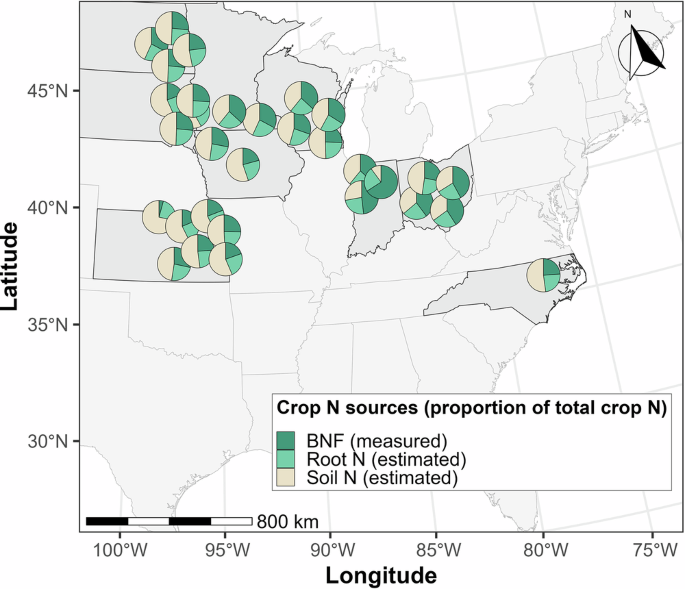
Colors represent the proportion of total plant N derived from aboveground BNF (dark green) and then estimated from belowground contribution of BNF (light green), and soil mineral N (yellow). Root N was estimated to represent 24% of the whole plant N6, and soil N the complementary N fraction. State boundaries are from U.S. Census Bureau TIGER/Line shapefiles.
Across observations, greater BNF was associated with lower negative N budgets. Conversely, higher yields tended to increase the negative N budget, as the proportion of N fixation does not necessarily increase with yield (Fig. 2). On average, the N budgets remained negative, with a mean deficit of -81 kg N ha-1, and neutral or positive N budgets were rare (Fig. 2a). The required contribution from BNF to offset seed N removal ranged between 56 and 68% (95% credible interval), with an average of 62% (Fig. 2b). Despite substantial contributions from BNF, it rarely matched seed N removal. This leaves most environments with negative N budgets, which might have long-term productivity consequences on the current agroecosystems.
Fig. 2: Relationship between % crop reliance upon BNF and the N budget (kg ha-1) across environments.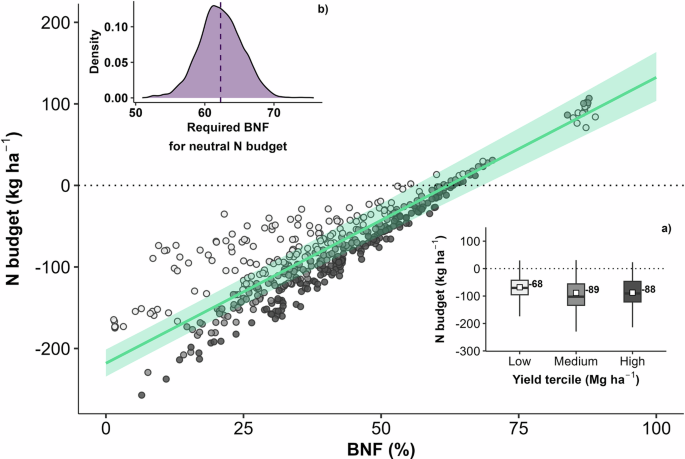
Points are individual observations, colored by yield terciles (Mg ha-1): low ( < 3.49), medium (3.49−4.18), and high ( > 4.18). The solid green line is the fitted model with its 95% credible interval (shaded ribbon). The horizontal dotted line marks a neutral budget (0 kg ha-1). a Boxplots of N budget by yield tercile, white squares are means (values shown). b Posterior density of the required BNF for a neutral N budget, the dashed line marks the posterior mean, and the colored area indicates the 95% credible interval.
Implications for soybean-based agroecosystems
The application of N fertilizers to the cereal-based systems alters N availability and subsidizes those agroecosystems7. The overall availability of N is key controller of productivity and carbon (C) levels8. The impact of introducing legumes is often smaller in highly intensified, low-diversity systems, such as corn (Zea mays L.)-soybean rotations, due to the increase in residual soil mineral N derived from the large synthetic N inputs applied to the cereal crop, reducing soybean reliance on fixation and limiting total BNF contribution3. As a result, legume-derived N inputs and the expected rotation benefits could be less pronounced under high-input management. Improving overall estimates of the contribution of BNF for more accurate N budgets linked to sustainability, soil health, and long-term productivity9. The 15N natural abundance method permits the partitioning of crop N derived from soil mineral N and atmospheric N210. The overall proportion of N2 fixed by legumes usually varies by many factors, such as the availability of soil mineral N (and timing)11 the crop productivity (related to the crop N demand)12, effectiveness of rhizobia13, and environmental factors limiting the overall BNF process14,15,16. Specifically for soybeans, the overall N contribution to the system will depend on the removal dictated by the N harvest index (NHI) of the crop and the contribution of BNF. In a soybean-based system, a positive N balance is achieved when the proportion of whole-plant BNF exceeds the fraction of N removed in the harvested grain. In recent review papers, the overall variation of NHI for soybeans (considering only aboveground biomass) in US ranged from 69 to 85%, with an overall mean value of 75%17, while for BNF the proportion ranged from 46 to 73%, with an overall mean value of 58%3. A recent review18 highlighted the major issues linked to the estimation of NHI from the aboveground biomass, mainly linked to samples collected at maturity without accounting for substantial losses of N in fallen senesced leaves, overestimating NHI. Optimal sampling times for obtaining a more precise estimation of NHI should be executed towards the end of the seed filling, with uncertainties and errors for this factor previously acknowledged by several authors19,20,21,22. Thus, the importance of obtaining relevant estimations of NHI as the key factor representing N removal from the aboveground biomass for soybeans.
Implications for breeding and crop productivity
From a soybean breeding perspective, modern cultivars can fix more N in absolute terms, but the relative contribution of BNF to total N uptake has not increased with breeding (varieties from 1930s to 2000s)23. Thus, if the relative contribution of BNF present a ceiling, a larger absolute amount of N must come from soil mineral N, increasing the risk of negative N budgets. As suggested by our results, N budgets remained negative even in the lower-yield tercile, indicating that reduced yield alone does not guarantee neutrality. Instead, across yield groups, greater reliance on BNF consistently shifted budgets toward neutral, and as productivity increases, grain-N export rises and deficits magnify when the contribution of BNF does not keep pace with crop demand. Similar results have been recently reported24 reflecting that high-input systems that maximizes yield, increased N uptake and seed N removal but without improving BNF, enlarging negative N budgets. A long-term negative trend (1970s to 1995) in the contribution of BNF for soybeans25 has been previously reported, plausibly linked to several factors, such as the high use of N fertilizers in preceding corn crops and increase in residual N. However, a more recent review documented a slight positive trend in BNF, roughly from 50 to 60% in US soybeans, for studies conducted from 1973 to 202026. Beyond the overall trend, many of these reports present the overall contribution of BNF around 50–60% from the crop N demand3. This implies that the rest of the crop N demand has been supplied by a large contribution of soil mineral N.
Implications for sustainable agriculture
Increasingly negative N budgets over time will lead to gradual soil organic C and total N depletion, a trend temporarily masked by high synthetic N inputs to cereal crops27. While fertile soils can buffer short-term removal, repeated cycles can mine organic matter and nutrient pools that sustain high productivity environments28. This biological “subsidy” can also degrade the soil water-holding capacity and increase its vulnerability to extreme weather events, such as mid-season droughts that threaten US agricultural resilience. Bridging this deficit does not necessitate a trade-off with profitability. Instead, it requires a systems-oriented approach, where farmers can maintain yield potential of their land for future generations by adopting management practices, such as precision N application (to avoid excess of synthetic N) and use of legume or mixed legume/cereals cover crops to contribute N to the system and rebuild soil health. By transitioning towards diversified rotations and a more rationalized use of inputs, producers can align immediate high-yield goals with the long-term sustainability of the US agroecosystem. In this sense, our evidence shows that BNF is essential but rarely sufficient to offset N removed in seed, leaving a persistent N gap between BNF inputs and N export. As yields increase (and seed N removal rises accordingly), this gap can widen, driving increasingly negative N balances. This exposes the system to increased economic costs29,30. Since soybeans are central to the US economy and supply chains, neutral N budgets represent more than an agronomic benchmark, linking farm management with long-term economic viability and food security31.
Summary and forward-looking insights
In summary, our findings highlight the importance of conducting on-farm assessments of BNF to quantify N budgets, a key sustainability metric for US soybean-based agroecosystems. The probabilistic approach used here provides more robust insights by capturing the average contribution and range of variability across environments. For policymakers, this uncertainty-aware approach provides a more realistic baseline for developing sustainability metrics, ensuring that incentives are grounded in the probabilistic nature of BNF rather than overly optimistic averages, and focusing on metrics connecting soil health and sustainability with long-term productivity. This ensures that meeting immediate global food demand does not come at the expense of the soil natural capital required to sustain future generations. Lastly, although the US Midwest has achieved high soybean yields, maintaining long-term productivity requires significant attention. To enhance soil health, expanding crop rotations beyond the corn-soybean system is imperative for ensuring long-term sustainability and productivity32,33. This system-oriented approach should also focus on the long-term strategic management of agricultural systems rather than focused on practices that maximize crop productivity, profits, and sustainability for a single growing season. Addressing these challenges properly require acknowledging biological trade-offs and quantifying N budgets on farmer fields for exploring system-oriented solutions and informing agricultural policies beyond a single crop growing season.