
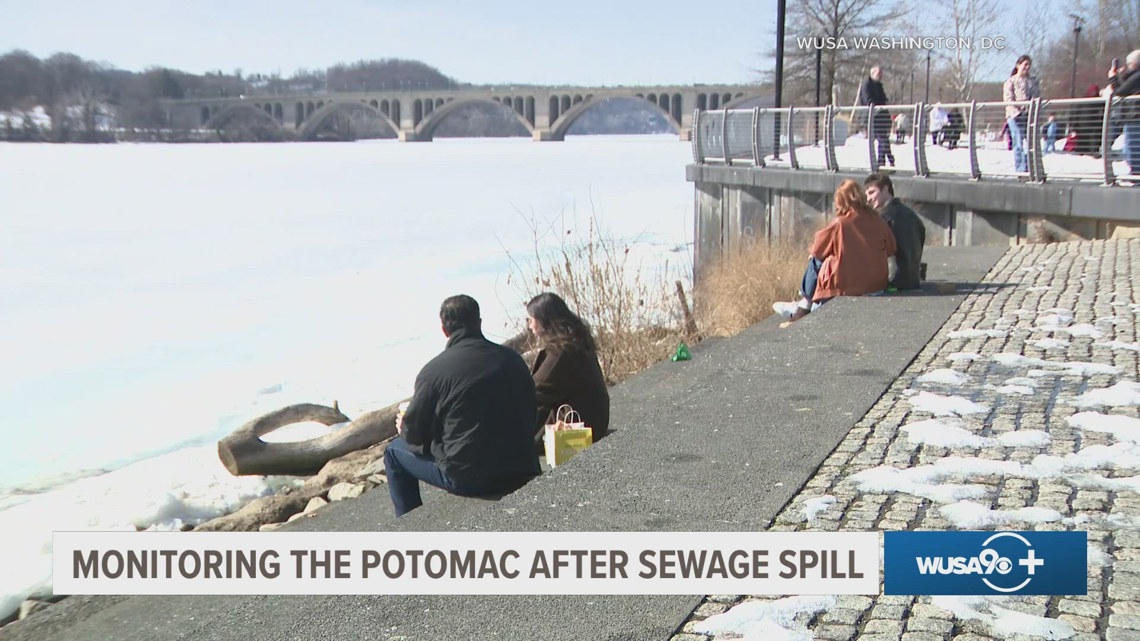
Some spending a warm Valentine’s Day at the Georgetown Waterfront said they didn’t even know about the spill or any health concerns
WASHINGTON — Health and environmental officials are warning of potential hazards along the Potomac River as temperatures rise and ice begins to melt following a massive sewage spill nearly one month ago.
Officials say the river remains partially frozen, but with highs climbing into the 50s this week, bacteria trapped in the ice could soon be released into the water, posing risks to people who live, work, or recreate along the river.
Visitors at the Georgetown waterfront on Saturday said they were alarmed to learn how far the contamination may have spread.
“I might have to invest in a mask or a clothespin for my nose come the springtime because I don’t want it to smell like Victorian London,” one visitor, Griffin, said.
Another resident, Megan, says she’s a nurse and expressed concern about outdoor activities popular along the river corridor.
“It’s super gross and it’s dangerous,” the resident said. “People love to hike Great Falls and go kayaking. I think it’s really going to get some people sick.”
Health officials have called the spill an ecological disaster. An estimated 250 million gallons of raw sewage poured into the Potomac River after a pipe burst in Cabin John, Maryland, nearly a month ago.
Maryland lawmakers met Friday to discuss next steps as testing continues.
Experts warn that exposure to contaminated water, even through small cuts, could cause serious infections.
“The big risk is having a cut and having contact that could lead to a serious infection that can’t really be treated with antibiotics,” said Dean Naujoks, with the Potomac Riverkeeper Network.
Environmental groups say the timing is especially concerning as warmer weather is expected to draw thousands of people back to the river in the coming weeks.
“Some of this melting ice can trap bacteria and then cause a delayed release,” Naujok said. “People need to be cautious for quite some time.”
Researchers from the University of Maryland testified that testing detected toxic bacteria as far as nine miles downstream from the rupture site, reaching areas near Alexandria, Virginia, and National Harbor, Maryland.
Samples showed not only E. coli, but also Staphylococcus aureus and the antibiotic-resistant superbug MRSA.
Dean Naujoks with the Potomac Riverkeeper Network said the contamination is visible in some areas.
“You can visibly see all this raw sewage and toilet paper,” he said.
Residents at the Georgetown waterfront said they want clearer signage and stronger public health alerts, especially as spring approaches.
“I live not a mile from here, and I had no idea,” Griffin said.
Officials say the concern is not limited to the water itself. Sediment along the riverbanks may also contain harmful bacteria, posing an ongoing risk in the months ahead.