
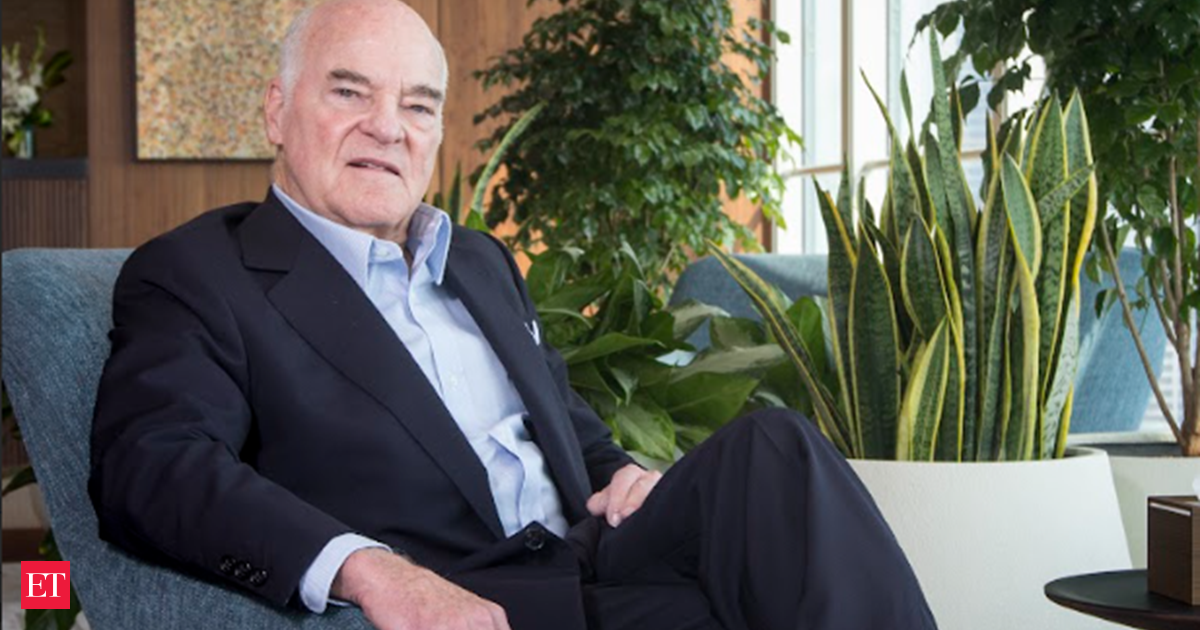
MUMBAI: Henry Roberts Kravis, cofounder of KKR, is longtime India champion. A pioneer of leveraged buyouts in the US, he’s seen the evolution of the industry up close over the 50 years that KKR has been around. Kravis, 82, and Trehan, 50, spoke to ET on topics ranging from Donald Trump to AI, the rise of private credit and what excites him the most about India. Edited excerpts:
In 50 years, KKR has grown from $120,000 of ‘startup capital’ to $744 billion in assets under management (AUM). What were the inflection points that enabled that transformation—and what will define the next chapter?
Henry Kravis: When we started in 1976, George (Roberts), Jerry (Jerome Kohlberg Jr), and I were three people with $120,000 and a conviction that companies could be run better. It was a real risk. We had no fund and no brand, just the belief that ownership and incentives needed to be aligned.
One defining inflection point was our willingness to change before we had to. I’ve always said, “If you dislike change, you’re going to dislike irrelevance even more.” As markets evolved, so did we. We expanded globally. We moved beyond buyouts into infrastructure, real estate and credit. More recently, we brought insurance and strategic holdings into the firm. None of that was obvious at the time. There was no blueprint. We built it step by step, by staying curious and by being willing to try new things.
The next chapter will be defined the same way. The world is more interconnected. Capital moves faster. The lines between equity, credit and real assets are increasingly blurred. Companies want partners who can think across the capital structure and across cycles—and who are prepared to provide long-term solutions, not just capital. That requires imagination and discipline at the same time.
 Live EventsAs we enter our sixth decade, I don’t think of us as 50 years old. I think of us as 50 going on 100. In a way, we are doing what we did at the beginning—building something new again. What sustains a firm over decades isn’t size. It’s the willingness to keep evolving, to keep reimagining what’s possible, without losing the spirit and culture that got you there in the first place. And we’ve got the best leaders in Joe and Scott to take us there. (Joseph Bae and Scott Nuttall are KKR’s co-CEOs.)
Your platform spans $229 billion in private equity, $192 billion in real assets and over $320 billion in credit. How has KKR’s evolution beyond traditional buyouts reshaped the firm?
Kravis: When we started, private equity was a very small part of the market. Today, private markets are mainstream. Most US pension funds invest in private equity, tens of millions of individuals have exposure through their retirement systems, and millions work at private equity-backed companies. The scale—and responsibility—is far greater now. The industry has also broadened. At KKR, private equity is about 30% of our business today. Our largest strategy is credit, with over $320 billion in AUM, alongside our insurance platform. We invest across more than 45 strategies globally.That reflects how companies’ needs have changed. They don’t just need capital—they need solutions. When we meet an entrepreneur, we can bring the entire capital stack. Capital itself is more available today. What matters is what comes with it—insight, experience, long-term partnership. Capital is a commodity today. So, find money from people that actually will help you. It costs you exactly the same.
Value creation has also become more demanding. It’s not just about financial structuring. It’s about operations, technology, people and strategy. It’s more complex, more institutional, but the objective is still the same: build stronger companies over time.
You’ve always described India as a key pillar of the firm’s global strategy. In 2026, how central is India compared with maybe five years back?
Kravis: In the last five years, we put about $9 billion to work of equity. In the next five years, we expect this to significantly increase and at a much faster pace. In all we have so far invested more than $13 billion in India. Initially we were just private equity, but today we are also one of the largest infrastructure investors in the country and have also built a strong private credit platform. Going by our commitment, I won’t be surprised if we deploy $20 billion in the next decade.
Gaurav Trehan: The Indian economy with a nominal GDP of 11-12% is going to double every seven years. We believe our industry and the solutions we provide are going to become a larger part of the capital structure of entrepreneurs and founders and the companies that are there in this country. As the industry gets bigger, our commitment, as the market leader, will only get larger. Directionally, we are getting more and more active, investing more, and getting deeper across strategies within India.

Gaurav Trehan, co-head, KKR Asia Pacific; Head of Asia Pacific Private Equity, KKR
Henry, you’ve been coming to India for a long time. How have you seen the Indian entrepreneur evolve in terms of ambition, execution chops, commitment to corporate governance?
Kravis: I’d say all of the above is an improvement without a doubt. I mean, they’ve all gotten better. Let me put it in perspective. I’ve invested personally in venture startups since 1998. In the dot.com period, founders were only interested in going public, which to me is not strategy but only financing. They had no idea what they wanted to do.
Today, I am blown away by so many of these entrepreneurs that I meet. I’m talking about young companies who know exactly what they want to disrupt or replace. Governance has improved. They’ve also become extremely good about hiring. It used to be ‘let’s just add bodies.’
The quality of what I’m seeing here in India is starting to be as good as many companies in the US, which has had the benefit of time. These young founders have thought it through. Most of these companies don’t even want to go public. They’ll say, I just want to stay private. They may get pushed to go public because the institutions or the individual investors want to get some money out. You don’t see people rushing to the market until they have something really good in place.
Also Read: KKR could deploy $20 billion in India over the next decade, says cofounder Henry Kravis
When you talk about India, would you say the opportunity set is also increasing? Traditionally, we’ve seen PEs back export-led stories like technology or SaaS companies or export-led pharma.
Trehan: If you look at our Asia business, especially within private equity, over 90% of what we invest in Asia is local for local, which means India for India, or Japan for Japan. We truly believe in the fundamentals of all these countries in different thematics. If you take India, for example, which is a growth economy, it’s one of the best places to invest right now. What we do in India is back entrepreneurs who are playing to the fundamental growth of this economy, whether it’s in consumer, healthcare, financial services, or education. These businesses and industries are going to grow and compound not one or two years but 10 to 20 years and beyond as India grows.
Secondly, of course, there are parts of the Indian economy that cater well to the global world. We also play to these thematics such as technology or pharmaceuticals. By and large we are fundamentally excited about what’s happening in India.
Kravis: That’s really important. With export businesses, we have a nice currency hedge in place. With a 1.4 billion population, the need for 20 million jobs a year will push you to go to tier two and tier three cities, as the next demand drivers. And to cater to them you need to build infrastructure and you need to offer credit and capital solutions.
We are also seeing more interest from family businesses who prefer to partner with people like us and grow their business, as in many cases the younger generations are not keen to be in the driver’s seat. Non-core subsidiaries are becoming a big spot of opportunity. So many people are coming to us to ride the upside with us. This is a great source of partnerships for us. Part of it is because these companies–even the bigger ones– are limited on capital.
We are seeing Private Credit 2.0 for KKR in India as well. How has the journey been so far? One might argue that compared to the past it’s been rather muted.
Kravis: I’d say Manipal Group would be a good example there. That’s a $600 million financing line that we provided to Manipal Group. This is a terrific company.
So we’re going to be selective. We’re going to hopefully pick good companies to invest in, good promoters that we really trust and that we have confidence in, and we’ll get behind them for sure. For the longest time, India did not have a corporate bond market and had rules that were not conducive. You could only own 25% of insurance companies as a foreigner and that blocked a huge source of capital. Now you can own up to 100%.
You didn’t have a bankruptcy law and that was a big impediment. Now you have a bankruptcy law that gets better every single year. That is a big difference.
You were a bank market before but now India finally is getting into a broader and deeper corporate bond market. If you don’t it will stymie growth. Your companies need to grow if you are looking to create 20 million jobs annually. Large companies grow but globally the real employment generators have always the small and medium-sized businesses that grow and become bigger. They cannot do that unless they have capital and that’s why developing the corporate bond market is such an important piece.
Trehan: In India the market is still evolving. We are helping it grow by being part of that ecosystem, and regardless of whether it’s private equity, infrastructure or credit, I think the key approach here is to be selective and partnerships. Just because we give them credit vis-a-vis private equity, does not mean that we’re not partnering with them. Manipal Group is a great example of partnering with someone like Ranjan Pai, whom we’ve known as a firm for a long time and we really respect. He chose KKR for the $600 million transaction not just because of the quantum or the nature of the instrument but because it’s a true thought partnership where we are working with him on many other areas as well.
On a policy level, do you feel there are roadblocks that need to be removed?
Kravis: The biggest issue as I see it as an outsider is the lack of financing for small and medium-sized companies. That’s the one missing piece that needs to be taken care of and I think private credit can start to fill that gap because banks are not as active in that space. Small and medium-sized companies have real trouble getting money outside.
In the past, it was the lack of bankruptcy law that made it really hard to lend to companies. Today, in less than a year I can get my money back if required. So there are improvements, and while it is still evolving, it will only get better in my view.
Trehan: Even business owners and entrepreneurs are gradually figuring out the nuances of the different instruments. Earlier, it was just equity and bank loans. Now there are far more capital solutions on the balance sheet, starting from equity all the way to senior debt and everything that’s in the middle between equity and senior debt. We are spending a lot more time with founders and entrepreneurs because all of a sudden they want to understand and fully grasp these new instruments. It’s a new learning curve for them too. With policy getting more nuanced and refined, the corporate bond market is starting to develop. Like everything, it takes time, but it’s coming together.
Since the relaunch of our private credit strategy, we’ve already done multiple deals in multiple sectors with multiple partners and founders and our track record and our experience has been nothing but very positive.
How has it been for corporate America in the past year under Trump 2.0?
Kravis: The economy has grown very nicely during the 2025 period. Fourth quarter numbers were strong for companies. The stock market is at an all-time high. Productivity, which is a very important piece, is up over 4.5% right now. And that’s not all driven by technology. A lot of companies are saying, let’s do more with less people. And that is really paying off.
At the end of the day, business executives just want clarity on the rules. The rest they can figure out within those rules. But they don’t want the rules to keep changing. Businesses can adapt to almost any framework—they just need consistency and predictability.
There has been a clear focus on reducing regulatory complexity and streamlining processes. Greater clarity and efficiency tend to support economic activity. So I’d say right now, we’re all operating very well.
The amount of money that is being raised right now for AI, for Anthropic, for ChatGPT, or OpenAI, is immense. And there’s an enormous amount of capital available.
At KKR, we today have over 150 data centres around the world. We’ve got around 25 operational data centres, and another 20 or so that are under construction or in development in India alone right now. Why are we doing that? Because we believe in the future. And the way we invest and have always invested is we try to invest in a linear fashion. We’re not smart enough to pick tops and bottoms. We’re not picking stocks.
Number two, our job really begins the day we make an investment. We often say don’t congratulate us when we make an investment. That’s easy. Anybody can make an investment. Congratulate us when we’ve made money on that investment and have left the company in better shape than when we found the company, which is what our focus always is. We really act and think like industrialists.
Trehan: As long-term investors we go through many cycles. We go through political cycles. We go through macro cycles, macro crises. But we focus on what we can control. And that’s really important for us.
Listed alternatives managers have seen volatility over the past year, amid concerns over private credit and exits. How do you interpret the public markets’ reactions? Is this signal or noise?
Kravis: Public markets tend to move faster than private markets – and sometimes the reactions are based on sentiment rather than fundamentals. What is happening here is not specific to KKR but has to do with the whole group of listed private equity stocks and there are only a handful of us that are publicly traded.
There are two things that really are weighing on all our stocks and I don’t happen to agree with them. Number one: People are worried about private credit. Now, it’s not a systemic problem, because we raise money in funds. There are no deposits that we take. We’re not a bank. And so, when we take these funds, we put them into private credit. Now in the US, there have been two recent bankruptcies, including First Brands. Fundamentally, they failed because they were not great companies. And that was all bank credit.
There may be firms that are entering credit without deep underwriting experience. In any growing market, that happens. What I worry about are those firms that have decided they want to be in credit, and they don’t have a driver’s licence. So they go into private credit but without the same kind of rigour to the credit analysis that we make at KKR. But broadly speaking, private credit remains a disciplined asset class.
The second reason is more recent. Everyone is worried that all enterprise software is going to be in trouble because it’s all going to be put out of business by AI. Only 7% of our total assets have any exposure to SaaS–that’s it. I’m not overly concerned about that. More importantly, disruption creates opportunity as well as risk.
Again, I come back to how we invest. As long as we can keep very diversified and stay disciplined, we are fine.
We have seen ESOPs become de rigueur in tech companies. But is the trend getting wider? Are you surprised to see how it can act as a catalyst to boost productivity?
Kravis: No. I’m not surprised. For the longest time, it was perceived that private equity takeovers would lead to stripping off benefits of workers.
The reality is that you have to put money back in every company and keep it growing and innovate. When we started investing in the early 70s, only the top 25, say, managers, would own equity. So we came up with this idea about more than 10 years ago where everybody in the company gets to be an owner.
In the companies we rolled out broad-based employee ownership, turnover has gone down but productivity has shot through the roof. When you act like an owner, you think like an owner, not like a renter of the corporate asset. You cannot imagine what it does to workers in the middle of rural US or Japan where they work when they feel like owners. And when there is a liquidity event, we also help them with financial advisors. In many cases, we have seen they also want their next generation to work in the same place. That’s the bond we create.
Is there an AI bubble that we should be worried about?
Kravis: When I talk to the venture capital guys, they’re convinced they can put AI in any company and it’s going improve operations. Hold on. You might. Go to Silicon Valley, and you’ll hear how everyone might be getting flying cars or other things soon. Everything is going to be automated. People will be out of a job. I’ll be out of a job. I don’t believe that will happen. I also don’t have a view on which AI is going to win in the end.
So will you stick to the infra side of AI for now? Or in retrospect, do you feel that’s a mistake and there should be a correction?
Kravis: We’re going to stay on the picks and shovels side. First of all, not all AI is going to work. But the infrastructure will be there. You’ve got to have data centres and cloud and so forth. I had mentioned that US productivity is up. Very little of that has to do with AI right now because AI hadn’t really kicked in yet. It’s just starting to kick in.
Trehan: We think about the right capital structure, and we believe, right now, picks and shovels with the right capital structure is a good risk-reward to play the overall thematic of AI that you talked about. We’re in the very early innings of how these things will play themselves out.