
Rare false gharials had been assumed extinct in Thailand
PUBLISHED : 15 Feb 2026 at 16:30
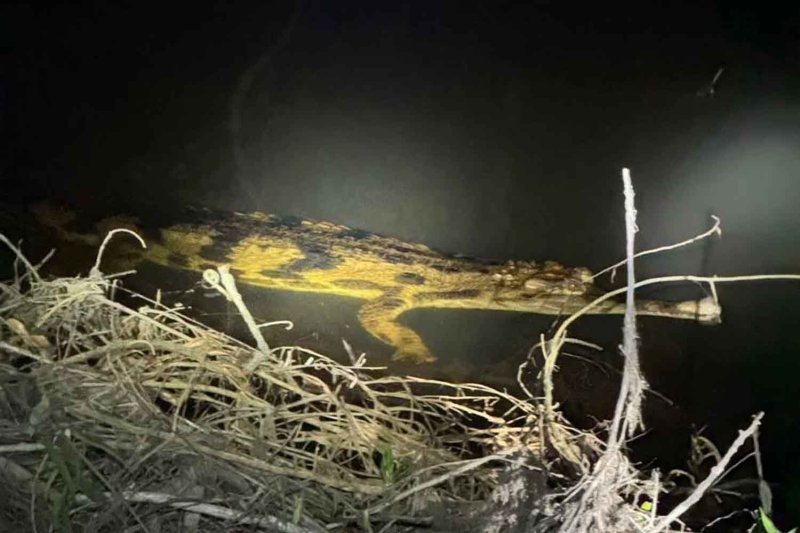
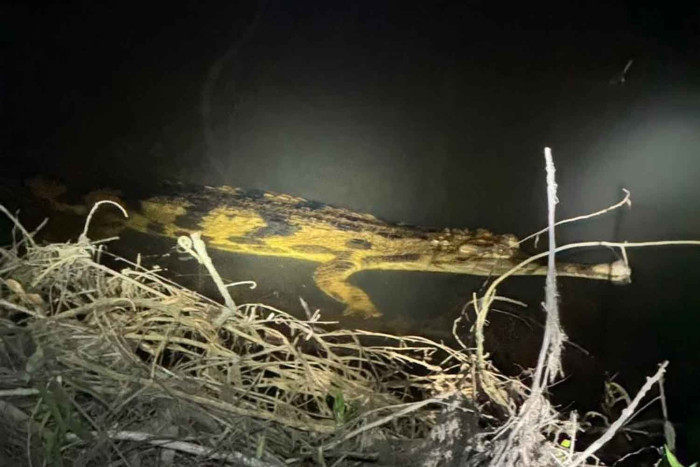
A very rare false gharial discovered in a canal in Tak Bai district of Narathiwat in late January. (Photo: Department of National Parks, Wildlife and Plant Conservation)
Two endangered thin-snouted freshwater crocodiles were recently seen in the wild for the first time in decades in the far South, where they had been believed extinct, the Department of National Parks, Wildlife and Plant Conservation reported.
Director Sukhee Boonsang said the two false gharials were of different sizes and were spotted in the wild in the southern border province of Narathiwat in January. The rare reptiles are known as takhong in Thai.
Natthawut Yuenchon, a resident in Tak Bai district of Narathiwat, encountered a false gharial about three metres long in a canal at dusk, and took a photo of it, Mr Sukhee said.
Later a team from the Halabala Wildlife Research Station visited the area and found another false gharial about 1.5m long near the location of the first sighting.
“The evidence shows that there are at least two false gharials in the ecosystem of the Tak Bai swamp forest. Their different sizes indicate that their population may grow in the future,” Mr Sukhee said.
False gharials, or thin-snouted freshwater crocodiles, were indigenous in Southeast Asia and were found in southern Thailand, Malaysia and on the islands of Sumatra and Borneo in Indonesia, he said.
The wild population had plunged in recent decades due to loss of habitat caused by the expansion of farmland, dam construction and illegal hunting.
In Thailand, researchers had only stories and the tracks made by false gharials to work with. No researcher had seen them in the wild and it was assumed they were extinct in Thailand.
The International Union for Conservation of Nature lists the reptile as an endangered species, on its Red List, with fewer than 2,500 fully grown false gharials recorded worldwide.
“The discovery of false gharials in a main canal that flows through an upper swamp forest into the sea in Narathiwat province proves that the ecosystems of swamp forests in southern Thailand are good enough to be the last habitat of this endangered species,” Mr Sukhee said.
Researchers would patrol and study the area, and prepare a conservation plan in consultation with local people, he said.