
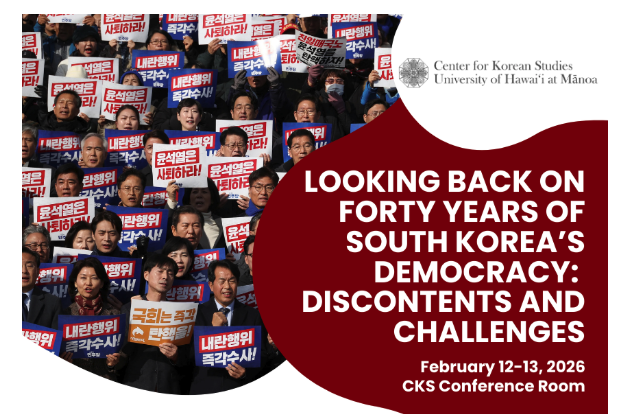
This past week, the Center for Korean Studies hosted an important conference with leading scholars from across the world, “Looking Back on 40 Years of South Korean Democracy: Discontents and Challenges.”
Organized by Sociology Professor Myungji Yang and supported by the Center for Korean Studies led by Professor Young-a Park and UH faculty, the conference deepened understanding of democracy from diverse historical, political, economic and cultural perspectives.
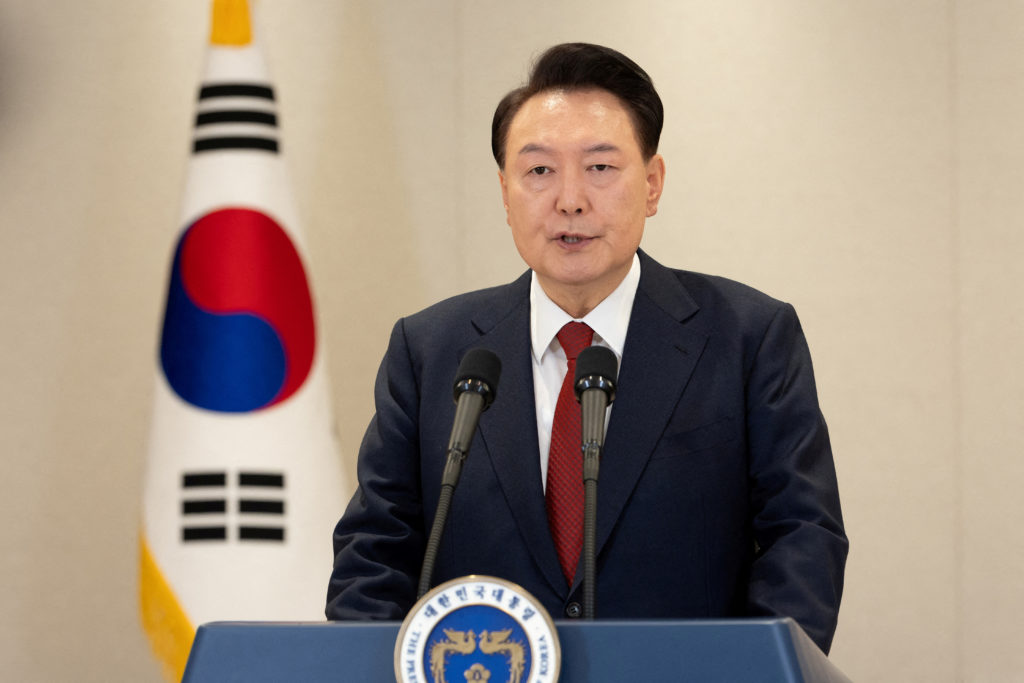
The conference is timely and relevant to Hawaiʻi, the United States and the Asia-Pacific region. While the declaration of martial law in December 2024 by former president Yoon Suk Yeol challenged decades of progress towards democracy in Korea, it also provided an opportunity to reexamine the resilience of democracy in Korea.

Ideas showcases stories, opinion and analysis about Hawaiʻi, from the state’s sharpest thinkers, to stretch our collective thinking about a problem or an issue. Email news@civilbeat.org to submit an idea or an essay.
Yoon was impeached, put on trial and found guilty for insurrection, obstruction of justice, falsifying documents and violating campaign laws. In January 2025 he was indicted on further charges that he mobilized the military and police to storm the National Assembly to prevent lawmakers from stopping his declaration of martial law. Yoon ordered the arrest of opposition leaders and encouraged his supporters to attack the judiciary and government offices.
While there are similarities and connections with Yoonism and Trumpism, MAGA and its equivalents in Korea, it is important to recognize the challenges of understanding the role of democracy and the trajectories across time and space.
Democracy and politics and the challenges of governance in a world drifting towards both authoritarianism and populism is as relevant to Korea as it is to the United States. Looming issues include not just public trust in government and but the rule of law and the balance of executive, legislative and judicial powers. Managing security threats and the geopolitics of treaties, trade and multilateral agreements further complicate matters given the rise and influence of multinational corporations and technology giants.
Here in Hawaiʻi, where U.S. Indo-Pacific Command, the largest and oldest unified military command is headquartered, tensions have never been greater. In addition to the alliances between North Korea, Russia and China, security threats in Taiwan, Iran, India and Pakistan as well as the Korean peninsula persist. North Korea’s support of Russia in Ukraine, cyber operations and nuclear and ballistic missile capabilities are significant risks. Increased militarization, decreased diplomacy and the demise of democracy have fostered an “us versus them” mentality with China, Russia, North Korea on one side and the United States, Japan and South Korea on the other.
With increased investments in developing countries and projects such as the Belt and Road Initiative, China touts itself as a democracy, different and superior to the United States. China’s so-called “Whole Process People’s Democracy” integrated with the Chinese Communist Party includes elections, consultation and deliberative processes to support implementation of policies and collective actions.
In China, there is strong reliance on technical expertise and hierarchical decision-making. China recently commissioned studies of democracy in the United States, highlighting the Jan. 6, 2021, attacks on the Capitol and other failures in American democracy. While China’s one-party system and socialist programs enable an “outcomes oriented” emphasis on security and human needs, deeper critique and evaluation of these claims is needed.
While this is an over simplification, democracy means that the people rule through free and fair elections, with a free and unfettered press, under the rule of law and open, transparent debate and deliberation of policies and collective actions. Democracy is seen as expensive, inefficient and not leading to progressive let alone desired outcomes. We see the willingness to abandon democracy following disasters when we suspend normal rules to expedite decision-making and action. Indeed, Yoon’s justified the declaration of martial law on the basis of an emergency with security threats and anti-state forces threatening Korea.
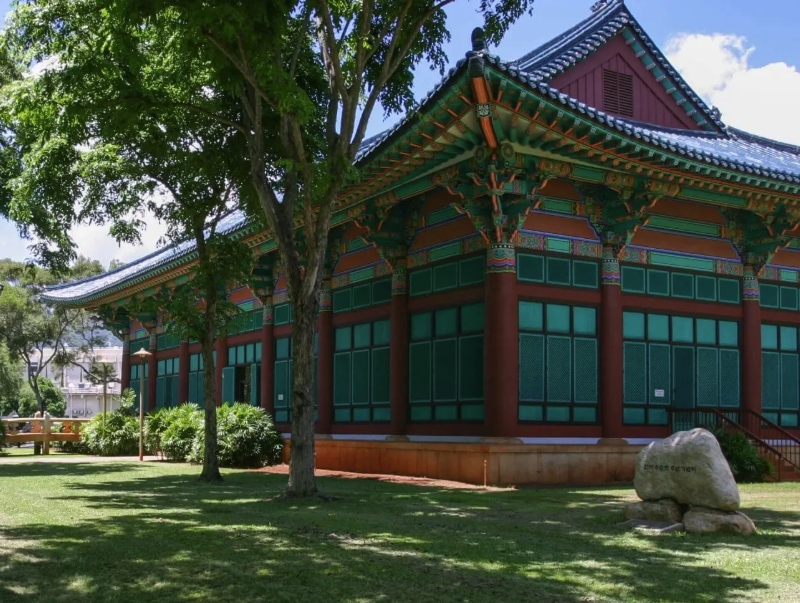 The Center for Korean Studies building at UH Mānoa. (Screenshot/2026)
Democracy comes in many shapes and sizes. In addition to its origins in Western civilization, there are powerful ideas and practices across cultures and societies. Focusing on a single country like Korea shows how difficult and fragile democracy and its ideals can be.
In the course of a few decades, South Korea has transitioned from a military dictatorship to a vibrant democracy. It a grew from a poor, war-torn country to a global economic power. With K-pop, film, drama, music, beauty, cuisine and culture, Korea has demonstrated to the world how soft power rather than military might supports safety, security and prosperity.
In vibrant democracies, governments do not kill protestors. Targeted investments in not just education and technology tell only part of the story. The role of activists, organized labor and people coming together in protests, uprising and struggles for freedom and democracy, human and LGBTQ rights are part of the remarkable change.
In June of 1987, when I had a Fulbright to Korea, I witnessed the massive protests against President Chun Doo-hwan. These demonstrations triggered the adoption of democratic reforms including elections and greater citizen participation at the local and provincial levels of government. I’ve seen, first-hand, the powerful consequences of embracing freedom, human and civil rights and allowing democracy to flourish. While there are contradictions and inequities arising from the explosion of wealth and prosperity, democracy has been good for the people.
The “40 years of Democracy in Korea” conference demonstrated not just the challenges of studying democracy but also new methods and technologies which support tracking the impacts and influences of popular movements and the effects of response, repression and remaking of societies. There are powerful lessons as to how Koreans organize, involve under-represented groups and promote peace and prosperity through collective action. Many recent disasters including structural failures, maritime accidents, stampedes and other disasters where innocent lives were lost have created new opportunities for learning and fixing our resilience to harm.
In Korea as in the United States, we need to investigate and understand what works and what does not. We need to appreciate history and culture and the role of universities and community-based organizations working directly with people to support change and foster peace and prosperity. This involves remembering the struggles and sacrifices and also the ongoing, unfinished business of not just sustaining but improving and spreading democracy here and abroad.

Sign up for our FREE morning newsletter and face each day more informed.
Sign Up
Sorry. That’s an invalid e-mail.
Thanks! We’ll send you a confirmation e-mail shortly.