
The Philadelphia Eagles have built one of the NFL’s most quarterback-friendly ecosystems, pairing a dominant offensive line with a scheme tailored to mobility, RPO decision-making, and vertical aggression.
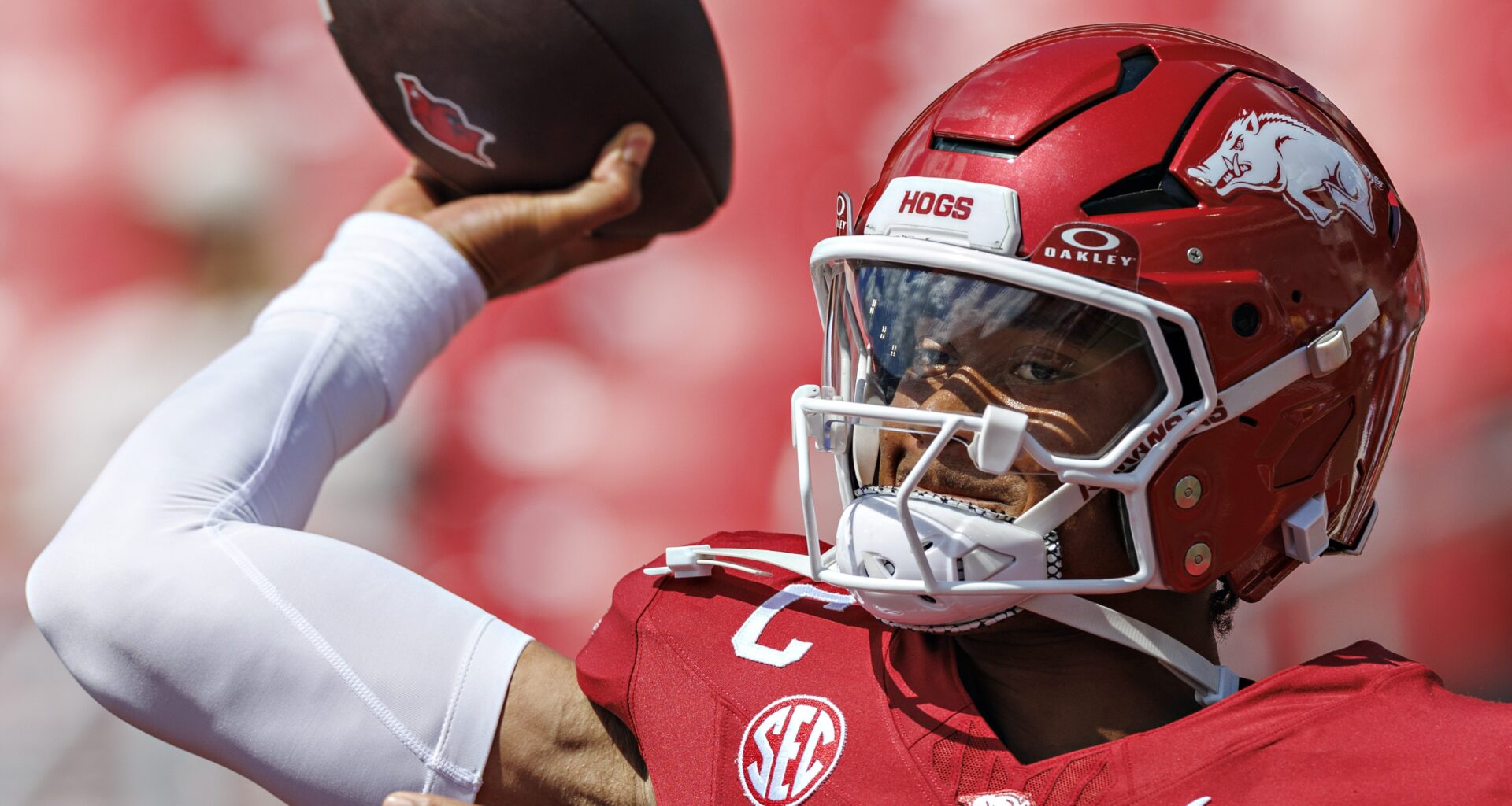
With Jalen Hurts firmly established as the franchise centerpiece, Philadelphia’s next quarterback move is unlikely to be about immediate competition. Instead, the Eagles could look to reinforce the position strategically in the 2026 NFL Draft — and Arkansas dual-threat quarterback Taylen Green stands out as an intriguing developmental target who fits the organization’s long-term philosophy.
At 6-foot-6 with elite athletic traits, Green represents the kind of upside swing Philadelphia has repeatedly shown willingness to make at premium positions. His combination of size, running explosiveness, and arm strength mirrors the archetype the Eagles have prioritized in the Hurts era. Drafting Green would not be about replacing the starter; it would be about preserving and extending the offensive identity that has defined Philadelphia’s success.
Green’s Physical Tools Make His Draft Stock Appealing
Green’s physical profile alone places him among the most intriguing quarterbacks in the class. He’s a long-strider with legitimate open-field speed, capable of creating explosive runs on designed carries or broken plays. Arkansas leaned into that ability with read-option and quarterback run concepts, forcing defenses to account for Green as both a runner and vertical passer. That dual-threat stress is precisely what the Eagles’ offense is built to generate.
As a passer, Green flashes high-end traits: effortless deep-ball velocity, the ability to drive throws outside the numbers, and the arm strength to attack tight windows downfield. His aggressiveness in pushing the ball vertically aligns with Philadelphia’s preference for explosive plays rather than conservative underneath distribution. When his mechanics are synced, Green can deliver NFL-caliber throws at every level.
The primary developmental areas — timing consistency, intermediate accuracy, and pocket sequencing — are typical for athletic quarterbacks transitioning to the pro level. Crucially, they are coachable issues rather than physical limitations. In Philadelphia, Green would enter a low-pressure developmental environment behind an established starter, allowing coaches to refine his footwork and processing without forcing early action. That runway significantly increases his chances of reaching his ceiling.
Schematic Fit and Long-Term Roster Building
What makes Green particularly logical for Philadelphia is how seamlessly his collegiate experience maps onto the Eagles’ scheme. Arkansas utilized heavy shotgun alignments, RPO reads, and designed quarterback movement concepts that mirror core elements of the Eagles’ playbook. Green is already comfortable making perimeter decisions, reading second-level defenders, and threatening defenses horizontally and vertically — foundational traits in Philadelphia’s offense.
From a roster-building standpoint, the move also aligns with Howie Roseman’s long-standing approach. The Eagles consistently invest in quarterback depth not only for insurance but for asset value. Hurts’ physical play style makes capable depth especially important, and recent seasons have shown Philadelphia cycling through veteran backups on short-term deals. Drafting Green would create a cost-controlled No. 2 with upside to start in emergencies or develop into a valuable trade asset.
There’s also strategic continuity to consider. If the Eagles’ offense is fundamentally designed around quarterback mobility and run-game multiplicity, maintaining that structure behind Hurts is essential. A traditional pocket passer changes the playbook; a player like Green preserves it. That continuity has tangible value in weekly preparation and game-planning flexibility.
Ultimately, Taylen Green embodies the traits Philadelphia has repeatedly prioritized: rare athleticism, vertical passing potential, and schematic compatibility with a quarterback-centric rushing attack. With time to develop and coaching continuity, he offers legitimate starting upside. For a franchise that views the quarterback position as both its identity and its most valuable asset, investing in Green would be a forward-thinking move that strengthens the position today while protecting it for the future.