
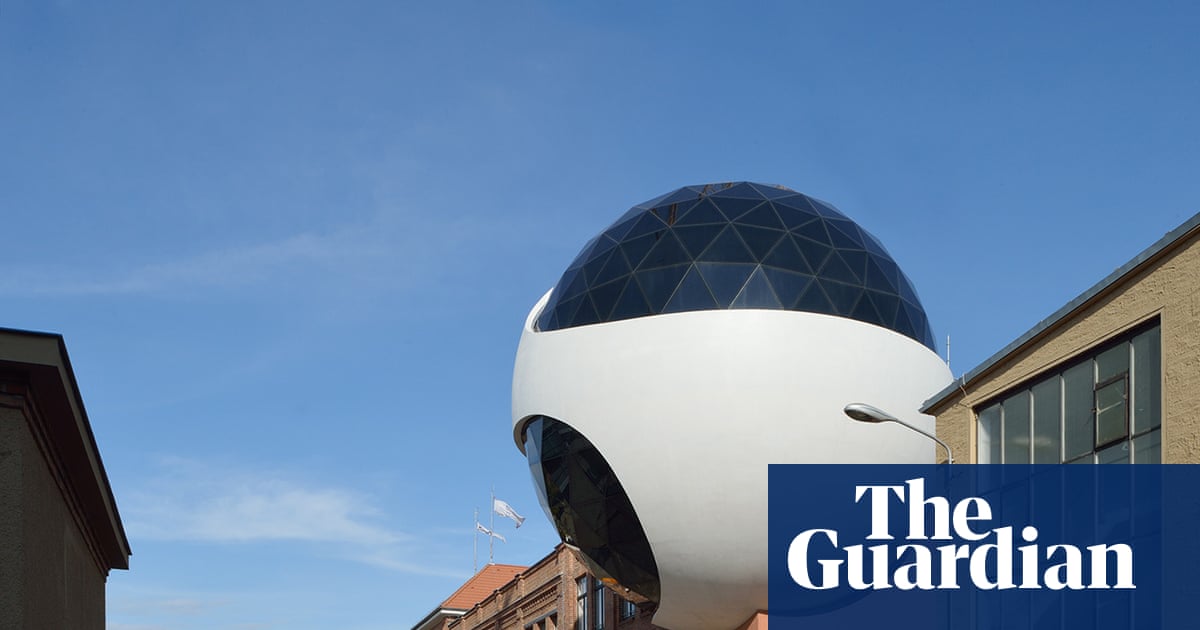
Perched among old brick buildings in an industrial neighbourhood of Leipzig in eastern Germany, a giant white sphere appears to hover over the corner of a former boiler house. Is it a giant’s golf ball? An alien spacecraft? A fallen planet?
Twelve metres in diameter, the Niemeyer Sphere is the final design of world-famous Brazilian architect Oscar Niemeyer and probably the most surprising creation by a visionary who valued the sensation of newness in art above all else, the result being mesmerising buildings that seem both space age and out of this world. The Sphere is like a vision from the future, dropped among used-car dealerships and construction equipment rental outlets, in a working-class neighbourhood that few tourists would ever pass through by design.
We had this very good cook in the canteen – and he needed a space to deliver more refined dishes
The Sphere has only been open since June 2020, when its arrival was barely noticed due to Covid, but the journey from idea to inauguration took two decades. Throughout the construction process, photographer Margret Hoppe documented its various elaborate stages. The Spirit of Past Future, an exhibition of her shots, has just opened in the building, also featuring work by Armenian artist Nvard Yerkanian.
This exhibition tells the story of modernist architecture, including artful photographs of Bauhaus structures, which Niemeyer found too rules-based, and buildings by Le Corbusier, who employed the young, not-yet-famous Brazilian architect as a draftsman at the beginning of his career. The Niemeyer Sphere crowns that career.
‘Like walk-in sunglasses’ … the individually crafted liquid crystal glass panels. Photograph: Dpa Picture Alliance/Alamy
Its story begins in 1994, when publicly owned East German companies were being essentially gifted to private buyers. West German entrepreneur Ludwig Koehne bought a heavy machinery factory for the symbolic fee of one Deutsche Mark. He changed its name to Techne Sphere.
“We had this very good cook in the workers’ canteen,” says Koehne. “It was always clear to me that he needed a space where we could do events and deliver more refined dishes.” Koehne envisioned a restaurant on the roof of the two-storey canteen, which could use the existing kitchen’s facilities to cook and wash up.
In 2007, Koehne took a business trip to Brazil, where he fell in love with Niemeyer’s ravishing Brasília buildings – from the Palace of the Dawn, the water-fronted modernist residence of the president, to the Cathedral of Brasília, a crown-shaped concrete-and-glass wonder that seems to reach for the heavens. Four years later, Koehne wrote a letter to Niemeyer and went back to Brazil to meet the architect in person. Upon his return, he asked Tibor Herzigkeit – the chef and owner of the canteen – to commit to staying on for at least 10 more years. Herzigkeit agreed.
Niemeyer’s genius … the Niterói Contemporary Art Museum in Rio de Janiero. Photograph: Donatas Dabravolskas/Alamy
Niemeyer was 103 when he drew the first sketch, a round ball with windows at the top and bottom. When he died a year later, in 2012, he hadn’t finalised the design, but left behind a lot of material. “It had to be true to his spirit,” says Koehne. “It’s a great honour to get such a nice drawing, as a small company with just old rooftops to play with. And I really felt obliged to do it because of that.”
To flesh out the original concept, Koehne and executive architect Harald Kern brought in Jair Valera, who had worked as Niemeyer’s right-hand man for decades. After more planning, testing and hiring the right companies, they laid the foundation stone in 2017. Structural engineering, construction and materials each presented their own challenges, but the south-west-facing windows posed a huge conundrum. Koehne wanted the space to be aesthetically pleasing and physically comfortable, from light to ambience to temperature. “The fear of getting overheated in summer was very high,” says Kern. The team sought “invisible shading that goes with the Niemeyer architecture”.
Merck, the company behind the windows, developed the technology while the rest of the project unfolded. Their liquid crystal glass was not ready until 2019, at which point the company individually crafted each of the unique 144 triangular panes which, says Kern, can be dimmed from “a nice and neutral soft gray to a nearly dark black”.
Water-fronted wonder … the Palace of the Dawn in Brasília. Photograph: Evaristo Sa/AFP/Getty Images
Niemeyer, in his acceptance speech for the prestigious Pritzker prize in 1988, said: “A concern for beauty, a zest for fantasy, and an ever-present element of surprise, bear witness that today’s architecture is not a minor craft bound to straight-edge rules, but imbued with technology: light, creative and unfettered.”
Challenging the wisdom that buildings should function like machines, Niemeyer pioneered the use of curves and rounded shapes, taking inspiration from natural surroundings. The circular cathedral’s interior, which can hold 4,000 people, has 16 white concrete columns that curve in and then out, holding up a glass ceiling.
Throughout his career, concrete and glass remained Niemeyer’s signature materials: stained-glass windows fill the spaces between the columns in river-like swaths of blue and green, surrounded by panes in lighter shades. Despite the weight of these materials, Niemeyer consistently produced an illusion of lightness or even floating.
Revered worldwide … Niemeyer in his office at the age of 95. Photograph: Reuter/REUTERS
The Niemeyer Sphere follows this tradition: white concrete and dark windows by day, with brightly lit windows against shadowy concrete at night. The dimming properties of the glass also protect against glare. “They’re like walk-in sunglasses,” says Koehne. “As the eyes adjust to the relative darkness of the facade, and the pupils open a little, you see things in the clouds you’ve never seen. That’s part of the experience of spending an evening dining here. You really experience the sky.”
Niemeyer always engaged with new technologies, such as when he built the Obra do Berço nursery in Rio de Janeiro in the late 1930s with panels that can move horizontally to open on cooler days, to let sunshine in, and close in the middle of summer, to keep it out. Valera and Kern believe Niemeyer would have liked these liquid crystals, which offer much the same functionality in a sleeker design.
In addition to the Sphere, the factory complex boasts two further art galleries in other buildings and hosts the occasional outdoor concert. The Niemeyer Sphere’s opening ceremony included the performance of a cello suite by Johann Sebastian Bach, arguably the city’s most famous citizen.
Space age … the National Museum of the Republic in Brasília. Photograph: AGB Photo Library/Universal Images Group/Getty Images
Inside, the concrete-and-glass ball has three levels. The bottom, inaccessible to guests, is the technical area. Visitors enter the Sphere on the middle floor and step into a bar serving kombucha and gin. The curved window descends below the floor, with those triangular glass panes appropriately dimmed from a digital device – the same technology used on modern aircraft in lieu of blinds.
On the top floor, the pampered guests gather on cushioned designer chairs to enjoy a drink while gazing out over the rooftops. The interior wall displays a drawing by Niemeyer, red lines on a light background, the sort of flourish the architect added to buildings throughout his career. And this, his final project, combines all of his artistic interests, from curves to surprise.
“In this project, Oscar was looking for simplification,” Valera said at the opening. “This simplification arises not by reducing elements, but through striving for elegance and extraordinary lightness – which are so characteristic of his work.”
The Spirit of Past Future is at Techne Sphere Leipzig until 22 March