

Predicting the performance of young players is an inexact science. There are clues evaluators use to build their assessments, but those vary by the individual. Some may point to the “results” the player produces, while others rely on the physical projection and “process” statistics. Even if you have a perfect system built on those factors, things like injury and team situation could also raise or lower a player’s stock seemingly randomly.
That gives fantasy managers a chance to snag value from players who’ve been “forgotten” or moved out of the limelight for one reason or another. In this article last year, I identified Mickey Moniak as a “buy-low” add, and he repaid my faith with a 24 homer, 110 wRC+ season. I also recommended Ke’Bryan Hayes (65 wRC+) and Forrest Whitley (13.50 ERA, now in NPB), so keep in mind the volatility at play in these suggestions.
I want to state a reminder before we start. These players could break out and become fantasy relevant. There is no guarantee that they will, but there are signs that they have the chance to. The names discussed here are not “must-adds”, but could be high-risk, high-reward additions to deep fantasy rosters.
Post-Hype Prospects with Breakout Potential
Dylan Crews – OF, Washington Nationals
After winning the Golden Spikes Award and a National Championship with LSU in 2023, Crews was considered a “can’t miss” prospect in that summer’s Draft. He spent most of the season as the consensus #1 pick, especially after a ludicrous .426 AVG with 18 homers and 182 wRC+ in his final collegiate season. In most Drafts, he’d be the clear #1. Unfortunately for him, Paul Skenes was in his class as well, and he turned out to be pretty good.
Crews dominated the minors, posting a 136 wRC+ in his first 35 games after the draft and a 117 in his first full season in 2024. He ended his first professional season with eight homers, 10 steals, and a .795 OPS in Triple-A, leaving fans predicting a late 2024 debut. Crews indeed broke into the big league lineup, but struggled to make the expected impact. Crews posted a .631 OPS with a 77 wRC+ and 0.2 fWAR in his first “full season” with the Nationals in 2025. Despite those numbers, he was one of five rookies with double-digit marks in homers (10) and steals (17).
While they haven’t materialized in the majors so far, baseball fans are quick to forget the excellent batted-ball data Crews put together in his 2024 stint in Triple-A.
Percentile Data via Prospect Savant
In the majors, he’s shown signs of being able to approach these numbers in the future. Crews possesses above-average bat speed (73.3 mph), which has led to solid marks in average exit velocity (89.7) and barrel rate (9.7%). He also cut his ground ball rate by 6%, although it hasn’t resulted in an increase in pulled fly balls as of yet (11.5% AirPull). If he can adjust his approach to channel the power he possesses to the pull side, he could double his homer tally in 2026.
The speed tool hasn’t disappeared. Crews’ sprint speed and range are both above the 80th percentile, meaning his legs will impact the game throughout the season. If he can cut back on his strikeouts even slightly, more balls in play could equal more stolen base/extra base chances. Given that this will be his third season facing big league pitching, the expectation is that he will be able to do that.
At the time of writing, Crews’ ADP sits in the 160-165 range (per NFBC), behind fellow outfielders Brenton Doyle (65 wRC+) and Chandler Simpson (.671 OPS). The upside Crews provides represents excellent value in that area of the Draft. A lot has to go right for the former #7 overall prospect, but he has the tools to threaten the 20/30 range as Washington’s everyday outfielder next season.
Mick Abel – SP, Minnesota Twins
After ending the 2024 season as the #49 prospect in baseball, Abel graduated to the big leagues with the Phillies. After just six starts with the organization, he found himself wearing a new uniform. Abel was sent to Minnesota as a part of the Jhoan Duran deal during deadline season, leaving the former top prospect as a part of a rebuilding Twins rotation.
On paper, his start in Minnesota wasn’t great. Abel posted an 8.36 ERA in four appearances, including two after being relegated to a bullpen role. In his first two games, he gave up 14 hits and 11 earned runs in four innings. Abel’s last start could be a sign of things to come, though. He went six scoreless innings against his former team, striking out nine Phillies and walking just one.
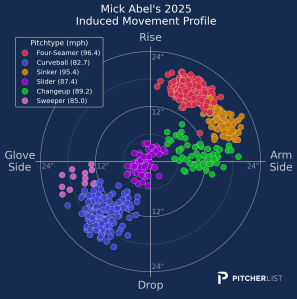
In that game, Abel showed the arsenal that made him a top-50 prospect in the sport. 73% of his 73 pitches (weird coincidence) were strikes, including a 45% CSW% on his fastball and 67% on his slider. He only threw the slider 12% of the time last season, but it’s his second-best offering in terms of PLV (5.01). The first, his sinker (5.21), only generated a 12% whiff rate while being his worst offering by xBA (.339). Abel’s last outing should give the Twins a clue on how to utilize the righty’s arsenal best, even if it means simplifying his six-pitch repertoire.
Abel is on the outside looking at the rotation as things stand. The Twins still have Pablo López and Joe Ryan atop their staff, and they’ll stay there until at least deadline season. After that, there are 11 options on the Twins’ 40-man to fill the final 3/4 spots. Among them are intriguing fantasy options like Bailey Ober and Zebby Matthews, as well as prospect arms to track like Connor Prielipp and David Festa.
The good news for Abel believers is that blockage means he’s a potential steal at his ADP. NFBC currently has him around pick 585. If Abel can utilize the momentum he started to gain at the end of last season to differentiate himself from the rest of the pack, he could factor into the latter half of the rotation in the first few months of the season.
Jordan Lawlar – OF, Arizona Diamondbacks
Those who haven’t been following the Diamondbacks diligently this offseason may be confused by the position label. No, it’s not a typo. Arizona’s GM Mike Hazen stated that Lawlar will get the “majority of his reps” in the outfield during Spring Training. With Corbin Carroll missing the start of the season due to a hamate injury and Blaze Alexander no longer on the roster, the door is wide open for Lawlar to claim an outfield spot.
Given that Lawlar was considered the “future shortstop” in the desert just two years ago, that’s quite the fall from grace. After spending three years as a top-25 prospect, he now finds himself in a fight for a roster spot with Tim Tawa (72 wRC+) and Ildemaro Vargas (0.8 fWAR since start of ’23). There’s no doubt that Lawlar is above Triple-A-level (18 HR, .328 AVG in 91 games), but that production tanks when he joins the big league club (.478 OPS in 42 games).
That drop-off has rightfully left fantasy managers worried that Lawlar will never be more than a “4A” player. So far, the on-field result has done little to quell those fears, but the tools that made Lawlar so intriguing are still present. Despite average bat speed (71.7 mph) and a compact frame, he’s able to generate elite exit velocities (113.3 max EV in Triple-A, 94th percentile). That power tool, mixed with the above-average knowledge of the plate (24% Chase) and ability to barrel the ball (10.3% Barrel, 43% Hard Hit) is a solid skill set to build on. While his whiff rate isn’t elite (27%), it’s still acceptable considering the wealth of other tools in his game.
The problem remains that all of those numbers crater once he gets to the big leagues. His barrel rate was half of his Triple-A mark, and his whiff rate jumped by 7% (although the chase rate stayed stagnant). Lawlar simply hasn’t been able to create the same damage as he’s proven to be able to in the minors. That said, Lawlar only has 42 big league games under his belt, and his two stints were over a year apart. There’s a chance that Lawlar’s struggles are simply down to a lack of exposure to big league competition.
Lawlar is currently projected to open the season on the major league roster and will spend the spring working with the big league club. Fantasy managers should be hoping that this exposure will allow him to get back to the 20/30 threat he was in the minors with the Diamondbacks. Considering his current draft spot is outside the top-400, he represents intriguing upside.
Bonus! Drew Gilbert – OF, San Francisco Giants
Gilbert introduced himself to the baseball world with a walk-off grand slam in the NCAA Tournament with Tennessee in 2021. Now, as a member of the Giants’ big league roster, he’s reunited with his former college coach, Tony Vitello, in the Bay. The Giants are already his third organization. Since being drafted in the first round by Houston in 2022, he’s been traded twice. First, by the Astros, when he was their #3 prospect, in return for Justin Verlander. After peaking as the #2 prospect (#55 in baseball) with the Mets, he was sent to San Francisco in return for Tyler Rogers. Even before that trade, he’d begun to slide down prospect rankings after an injury-affected 79 wRC+ season in 2024.
Going into 2026, he’s slated to be the fourth outfielder, providing a “competitive edge” to the roster. He could provide much more. Gilbert has above-average skills at the plate that started to come through in the majors, but were truly on display in Triple-A. He has more pop than one would expect from a 5’9″ frame, and possesses good bat-to-ball skills and plate knowledge.
He hasn’t been able to produce hard contact consistently enough to make an impact, though. His barrel rate (6.9%) and Hard Hit rate (37.7%) were average for Triple-A, and they cratered against big league pitching. However, like Lawlar, Gilbert only has 39 MLB games under his belt. In those games, he kept his strikeout rate in check (18.3%), even if his walk rate fell below his career marks (6.4%). If the walks regress to the mean, the strikeout rate stays in that range, and he can get his MLB metrics closer to his Triple-A marks, he could break out in a big way. On the other hand, that’s a lot of “ifs” for a player who is not a lock for consistent playing time.
At the time of writing, Gilbert is sitting in the ~720 ADP range. That late in the draft, taking a flyer on upside should be welcomed. In dynasty formats, the lack of clarity regarding the amount of at-bats he will get could make him an intriguing buy-low option to stash on the bench. Even if he doesn’t live up to the production he posted in the minors, Gilbert will be incredibly fun to watch in the playing time he does get.