
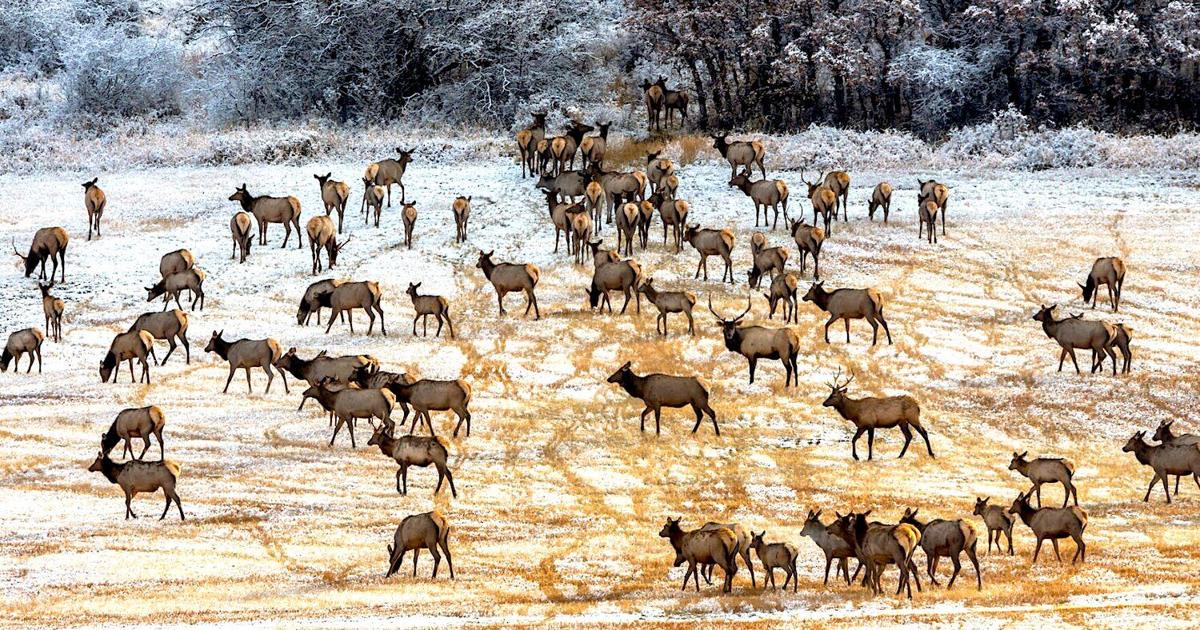

Elk congregate in a pasture along McLain Flats Road in late October 2023. Colorado Parks and Wildlife officials are focused on habitat preservation and conservation to support elk in the Roaring Fork Valley.
Aspen Daily News file
Ever seen a herd of elk hanging out somewhere that doesn’t look quite right? Maybe, the compost pile at the landfill? Or a golf course, surrounded by houses?
“Some of these types of places that don’t seem like natural settings — they’re not,” Colorado Parks and Wildlife’s Matt Yamashita told the Pitkin County Commissioners at a work session last week. “But [wildlife are] using it by default, … because they have to find a way to assimilate.”
The crux of the issue is habitat loss, Yamashita explained, speaking as an area wildlife manager for the state agency.
“A lot of [places] where the animals would like to be,” especially their winter range, “those are the developed portions of the valley.” And that impact can’t really be reversed. “They’re adapting to what we have left.”
Which is why Colorado Parks and Wildlife is putting its weight behind “habitat protection and conservation,” a “higher priority” for the agency than, say, wildlife crossings over busy roads.
“It’s not because of a lack of interest,” Yamashita said of the crossings, which have local advocates in the nonprofit Roaring Fork Safe Passages. “Any time there’s passage across a roadway that can save motorists from vehicle collisions, save animals from becoming a carcass on the side of the road, that’s a good thing.”
It’s just that this agency is more focused on habitat — the settings that give animals the elements of survival, like food, shelter and water. (There’s some “nuance” to the compost situation, though: It’s warm in a way that snow-covered dirt just isn’t, and the elk seem to “do well there,” Yamashita said.)
Yamashita pointed to the recent conservation of Three Meadows Ranch in Missouri Heights as a “phenomenal” example. It was a collaborative acquisition between Eagle County Open Space and Natural Resources, Pitkin County Open Space and Trails, and the Aspen Valley Land Trust for more than 4,250 acres, and conserved lands like that can help CPW manage herds. But such efforts don’t have to be this huge every time to make a difference.
“Thousands of acres are obviously better than tens of acres,” Yamashita said. “However, there are places where there are tens of acres or hundreds of acres that are super important” as well.
Land management actions like seasonal trail closures and wildfire mitigation (which can also help with wildlife habitat) are valuable tools for the agency as well.
In headcount alone, local elk aren’t doing too bad: CPW manages for a certain population range, and current stats for two local herds “are looking decent,” Yamashita said. But “almost more important” is the concept of “herd resiliency,” and specifically the number of young calves compared to the number of mature cows.
Those calf-cow ratios “are still below where we would be to sustain those herds,” Yamashita said. “We’ve got a lot of animals right here and right now, but for the future generations that are going to be living in this valley and enjoying that resource, we may reach a point of diminishing returns where we can’t recover those populations.”
This “herd resiliency” can be impacted by development, recreation pressures, predation and disease, some of which have to do with habitat and some of which can be managed. Speaking of recreation, Yamashita said, “As humans, we want to enjoy the outdoors. … The unfortunate part is that every time we do that, it does open a gate, and as an agency, it opens an avenue where we will see some degree of disturbance. We will see some degree of noncompliance [with trail rules].”
It isn’t a lost cause, though, as agencies work within those constraints and collaborate on solutions, he said.
“I’m proud that at least we’re paying attention to some of those things, and we’re going into it,” Yamashita said. “And even if there are some losses to recognize, there’s still hope.”