

Macias Gini & O’Connell’s articles from MGO CPA LLP are most popular:
with readers working within the Basic Industries, Business & Consumer Services and Construction & Engineering industries
MGO CPA LLP are most popular:
within Real Estate and Construction, Law Practice Management and Law Department Performance topic(s)
Key Takeaways:
The IRS has proposed rules eliminating the need to furnish Part
IV of Form 8308 to partners in most cases.
Partnerships must still complete full Form 8308 and file it
with Form 1065, but new relief simplifies what is sent to
partners.
These changes apply to Section 751 exchanges occurring in the
2025 tax year, and offer welcome certainty after two years of
temporary relief.
Partnerships dealing with Section 751(a) exchanges — those
involving so-called “hot assets” like unrealized
receivables or inventory items — have faced mounting reporting complexity over the past
several years. Form 8308, which must be furnished to
transferor and transferee partners in these exchanges, was
significantly expanded in late 2023. But in 2025, the IRS proposed
regulations offering targeted relief that streamlines these
reporting obligations.
Private companies operating through
partnerships should understand what has changed, what is still
needed, and how to remain compliant.
The Burden of Expanded Form 8308 Reporting
The revised Form 8308, released in October 2023, introduced new
Parts III and IV, significantly increasing the reporting burden for
partnerships involved in Section 751(a) exchanges. These exchanges
occur when a partner transfers their interest, and some of the
proceeds relate to unrealized receivables or inventory —
assets that trigger ordinary income treatment rather than capital
gain.
Under earlier rules, partnerships were expected to furnish the
full form — including detailed breakdowns of ordinary income,
collectible gains, and unrecaptured Section 1250 gain — by
January 31 following the year of the transfer. In many cases,
partnerships lacked the data needed to complete Part IV by that
deadline, especially when notice of the transaction came late or
data from transferor partners was incomplete.
Recognizing the compliance challenges, the IRS offered temporary
relief through Notice 2024-19 and Notice 2025-02. But that relief was short-term,
and uncertainty stayed.
What the Proposed Regulations Change
In August 2025, the IRS issued proposed regulations that address
the most problematic aspect of the expanded Form 8308: the deadline
for furnishing Part IV to transferors and transferees.
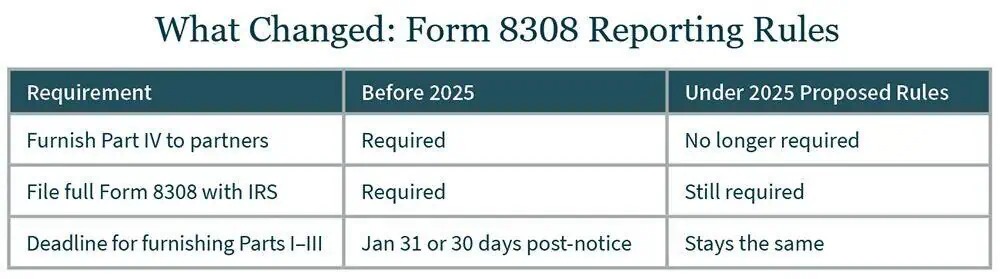
Under the proposal:
Partnerships no longer need to offer Part IV to partners by
January 31 (or within 30 days of receiving transaction
notice).
They still must give Parts I, II, and III to the transferor and
transferee within the standard timeline.
Part IV must still be completed and attached to the partnership
Form 1065 for the tax year that includes the exchange.
This distinction is important: the IRS still wants complete
information, but the burden of giving it directly to partners under
tight deadlines has been lifted — at least for now.
When the Changes Apply
The proposed rules apply to Section 751(a) exchanges occurring
on or after January 1, 2025, and are effective
immediately — even though final regulations have not yet been
issued. This gives partnerships more certainty as they close their
books for 2025.
The IRS also plans to revise the instructions to Form 8308 to
align with these rules.
What Hasn’t Changed
While the furnishing burden has been eased, other obligations
are still intact:
Partnerships must still decide if a Section 751(a) exchange
occurred.
The full Form 8308, including Part IV, must still be filed with
the IRS and attached to the partnership Form 1065.
Statements must still be furnished to both transferor and
transferee with accurate and timely information for Parts
I–III.
Penalties under Section 6722 may still apply if needed
information is incomplete, inaccurate, or delivered late.
For exchanges where the partnership receives delayed notice
— or where details of unrealized receivables or inventory are
not available — these clarifications offer some
administrative breathing room.
Practical Planning Considerations
As partnerships consider year-end tax filings and upcoming
transactions, several steps can help reduce risk and improve
compliance:
Evaluate your current 8308 process: Confirm whether you are
prepared to distinguish which parts must be furnished versus
filed.
Communicate early with transferor partners to gather any needed
information related to hot asset allocation.
Update your internal tracking of Section 751 exchanges —
especially those that occur late in the calendar year.
Coordinate with tax preparers to support accurate Form 1065
attachments for timely IRS filing.
For firms handling multiple transfers or with tiered partnership
structures, proactive tracking will be key to avoiding penalties
and back-end cleanup.
Your Path to Easier Year-End Reporting
MGO supports private companies navigating complex partnership
reporting obligations — including those related to Form 8308
and Section 751(a) exchanges. We help show which reporting applies,
streamline documentation, and provide guidance on both short-term
compliance and longer-term structure.
The content of this article is intended to provide a general
guide to the subject matter. Specialist advice should be sought
about your specific circumstances.