
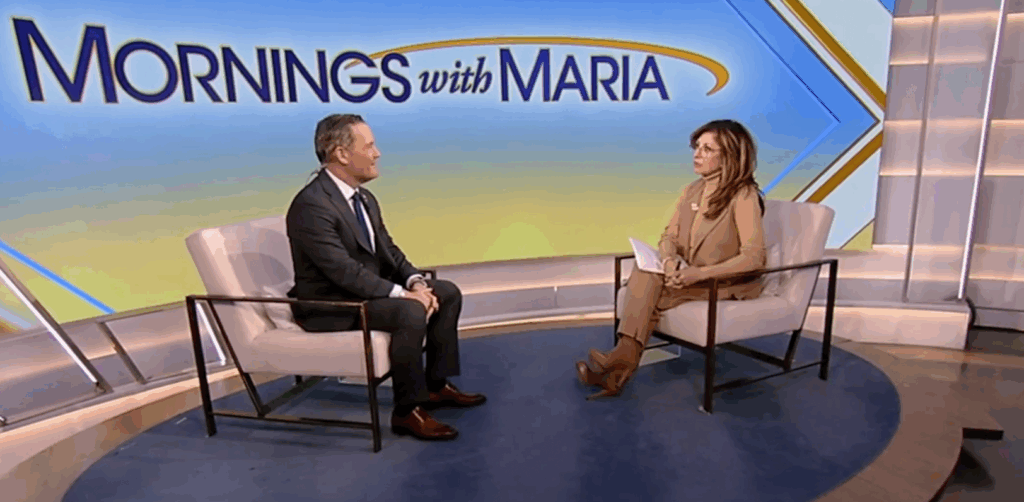
Ambassador Mike Waltz
U.S. Representative
New York, New York
AS DELIVERED
MARIA BARTIROMO: Joining me now is the U.S. Ambassador to the United Nations, Michael Waltz. Ambassador, great to have you.
AMBASSADOR MIKE WALTZ: Good to be with you. Thanks so much.
BARTIROMO: Thank you so much for being here. We so appreciate it. So, what should we expect from these talks? And I’ve got to say, it is just incredibly ironic that the UN would name Iran a vice chair of a group which is supposed to be in charge of women’s rights.
AMBASSADOR WALTZ: Yeah, exactly, Maria. And this is why we have to clean house at the UN. We are putting in a reform agenda. President Trump’s direction – 3000, by the way, UN Headquarters’ bureaucrats are now being cut, first budget cut in history. And some of these committees are just unreformable. It’s why we’re not participating. It’s why we walked away from, for example, the Human Rights Council, where we’re seeing a lot of this ridiculousness.
BARTIROMO: Who makes these rules? There is outrage. Iran elected as the vice chair of the UN Commission for Social Development. This is supposed to be a body promoting women’s rights. We know how women are treated in Iran.
AMBASSADOR WALTZ: Exactly, and that’s why, with some of these, we’re not participating. We’re walking away, and we’re going to let that one die on the vine. However, where President Trump does see potential. And back to the negotiations. What has set the table, despite the fact that everyone is focused on the military pieces of this is President Trump’s maximum pressure campaign that we went back to last year that has their currency tanking, their foreign reserves tanking. It was actually merchants out in the Iranian economy that kicked off this latest round of protests. The UN stepped forward with snap back sanctions so that we get the entire world involved in terms of closing off and isolating the Iranian economy. Because the thing the regime cares about the most is its money. The IRGC controls about half of the Iranian economy, and that’s what allows it to keep such a tight control over the Iranian people. So, we can’t throw the baby out with the bath water, but we are cleaning house at these UN institutions.
BARTIROMO: Some people wonder, why are we even negotiating with people who have killed 40,000 people in the last month. So, we just want to understand President Trump’s thinking on all of this in terms of Iran and what happens. What kind of a deal is possible?
AMBASSADOR WALTZ: Look, he’s a peace president. He will always put diplomacy first and give it a chance, but it is backed by the very real stick of the United States military that we demonstrated to the world through Operation Midnight Hammer can be incredibly effective. So, Iran has to give up its enrichment capability. It has to give up its already enriched, highly enriched uranium. There’s no reason except for a weapon that it’s enriched to that degree, also its support for terrorism, and its long-range ballistic missiles, all of those things we’ve been very clear are on the table. We’ll see. They should listen. The President means what he says when he means he’s going to take decisive action.
BARTIROMO: I know that. Now, the President also announced a $5 billion pledge for aid for Gaza. Members of the Board of Peace, the group of nearly 20 countries will meet again in Washington on Thursday. Tell us what to expect there. The President wrote this on Truth Social: this will go “toward the Gaza Humanitarian and Reconstruction efforts. We’ve committed thousands of personnel to the International Stabilization Force and Local Police to maintain security and peace for Gazans, Hamas must uphold its commitment to Full and Immediate Demilitarization.” Your thoughts?
AMBASSADOR WALTZ: Well, you’re hearing and seeing – I certainly did out in Munich – a lot of hand wringing from the Europeans that the President’s creating this alternative to the UN. I reminded them all that actually it was the UN Security Council that unanimously voted in the Board of Peace, 13 to zero. And I was proud to help shepherd that effort through. Look, the President is not focused on process or 80 year old institutions. He’s focused on results. And what is the Board of Peace and his 20 Point Peace Plan already gotten done. The ceasefire is still in place, shaky, but still in place. The hostages are out. The aid is flowing. We now have a technocratic committee of Palestinians to restore government services. We have a fund that international donors are contributing to, that $5 billion, and we have a stabilization force of international troops, 8000 pledged so far, and more will be coming this week. So again, back to the kind of good parts of the UN, these countries need that stamp of international law in order to contribute their troops in their own domestic constituencies. So, we’re getting it back to basics, back to focused on peace and security, and stop trying to be everything to everybody with these ridiculous committees.
BARTIROMO: Well, it’s a good point, and maybe the powers that be at the UN need to understand, if we’re going to see countries like Iran in charge of, you know, protecting women’s rights, maybe the Board of Peace should replace the UN, by the way. I mean, if these are the kinds of decisions that that the UN continues to make.
AMBASSADOR WALTZ: Look at the effectiveness that we’re seeing and the action and the results that we’re seeing, versus decades of meaningless resolutions and strongly worded letters that we saw from the Security Council.
BARTIROMO: Tell us more about Munich and the Security Conference this past weekend, we’ve been talking about how AOC and Michigan governor, in many cases, embarrassed themselves. They were asked simple questions about foreign policy, and they could not deliver. I mean, I know it was a lot about security and Marco Rubio’s speech in terms of tough love for Europe. What else struck you?
AMBASSADOR WALTZ: Well, you know, look, it’s this balance. Tough Love is exactly the right word. There was really a lot of angst and a lot of hand wringing there in the European audience. I did a panel as well, and said, look, guys, relax. We’re not getting a divorce. We can be friends and allies and have tough conversations. They need to be had. And you can’t tell me, for example, that NATO isn’t better off now than it was 10 years ago when President Trump took office and barely seven of the 30 were living up to their bare minimum commitments. Now you have all of them, and now they’re going from 2% to 5% thanks to his leadership. Look, we’re going to do the same types of reforms at the UN. We’re going to MUNGA – make the UN great again – just like he’s done for NATO. But these multilateral institutions have to get focused, and they have to get results oriented. And the other piece was the Europeans need to own up to the fact that mass migration over regulation and lack of defense spending have left them in an awful place. And what I think Secretary Rubio did so effectively, was say, we’re approaching this from a place of caring and a place of partnership, you got to clean up your act so that we truly can share the burden that’s a two way street as we tackle the world’s problems.
BARTIROMO: Yeah, well, the Secretary’s speech –
AMBASSADOR WALTZ: Fantastic.
BARTIROMO: Wide praise, for sure. He led the delegation, obviously, but the congressional Democrats who showed up really struggled with answers, and one of the answers that AOC struggled with was having to do with China. So, what do you want to say about China? I mean, she was asked about Taiwan. Let’s watch this exchange and get your reaction.
QUESTION: Would and should the U.S. actually commit U.S. troops to defend Taiwan if China were to move?
ALEXANDRIA OCASIO-CORTEZ: This is, of course, a very long standing policy of the United States. And I think what we are hoping for is that we want to make sure that we never get to that point, and we want to make sure that we are moving in all of our economic, research, and our global positions to avoid any such confrontation and for that question to even arise.
BARTIROMO: I mean, she doesn’t want the question to arise. The question is here. I mean, the question has been here. We know that China wants to unify, reunify with Taiwan.
AMBASSADOR WALTZ: Yeah. Chairman Xi has said he’s going to do it on his watch, and he’s in his early 70s, so do the math. Look, she, after stumbling and bubbling painfully on the world stage, got to what our current policy is, which is strategic ambiguity. And I firmly believe that President of the United States, Commander in Chief should have that flexibility. But there was all kinds of things to talk about, in terms of supply chain reshoring, critical minerals, all of the things that we’re doing to make sure our economy is resilient and that we can defend ourselves. Just blew it.
BARTIROMO: What’s going on with Anthropic? I mean, and the Pentagon’s new new stance there. The Chinese Communist Party has been working to rebuild its nuclear arsenal. We know that The New York Times reporting that deep in China’s mountains, a nuclear revival takes shape, adding satellite imagery of secretive nuclear facilities reveals Beijing’s efforts to expand its arsenal, just as the last global guardrails on nuclear weapons vanish. Talk to us about this, because we talk about China every day, Ambassador, and I think this is a region of the world where American business people are very interested in understanding a clear policy here.
AMBASSADOR WALTZ: Yeah, so two things there. One, there was the New START, basically the Nuclear Non-Proliferation Treaty, both on Russia and the United States. The President has allowed that to lapse because, one, Russia wasn’t abiding by it, so we were self-regulating ourselves in terms of our nuclear arsenal. Meanwhile, China, which isn’t a party to it at all, is tripling theirs across the board. So that needs to be renegotiated, and needs to be a three way, if not a full multilateral treaty that takes care of everyone. That’s incredibly important. And then to your other piece, kind of back to my foxhole in the UN – feels like a foxhole some days – that Chinese are pushing into these institutions in a big, big way. Here’s why that matters. There’s, for example, the World Intellectual Property Organization. We need to make sure our IP is protected as our entrepreneurs and our venture capital and others innovate. If we just walk away from all of these UN institutions, then China is going to be there with the rest of the world without us. There’s the International Telecommunications Union. Never heard of it, but it does global standards on space, on telecom, on 6G, on radio, and all of these things that are critical to our businesses, our industries, and our ability to compete around the world. My argument is we have to get in there and reform and fight and particularly where the People’s Republic of China is incredibly active for their industries, rather than just walk away.
BARTIROMO: Yeah, and that’s why I began the question with Anthropic. Do you think a corporate America gets it that these are all national security issues? You just mentioned a handful of them, like intellectual property theft that has been going on for decades. Does business understand this? I know they understand it better with President Trump spelling it out to them. But do you think they’re on board now?
AMBASSADOR WALTZ: I think it’s still a mixed picture, Maria. You know, some absolutely do. We’ve seen like, you know, the Andurils and the Saronics and others, these new defense tech startups that are there to defend our great nation and to innovate and to work with the Pentagon in a better way. And then you see others that are just, I think, focused on the bottom line, regardless of its impact on national security.
BARTIROMO: And it’s important because our adversary, China, while those companies are going to listen. That’s real top down. We know that.
AMBASSADOR WALTZ: That’s for sure.
BARTIROMO: Ambassador, it’s a pleasure to see you again. Thanks very much for coming into studio.
AMBASSADOR WALTZ: Thanks.