
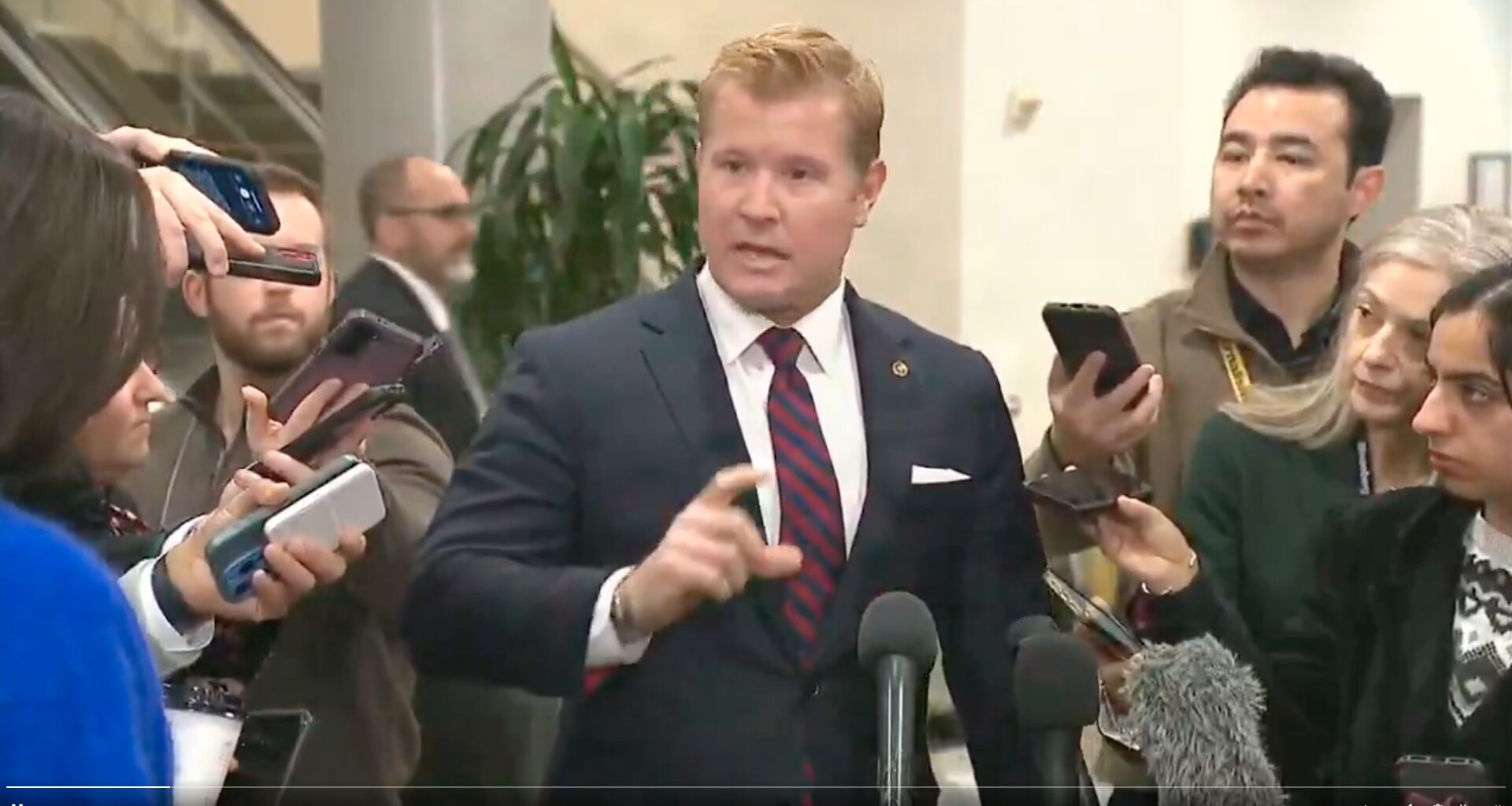
Montana’s junior U.S. Senator, Tim Sheehy, wants to expand federal law to allow victims of crimes to sue judges if they are harmed by someone accused or previously convicted of a violent crime while awaiting trail.
Sheehy introduced the Judicial Accountability for Irresponsible Leniency, or JAIL Act in November. Since then, U.S. Sen. Marsha Blackburn, a Republican from Tennessee, is the only other Senate member to cosponsor the legislation. Currently, the bill is waiting for a hearing in the Senate Judiciary Committee.
However, the bill adds to a growing number of ideas, both on the state and federal level, that GOP lawmakers have to reshape the judiciary.
Sheehy, a Republican, said the bill would push back against “radical judges in far-left jurisdictions (who) prioritize soft sentencing for criminals over common-sense and public safety,” according to a press release from his office.
The JAIL Act, would essentially allow a crime victim (or one of their family members if that person is dead) to sue the judge or the institutions that release “violent people.” The short, page-and-a-half bill would include anyone who was charged with a crime of violence or previously convicted crime of violence, while on bail. Sheehy, in materials released by his office about the bill, said his basis for the bill was the murder of a North Carolina resident who was killed by a man who had been released on bail numerous times and had a lengthy criminal record.
“In an eight-year study, the United States Sentencing Commission explains that nearly two-thirds of violent offenders released in 2010 were rearrested and (sic) the same rate for violent offenders released in 2005,” Sheehy’s office said, citing to the 2022 report.
“Thanks to soft-on-crime policies, judges have neglected justice served to the fullest extent of the law, putting public safety at risk, and instead prioritizing criminals over law-abiding Americans,” said Sheehy in a description of the legislation.
Also, it would prohibit a longstanding principle of judicial immunity from being used as a defense for a judge. The section would not only apply to federal judges, but also state judges.
A constitutional law professor at the University of Montana, though, said from a legal perspective, the proposed bill has several serious hurdles. One of those is judicial immunity. Another factor is the principle of federalism, which generally allows state courts to operate independently of federal oversight. Sheehy’s proposed legislation also raises issues with the principle of bail, a right that citizens have in most cases to post a bond in order to avoid being detained in jail during the legal process.
“This legislation is very unlikely for a number of reasons,” said Constance Van Kley, an assistant professor at the University of Montana’s Alexander Blewett III School of Law.
Foremost, the law would seem to run afoul of the bedrock judicial principle of federalism, which holds that unless the Constitution has outlined certain powers to the federal government, and the rest are retained by the states. In this case, federal courts are often “courts of limited jurisdiction,” meaning that they settle only certain types of disputes. In many settings, crime is prosecuted at the state level. Sheehy’s JAIL Act potentially forces rules on state courts and judges.
“Telling states how to operate is a classic violation of federalism,” Van Kley said.
She said case law generating from Montana has helped shape this principle, including a case from Ravalli County, which challenged a portion of the “Brady Bill” that required state officers to conduct background checks. Jay Printz, the Sheriff and Coroner of Ravalli County challenged Congress’ mandates that chief legal officers in every jurisdiction comply with federal background gun checks.
In the 1997 decision, then-Justice Antonin Scalia wrote for the majority of a split United States Supreme Court that Congress couldn’t offload its power to chief law enforcement officers around the country. Scalia’s decision delved deeply into the Constitution’s history showing that states have frequently resisted duties that Congress tried to push to them.
“Not only do the enactments of the early Congresses, as far as we are aware, contain no evidence of an assumption that the federal government may command the states’ executive power in the absence of a particularized constitutional authorization, they contain some indication of precisely the opposite assumption,” Scalia wrote, agreeing the federal government could not force state law enforcement officers to conduct a federal background check.
Using the same principle, Van Kley said it’s easy to see that Congress cannot tell state legislators and state courts how to do their job.
Judicial immunity and sovereignty
Even though Sheehy’s bill, if passed, would not allow judges to claim judicial immunity, Van Kley points out it’s not just a matter of putting that into a bill. Instead, judicial immunity has its origins in the U.S. Constitution.
Judicial immunity is a legal concept that protects judges from being sued by people who feel harmed by the judge’s actions, whether in civil or criminal court. The principle says that so long as judges are doing a faithful job, even if they make a mistake, they cannot be sued under normal circumstances.
The Eleventh Amendment to the U.S. Constitution, passed in 1795, clarifies the role of the federal court system, especially as it relates to disputes between people of different states. It reinforces the idea of state court sovereignty.
Also, because of the long-held principle that federal government must respect the autonomy of state courts, Van Kley said she suspects Sheehy’s JAIL Act would run into more constitutional trouble.
“Congress can’t just do away with sovereign immunity,” she said.
The proposed bill also misunderstands the nature of judges, Van Kley said. When a judge — either at a state or federal level — holds court, that judge isn’t doing so as an individual, rather as an extension, a sort of representative, for the state.
A defendant’s rights
In criminal law, Van Kley said there is an extensive list of rights those accused of a crime possess — and there’s a reason for that. She said that people who are accused of crimes can be imprisoned and that means a loss of many rights.
That’s why there are multiple protections for those accused of a crime, including the presumption of innocence, a right to an attorney, and bail. Both the federal government and the states recognize a right to bail so as not to be held without freedoms in prison without due process.
“A judge has to make a determination about bail, and most states prohibit setting excessive bail,” Van Kley said.
That also means that judges who set reasonable bail may just be following the law. However, Sheehy’s proposed legislation would make an impossible or illegal decision between following the law which calls for bail, or opening themselves up to personal liability.
“If judges can be held liable for getting it wrong, it will have a considerable effect on people caught up in the system,” Van Kley said.
Some of those effects could be a huge increase in the number of people being incarcerated, fewer people wanting to become judges, and problems with “speedy trials” being held in courts which often have considerable congestion and backlogs.
“If a law like this passes — even if you believe it is unconstitutional — you’d still expect it to have an effect on judicial behavior,” Van Kley said.
Other remedies
Van Kley said that running to sue a judge may not be the best way of solving problems with the criminal justice system. For example, many states, including Montana, have established victim’s advocates and some have a victim’s fund. Moreover, getting justice for victims is already a challenging process, with trials and the court process playing out for years.
Other states have adopted different combinations of “Victim’s Bill of Rights” which include notification and restitution.
“There are already congested court dockets,” Van Kley said. “If you sue a judge, someone will likely have to wait a long time.”