
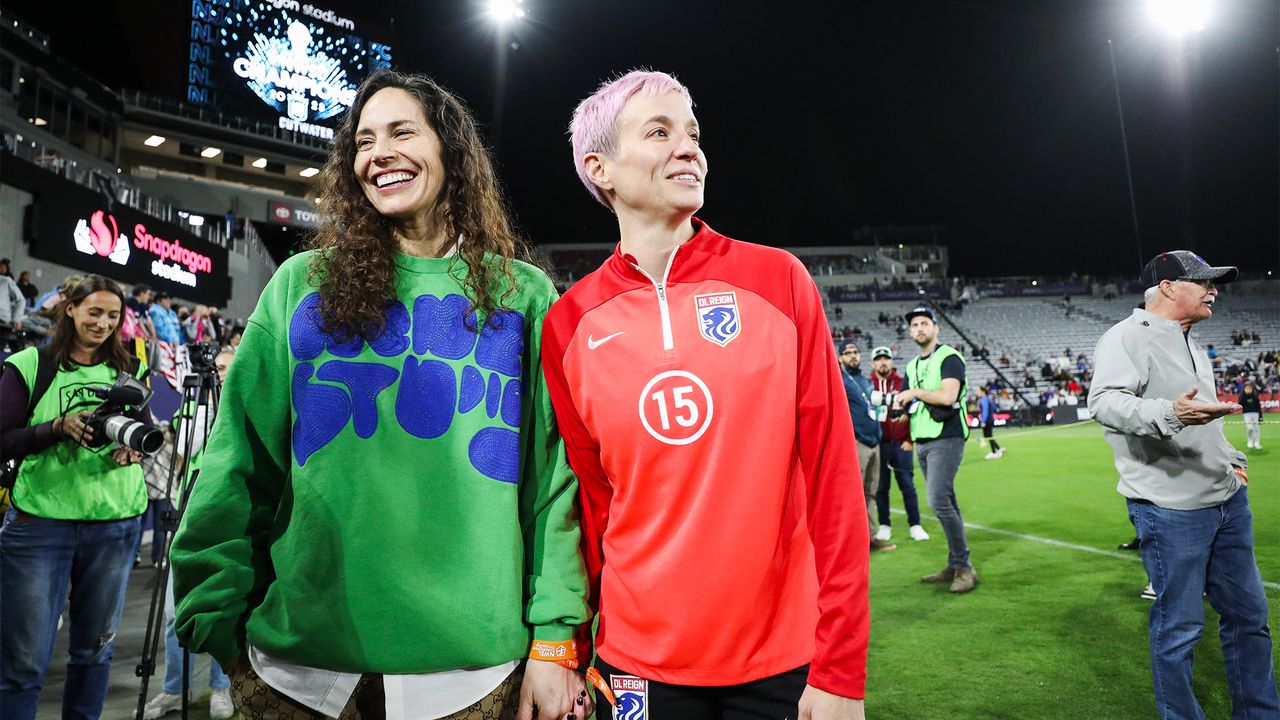
I was at your event in Brooklyn and Jason Sudeikis was there. I’ve seen his support as a particular boon for the league and everyone was taking pictures with him. How has the support from male celebrities looked for you internally?
Bird: If I’m being honest, that is not new. First of all, let me give credit, Jason is a very passionate New York Liberty fan. He goes to the games when he’s in LA as well, because he’s kind of bicoastal. Jason is definitely ride or die. But honestly, for me personally, men have been a fan of women’s basketball, have been a fan of myself for forever. Who stops me on the street more than anybody else?
Rapinoe: It’s the wildest, in-the-wild thing I’ve ever seen. Crossing the street or walking in any city in the whole country and it’s like, “Hi Sue!” Adorable.
Bird: So it’s really not that surprising. I think that’s what’s so interesting about this time. There are certainly some things about what’s happening in the world of women’s sports that are new, don’t get me wrong. But then there’s some things that are getting highlighted and it’s like, you just weren’t looking at it before.
I guess the question then becomes, why did it take so long to have these conversations?
Bird: How much time do you have?
Rapinoe: Um…I think it’s sexism. Broadly.
Bird: It’s the isms. The ways in which it’s just been held back. It has always been this way. I was in college, it was my junior year, I hit a game-winning shot. The year is 2000 and there’s no social media. You’re only going to see this so many ways, but it was on the ESPN top 10. Immediately the next day, and then following week, I was getting all kinds of calls from celebrities to the basketball office. I wouldn’t drop names, I don’t want to be that person, but it was, like, NBA players were calling to congratulate me, like, “Oh, let’s exchange information.” Actors were calling. Like, “I’m a big fan.”
It’s always been there. That’s how suppressed and held back this sport, and women’s sports in general, has been. The same goes for soccer. Tons of people have been going to your games for years and years and years. There’s a variety of things that finally ripped the blinders off people to women’s sports, and now they’re seeing all of it when it was already there.
Rapinoe: I also think the mechanism for information delivery changed dramatically. So, prior, if you weren’t watching ESPN and it didn’t make the top 10, or the producer didn’t choose to talk about women’s sports, women’s sports weren’t talked about. Your Final Fours were sold out, the community’s been there. But from a broad cultural perspective, it wasn’t spoken about. It was suppressed, it was held back. Women’s sports social media just really blew the top off of who was getting access to what was actually happening. Before Caitlin Clark, before some of these bigger things—those moments were already happening.