
Sign up for the Slatest to get the most insightful analysis, criticism, and advice out there, delivered to your inbox daily.
Two American politicians drew top billing at this past weekend’s Munich Security Conference, where U.S. and European political leaders gather each year to mull the state of the trans-Atlantic alliance—a topic that is now teeming with suspense and peril.
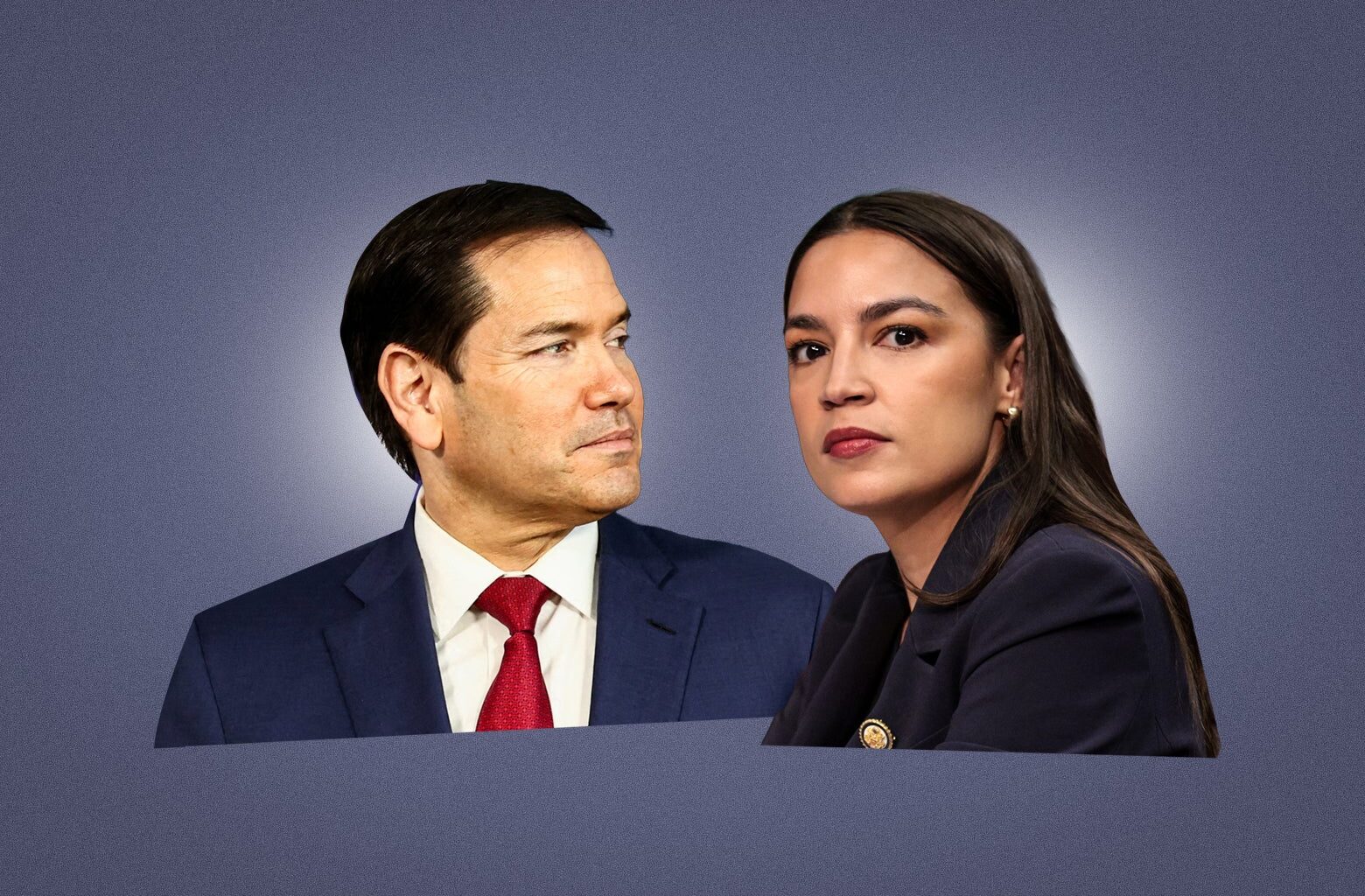
The headliners were Secretary of State Marco Rubio and Democratic Rep. Alexandria Ocasio-Cortez. The Europeans hoped Rubio would mollify their concerns about President Donald Trump’s commitment to the continent’s defense—or at least erase the memory of last year’s main speaker, J.D. Vance, whose unabashed hostility toward the Western alliance and firm embrace of Germany’s neo-Nazi party set off the crisis between the two continents today.
In this context, they viewed AOC as a possible harbinger of the U.S. leadership’s next generation and wondered—some with excitement, some with dread, almost everyone with curiosity, because she had never appeared at the conference before—just what her ascension might bode.
As it turned out, Rubio proved disappointing, while AOC was too vague to leave behind an outline of the alliance’s future or her chances of rising to its helm—though she expressed reassuring sentiments with (for the most part) encouraging eloquence.
Rubio received a standing ovation at the end of his keynote address on Saturday, mainly because he spoke softly and uttered a few welcome lines that the likes of Vance or, worse still, Secretary of Defense Pete Hegseth (who did not attend the conference) would never utter—for instance, “the United States and Europe … belong together,” “We are part of one civilization,” and “Our destiny is, and will always be, intertwined with yours.”
These lines inspired his interlocutor, at the start of a Q&A period, to note “the collective sigh of relief throughout this hall” during the secretary’s “message of reassurance and partnership.”
But those listening with more jaded ears, and nearly everyone who read the transcript afterward, saw it as what might be called Vance-and-Hegseth lite—warm and friendly in tone but pure MAGA in substance, or as Politico paraphrased his message: “Join Donald Trump’s campaign to reshape the world for Washington’s benefit, or get out of the way.”
The traditions that Rubio invoked, in recalling the alliance’s past, were those of nationalism (a subtle rebuke to the European Union, an open rejection of free trade, and a dismissal of international law), Western civilization as Christian civilization (ignoring not just Judeo-Christian heritage but the roughly 25 million Muslims who live in Europe), and the “unapologetic” mission “to build a vast empire out across the globe.”
His call for alliance unity was an invitation for “you” (Europeans) to “join us” (Trump’s America) on our path. His speech—at the world’s most preeminent security conference—did not mention Russia, NATO, or China, but instead listed as the West’s biggest dangers “fear of climate change, fear of war, fear of technology,” and the “mass migration that threatens the cohesion of our societies, the continuity of our culture, and the future of our people.” To renew our alliance, he said, means to “restore a place in the world” that will “rebuke and deter the forces of civilizational erasure that today menace both America and Europe alike.”
We’ve heard this phrase “civilizational erasure” before, from Trump himself. It translates, pretty explicitly, to Make America (and now Europe as well) White Again.
After his appearance in Munich, as if to confirm this impression, and to splash water on those who tried to interpret the speech as a beacon of hope, Rubio flew to Budapest, where he publicly embraced Hungarian Prime Minister Viktor Orbán and told him, “I say to you with confidence that President Trump is deeply committed to your success because your success is our success, because this relationship we have here in central Europe through you is so essential and vital for our national interests in the years to come.”
Rubio’s wish for Orbán’s “success” should be viewed in two contexts. First, the prime minister is facing a tough election; Rubio’s words amounted to an open endorsement by Trump. Second, Orbán is universally seen as the EU’s outlier—the Union’s most outspoken critic of democracy, supporter of Russian President Vladimir Putin, and opponent of military aid to Ukraine. In wishing for Orbán’s success, Rubio was thumbing his nose at the entire spectacle—the very purpose—of the Munich Security Conference. Basically, he was repeating, through his actions, Vance’s aggressively hostile speech last year.
If Rubio had gone to Munich after Hungary, the gist of his speech would have been grasped without illusion. Even before the speech, he gave what should have been seen as a hint of his real intentions by brushing off a meeting, which he’d been scheduled to attend, on the security of Ukraine.
Usually several members of Congress attend the Munich conference, though this time House Speaker Mike Johnson barred the funding of their flights, in anticipation of the impasse that froze the Department of Homeland Security’s budget. Still, a few made their own way, notably Sen. Lindsey Graham—who, at one session, said, “Who gives a shit who owns Greenland? I don’t.” (Too bad he couldn’t have summoned the courage to say that a month ago, when Trump threatened war over the question). A few politicians who are assumed to have presidential aspirations also managed to attend: Michigan Gov. Gretchen Whitmer (who stressed the vital relations between her state and Canada), California Gov. Gavin Newsom (who proclaimed that his state still observed tight laws on greenhouse gases), and the aforementioned AOC.
AOC was the big curiosity, and the two panels where she spoke—one on populism, the other on U.S. foreign policy—were hot tickets. She had never been to the conference before. She was there to lay out a vision of an alternative, progressive foreign policy—and therein lay the mystery: What is a progressive foreign policy in the era of Trump?
A decade ago, progressives would have been, and still would be, anti-war, but would they now support NATO and the armament of Ukraine, if just to distinguish themselves from MAGA isolationists? And how would a progressive fit the U.S. into Canadian Prime Minister Mark Carney’s assertion of “middle” nations’ power in his speech earlier this month at the Davos conference?
Before this weekend, I had never heard AOC speak at length, without a script, on foreign policy (or many other topics), and, following the panels streamed on YouTube, I found her for the most part impressive. She argued that income inequality fueled the resentment that triggered the rise of right-wing populism. She noted (as did Carney, though less pointedly) that the “rules-based order” has always excluded the poor from its benefits and the powerful from its obligations, and mused that, contrary to those who say we’re in a “post-rules-based order,” we might be in a “pre-rules-based order.” The real question, in any case, was “rules for whom.” She advocated a “working-class-centered” policy, in part for its own sake, in part to “stave off authoritarianism.” She supported firm commitment to allies, especially those that share our values on human rights and democracy, and adherence to treaties, regardless of whether Democrats or Republicans had signed them.
She didn’t quite explain what a “working-class” foreign policy might entail. (President Joe Biden talked about “a foreign policy for the middle class,” tying the idea to an industrial policy that let the U.S. compete with China in high tech; it’s unclear whether AOC would go there.) Nor did she address how a commitment to alliances would affect the balance between social spending and defense spending. In that realm, she (already famously) fumbled a question on whether she’d defend Taiwan from an attack (though, in fairness, the “strategic ambiguity” of U.S. policy on that question is confusing even to seasoned experts—she just hadn’t been briefed on the proper clichés to utter).
She still needs some seasoning in this sphere, but this was her first exposure, and she’s just 36 years old. She could acquire another 30 years of seasoning and still emerge younger than Trump was the first time he ran for president.

Fred Kaplan
Pete Hegseth Has Outdone Himself
Read More
But just as Rubio revealed his true colors on his first stop after Munich, AOC made what could turn out to be her most enduring impression after the conference as well. Rubio stood alongside Europe’s most authoritarian leader, in Budapest. AOC met and spoke with some of its most prominent left-liberal leaders, in Berlin.
She spoke first to leaders of Germany’s Social Democratic Party/SPD and then to its Left Party/Die Linke—both full-house events, mainly about leftish issues, which they had rarely heard about from an American politician, especially one as prominent as AOC.
But apart from the issues, AOC stressed the importance of sticking together. Whatever they might try to accomplish, she said at the first event, the approach “has to be coalitional.”
We have to grow our ranks … because if we go separately, we will lose it all. … Everyone has something to give here, and that’s why I’m proud to meet with Die Linke tomorrow and to be here with SPD today, because we cannot let the right win.
This Content is Available for Slate Plus members only
AOC Just Debuted on a New International Stage. How Did She Do?
This was a stern message to the two groups of German politicians, who have sharp divisions, despite knowing very well that, a century ago, similar divisions between social democrats and socialists abetted the rise of Hitler. Today, SPD and Die Linke together hold 19 and 10 percent of the seats in Germany’s parliament, respectively. The far-right-wing party, the AfD, holds 24 percent. (The centrist Christian Democratic Union holds 33 percent, and the Green Party holds 13 percent.) Together, the two left-leaning parties outflank AfD; apart, they can get crushed.
AOC is pursuing the same theme back in Washington. Back in 2018, when she was first elected as a Bernie Sanders–type democratic socialist, she formed a huddle with a few like-minded House members who called themselves the Squad. Now she is a power- and coalition-builder, even helping to raise money for centrist Democrats—who ask her for help, knowing that they need her constituents to push them over the edge, just as AOC knows she needs the moderates to push her agenda.
The U.S. probably hasn’t shifted quite left enough to elect AOC president in 2028. (It’s questionable whether she could even win upstate New York in a race for the Senate.) But domestic alliances are shifting, just as global alliances are shifting. In weighing the contestants for America’s top leadership positions, it’s worth noting that Trump, Rubio, and Vance endorse Orbán and the AdF—while AOC tries to unify the SPD and Die Linke.
Which of these sides should America be on?

Sign up for Slate’s evening newsletter.