
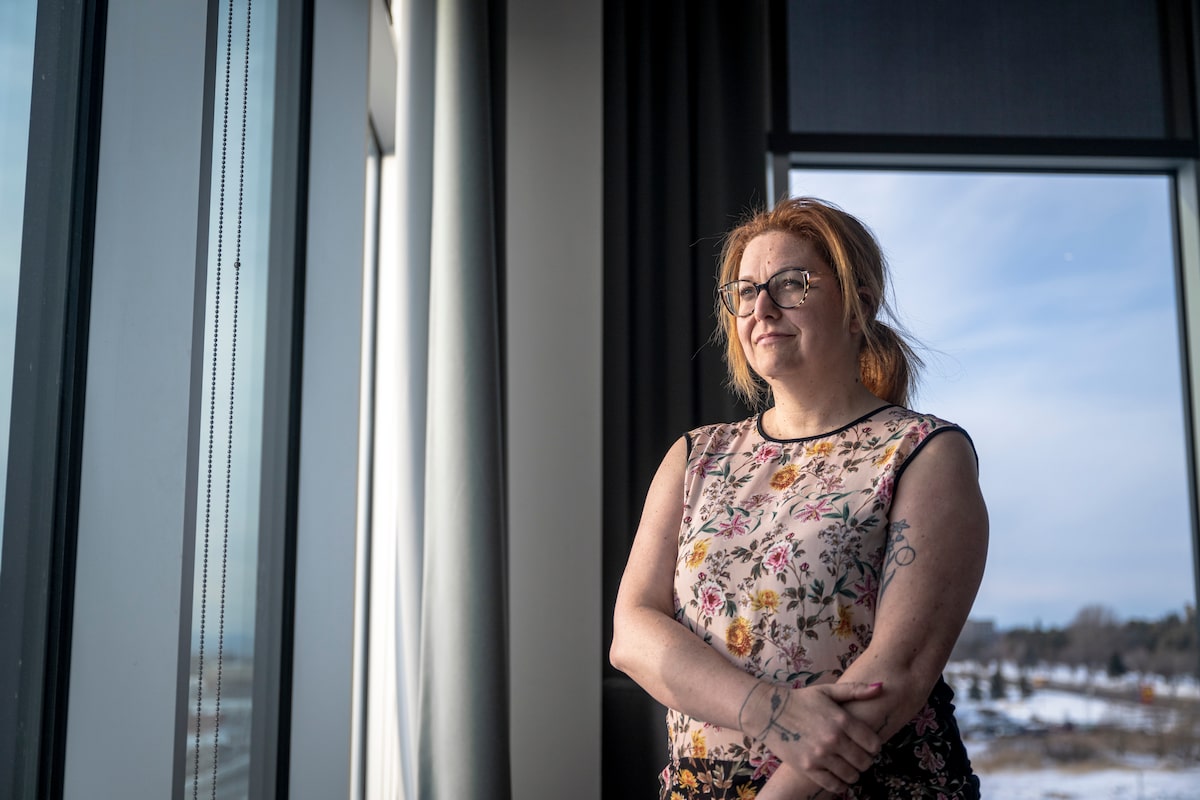
Sandra Demontigny in a common area in her building in Levis, Que., on Monday. Ms. Demontigny was diagnosed with early onset Alzheimer’s at the age of 39 and her advance request for MAID has been approved.Andrej Ivanov/The Globe and Mail
Sandra Demontigny, a 46-year-old mother of three from Lévis, Que., was diagnosed with Alzheimer’s disease eight years ago. Her father had also had Alzheimer’s, his mind slipping until his eventual death. Not wanting to suffer a similar fate, Ms. Demontigny made that wish known by signing a form, one only available to residents in her province.
A little over a year ago, Ms. Demontigny learned she was approved for a medically assisted death that could be carried out months or years in the future. Her advance request for medical assistance in dying (MAID) details how she wants her life to end when Alzheimer’s takes away her independence – and when she’s unable to verbally relay her wishes.
“I really don’t want to live like that,” she said, knowing the nature of her disease means her health will continue to deteriorate. “I cannot put my children through that.”
Ms. Demontigny is among more than 2,100 individuals in Quebec who have been approved for an advance request since the province began granting them in October, 2024. This means they will be allowed to access MAID months or years from now, to be carried out when they no longer have the capacity to consent. It is unclear how many advance request procedures have been administered.
Ontario woman calls for reform after her son ‘shopped’ for MAID approval in B.C.
Canada is considered to have some of the most permissive MAID laws globally, prompting fierce debate over who should qualify for a physician-assisted death. As the law stands, patients qualify if their deaths are reasonably foreseeable or they have an incurable condition.
In recent months, a number of cases have landed in court and sparked calls for reform, including from an Ontario mother of a 26-year-old who struggled with mental illness and was approved to die by MAID in B.C. Ottawa has delayed until 2027 a decision on whether people whose sole condition is mental illness can qualify for the procedure.
The reach of MAID in Quebec goes further than anywhere else in the country: It is the only jurisdiction where residents diagnosed with a serious, incurable illness that leads to incapacity, such as Alzheimer’s, can apply for advance MAID requests. Internationally, advance requests can also be made in Spain and Colombia. In the Netherlands, patients can write advance directives to spell out their wishes should they lose the ability to consent to MAID.
Ms. Demontigny with her cat Madame Litchi. Although her condition has recently started declining, she is still very capable and has not yet set a date for MAID.Andrej Ivanov/The Globe and Mail
Proponents argue Quebec’s approach offers valuable insights on how it could be expanded elsewhere, especially as the population ages and more people are diagnosed with dementia. Critics argue it is problematic because patients can’t offer consent just before the procedure occurs.
Last March, the United Nations Committee on the Rights of Persons with Disabilities recommended that Ottawa not support advance requests and that it should repeal MAID for anyone without a terminal illness. The committee’s main reason, as stated in a report, is that “inequality and discrimination cause and compound ‘suffering’ for persons with disabilities,” and that inadequate social supports can lead them to disproportionately seek advance requests for MAID.
Charter challenge over religious exemptions to MAID goes before B.C.’s Supreme Court
The federal government did not challenge Quebec over Bill 11, which was passed in its legislature in June, 2023, but it has also not amended the part of the Criminal Code that requires patients to have capacity to consent immediately before MAID is provided. The only exception to this rule concerns individuals close to death who have been assessed as being eligible and have a date in place to receive MAID.
Several groups, including the Alzheimer’s Society of Canada, have argued that those living with dementia should have access to advance requests.
Meanwhile, Pamela Wallin, an independent senator, has a bill before the Senate advocating for changes to the Criminal Code. She previously told the Senate that witnessing a decline in her mother, a former schoolteacher who had Alzheimer’s disease, was like watching a “slow decent into hell.”
“If you don’t know who your family is, if you don’t know who you are, then that sense of self is gone,” she said in an interview. “People are simply asking for the right to make that decision while they still can.”
Ms. Demontigny shows two pictures of her father, one before his Alzheimer’s diagnosis and another later in his life as his condition declined.Andrej Ivanov/The Globe and Mail
Ms. Demontigny had publicly advocated for Quebec to grant advance requests, and she believes those in other provinces should be able to access it, too.
Last fall, Canadian children’s author Robert Munsch, 80, described to The New York Times the dilemma he and others with dementia face outside Quebec.
“I have to pick the moment when I can still ask for it,” Mr. Munsch said. Otherwise, he said, his wife will be stuck with him as a “lump.”
Ms. Demontigny and her companion, André Secours, feared she would have to live while incapacitated. In the fall of 2024, she met with physician Georges L’Espérance and filed the paperwork that November. Ms. Demontigny learned the request was approved last January.
Mr. Secours knows it will be difficult for those close to Ms. Demontigny to see her condition deteriorate. He draws comfort from knowing the next steps are planned.
A scheduling memory aide in Ms. Demontigny’s home to help her time management.Andrej Ivanov/The Globe and Mail
Ms. Demontigny is still able to maintain her independence but he sees signs that her disease is slowly taking it away: She loses track of what she’s doing; language is more difficult; she’s tired; and she is increasingly losing her short-term memory.
Dr. L’Espérance, president of the Association Québécoise pour le Droit de Mourir dans la Dignité, Quebec’s chapter for the Right to Die in Dignity, has administered about 200 MAID procedures, mostly for those whose deaths were foreseeable.
He has also been part of the process of applying for advance requests in Quebec with five patients, including Ms. Demontigny. Each request is specific to the wishes of individual patients who are suffering from neurodegenerative conditions.
Dr. L’Espérance, a 74-year-old former neurosurgeon and medical-assisted death provider, sits with patients and their trusted loved ones through multiple conversations, and to fill out the paperwork.
Dr. Georges L’Espérance is the president of Quebec’s chapter for the Right to Die in Dignity.Andrej Ivanov/The Globe and Mail
Patients need to consider when they would like their lives to end and make those wishes clear. It takes time to speak to them to determine their own limits in keeping with their own values, Dr. L’Espérance said. Many, he added, do not want to live after they can no longer feed themselves or use the bathroom independently.
Public opinion polling commissioned by Dying with Dignity Canada has shown significant support among Canadians for advance requests. National consultations conducted by Health Canada also found advance requests to be “generally supported,” according to a summary released in October. Some participants, however, voiced concerns about moving ahead in the absence of final consent.
Still, Catherine Ferrier, a family doctor and assistant professor in geriatric medicine at McGill University, urges caution. She works in a geriatric clinic and sees patients with dementia. Dr. Ferrier is concerned about patients not being able to offer consent at the time of a MAID procedure, nor being able to understand what is taking place in the moment.
“I don’t think that this is adequate consent,” she said. “If you try to stick a needle into a person with advanced dementia, they’re going to resist. So either you have to sedate them or you have to hold them down to put in the IV.”
Ms. Demontigny sees it differently. She recalls hearing her father’s groans when he was unable to speak and how he could only move around on his hands and knees before the end of his life.
She does not want to endure that herself, nor does she want her children to see her like this.
“I don’t want to do the same.”