
Class of ’86: Unsung Classics From The Year Thrash Broke
By
·
Illustration by
·
February 18, 2026
A storm was gathering at the dawn of the 1980s, as a heavy metal thunderhead out of England swept toward California’s warm front of hardcore punk aggression. The first flash floods came down in 1983, with Metallica’s Kill ’Em All and Slayer’s Show No Mercy giving vicious, speed-addicted shape to this bold new combination of extreme sounds. By 1986, thrash was a Category 5 hurricane. Metallica were headlining arenas, not rock clubs. Slayer were recording with Rick Rubin. Rival scenes had popped up across not only the U.S. but the entire world. Thrash had arrived.
With the benefit of hindsight, it’s easy to pinpoint 1986 as The Year Thrash Broke—the moment when a violent, youth-driven movement became the new sound of heavy metal music writ large. From the California-centric U.S. scene, that year saw the release of Metallica’s Master of Puppets, Slayer’s Reign in Blood, Megadeth’s Peace Sells…but Who’s Buying?, and Dark Angel’s Darkness Descends. Sepultura, South America’s premier thrash export, debuted with Morbid Visions. All four of the German bands who would later be understood as the Big Four of Teutonic thrash released landmark albums: Kreator with Pleasure to Kill, Destruction with Eternal Devastation, Sodom with Obsessed by Cruelty, and Tankard with Zombie Attack. The music was pushing in exciting new directions, toward complexity and progressiveness on one end and toward a primordial expression of death metal on the other.
Given thrash’s topline dominance in 1986, it’s easy to forget how young the genre still was. Plenty of now-legendary bands hadn’t even released their debuts yet, and beyond the biggest names, most of the thrash records released that year remained resolutely underground. Pop culture depictions of 1986’s metalheads will always run through Master of Puppets, but the denim-clad tape traders who survived that era will always remember it as a time when a dangerous, fertile undercurrent roiled just below the surface. Consider the list below a kind of shadow history of The Year Thrash Broke.
Exumer
Possessed by Fire
Had Exumer been able to sustain the excellence of Possessed by Fire over a longer run of albums, we’d be talking about them as the fourth member of the Teutonic Four instead of their fellow Frankfurters in Tankard. Led by guitarist Ray Mensh and Turkish-born bassist/vocalist Mem von Stein, Exumer debuted with one of the best German thrash albums of all time, only to break up after the release of its follow-up, 1987’s Rising from the Sea. (They reunited in 2008 and remain active today.) Possessed by Fire is more melodically inclined and more obviously influenced by traditional heavy metal than what their peers in Kreator and Sodom were making at the time, but it retains some quintessentially Teutonic tells. Von Stein delivers most of his vocals in a strangled, mid-range rasp, and Mensh and co-guitarist Bernie Siedler run their rhythm parts through a grimy, rugged rig. It’s not extreme metal, but it flirts with it across a gulf of disciplined playing and clever songwriting. The catchy riffs and veins of dark melody, like the one that runs through the back half of “Destructive Solution,” give Possessed by Fire a sophistication that was unmatched in the German scene of 1986. Other bands would soon catch up, but Exumer set the standard.
Hirax
Hate, Fear and Power
Blink and you’ll miss Hate, Fear and Power. Hirax’s sophomore LP roars by in an impossibly tight 16 minutes; its title track kicks off the festivities in just 31 seconds. The Orange County wrecking crew had already proved themselves as California’s toughest thrash band on 1985’s Raging Violence, but on Hate, Fear and Power, they distilled their formula down to its very essence. There’s not a wasted note in the pit-opening riffs by guitarist Scott Owen, nor a wasted breath in frontman Katon W. de Pena’s spitfire excoriations on greed and religion. Informed by punk while clearly existing outside of it, Hirax sound more like a hyper-economical West Coast answer to the muscular, melodic street metal of NYC’s Anthrax. Hate, Fear and Power is armed and ready for combat, and it doesn’t take more than 16 minutes to tell you what it’s going to do to you.
Onslaught
The Force
Despite hosting the New Wave of British Heavy Metal and incubating perhaps the truest proto-thrash progenitor in Venom, the UK never really asserted itself as a thrash epicenter. Bristol’s Onslaught occupied a fascinating no man’s land, releasing 1985’s Power from Hell and 1986’s The Force in between the mainstreaming of the NWOBHM and the rise of the grindcore movement led by Napalm Death and Carcass. The Force, especially, was a triumph. Its long, complex songs didn’t strive for prog erudition but a kind of death by a thousand riffs. Like their U.S. peers in Dark Angel, Onslaught were celebrants of that fundamental base unit of heavy metal, and each song they wrote was stuffed to bursting with technically demanding, appealingly evil-sounding guitar parts.
Sacrifice
Torment in Fire
The intro track from Sacrifice’s Torment in Fire is called “The Awakening,” and the first time I heard it, it was as a sample in “The Banger’s Embrace,” Propagandhi’s great song about taking a pilgrimage to see the Canadian thrash legends live. Some years later, I caught up with the source material and heard what Propagandhi were so amped about. Torment in Fire is fucking relentless. A lot of the time, it sounds like Sacrifice are out ahead of their skis, playing faster and harder than their abilities can withstand. That just adds to the album’s atmosphere of chaos and menace. The maxed-out riffage and drumming on cuts like “Burned at the Stake” and “Necronomicon” still sound defiantly extreme; may they serve as a reminder that 1986 was just a year before the release of Death’s epochal Scream Bloody Gore.
Détente
Recognize No Authority
A sad truth: There weren’t many women in thrash bands in the ’80s. Détente’s Recognize No Authority would be an underground classic even without Dawn Crosby on the microphone, but her presence makes it historically significant as well as ass-kicking. Crosby’s reverb-soaked performance is unrestrained and endlessly charismatic, and the dual guitar work of Caleb Quinn and Ross Robinson chops up influences from the contemporary thrash, skate punk, hardcore, and even glam scenes, recombining them into a heavy, punchy sound that’s truly their own. Inner turmoil caused Détente to fall apart without releasing a second album, and Crosby died in 1996. (A comeback album in 2010 with Tiina Teal on vocals was dead on arrival.) Today, Recognize No Authority is a hidden gem worth rediscovering, and a tantalizing case of what could have been.
Jim Jones and the Kool-Ade Kids
Trust Me…
Jim Jones and the Kool-Ade Kids are as cult as cult gets, and I’m not just talking about their incredible, gleefully tasteless band name. Formed in tiny Grand Haven, Michigan in 1983, the band blurred the lines between thrash, doom, and hardcore punk, ending up as something like a snotty, über-American answer to Hellhammer, or a thrashier precursor to Winter. The Kool-Ade Kids released a lone LP, Trust Me…, in 1986, and broke up in 1989 after failing to find a label to put out a follow-up. Dark Descent rescued Trust Me… from obscurity with a lavish 2023 reissue, and hearing it today sounds revelatory. It’s amateurishly recorded, and the performances are hit or miss, but it feels sincerely uncommercial and off the beaten path in a way few American thrash albums of its era do. The band’s youthful enthusiasm and no-rules-genre-collapsing are genuinely inspiring. So is the fact that this group of teenagers, a full decade before home internet, was making this unholy racket in an obscure beach town on Lake Michigan.
Vulcano
Bloody Vengeance
Brazilian metal in the ’80s was special. Bands from the hotbeds of Belo Horizonte and São Paulo tapped into some primeval force that allowed them to push one another to ever more extreme places, even when it meant outstripping their capabilities and their secondhand gear. Everybody knows Sepultura, who got out of the country and became international megastars, but the Brazilian bench was deep, with Sarcófago, Mutilator, Mystifier, and Vulcano rounding out a generation of boundary-pushing bands who blended thrash with early black metal and death metal. Vulcano’s savage Bloody Vengeance was the best debut record to come out of the scene, and the album that best encapsulates its atavistic impulse. In fact, the album’s awe-inspiring, sub-two-minute highlight “Ready to Explode” captures Brazilian thrash in miniature. It’s fast, mean, and a little bit scary, and it sounds like it couldn’t possibly keep it up for a second longer. Vulcano didn’t possess the mainstream instincts of Max and Iggor Cavalera, but they came out swinging, and against all odds, have kept it up for the past 40 years.
Cryptic Slaughter
Convicted
There’s a parallel universe where Cryptic Slaughter’s Convicted is considered the first grindcore record. They put enough thrash in the sauce that it doesn’t usually get that credit, but it’s frankly shocking to consider that Scott Peterson’s unhinged, blast beat-heavy drum performance on this album came a full year before Napalm Death unleashed Scum. Apart from the drums, Convicted is an archetypal crossover album, full of breakneck thrash riffs, half-time mosh parts, and frenetic solos. Cryptic Slaughter would perfect their sound with 1987’s classic Money Talks, but Convicted is the raw, unvarnished sound of ’80s L.A. skate culture, anti-Reaganite politics, and punk-infused heavy metal colliding head-on.
Deathrow
Riders of Doom
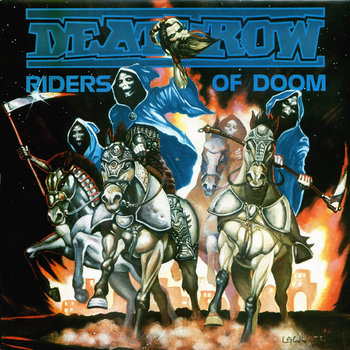
In 1986, technical thrash metal wasn’t yet a fully-fledged subgenre. Coroner, Sadus, Mekong Delta, and Toxik hadn’t dropped their debuts, and Voivod were still figuring things out. That makes Deathrow’s Riders of Doom a crucial album. It isn’t quite the German band at their most technical, but the seeds are all here, most evidently in the fact that these guys could play circles around the competition. There’s a lot of complicated rhythmic stuff going on throughout Riders of Doom, which Deathrow effortlessly shoots through with bursts of warped melody. The band also regularly manages to make their barrages of tricky riffs scan as epic atmosphere. (Master of Puppets deserves some proto-tech-thrash flowers, too, for all the same reasons.) Deathrow would be surpassed in both technical proficiency and overall quality before long, but in 1986, nothing else sounded quite like Riders of Doom.
Flames
Merciless Slaughter
Bless the tape-trading networks that allowed Flames to exist. When the band started in Athens in 1984, there was nothing else happening in Greece that sounded remotely like them. But they had heard thrash, speed metal, NWOBHM, and early Celtic Frost, and they found a way to synthesize them into a singular sound. I won’t mince words—a fair bit of Merciless Slaughter, the band’s second album, is tough sledding. It’s incompetently recorded and sloppily performed, and a couple of ill-advised songs make Spinal Tap’s perspective on sex seem enlightened. Still, the heavy metal spirit of Flames shines through, and it’s best exemplified by “Legend,” an eight-minute epic that manages to be deeply strange and affecting as it reaches for something just beyond its grasp. It doesn’t get more underground than this.