
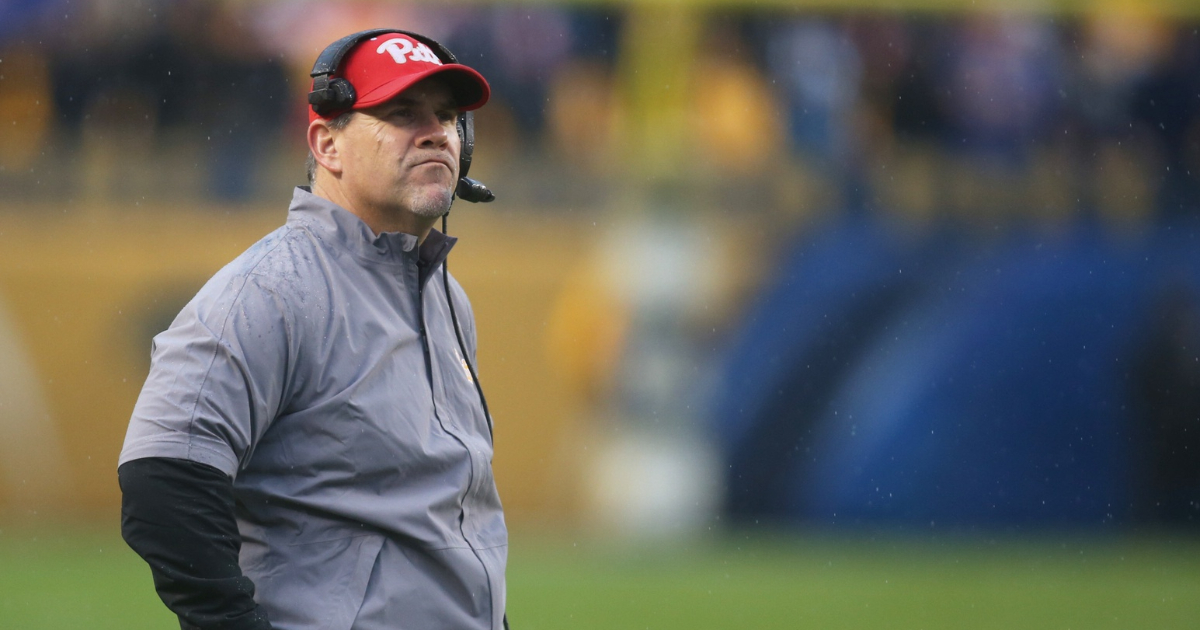
On Wednesday morning, Notre Dame defensive line coach Charlie Partridge met with local reporters for the first time since his hiring in early January.
Partridge discussed moving back to college from the Indianapolis Colts, Notre Dame’s transfer additions on the defensive line, his philosophy on rotations and more. Here’s everything he had to say.
Can you take us through the process of Notre Dame’s interest in you and when that really turned into something serious/turned into you leaving the Colts?
Timing-wise, I’ll leave that alone. But at the end of the day, me and Chris [Ash] certainly have a 30-plus-year relationship, so we communicate all the time. When it looked like they were considering a move with Al [Washington] to help his career to the linebackers, there was communication with me and Chris and then communication with me and Marcus [Freeman].
Again, I loved my experience with the Colts, and my experience in the NFL. Learned a lot. It was not an easy decision, but then it was. Meaning I certainly had the opportunity to stay with the Colts and all those kinds of things, but whether you guys know it or not — having covered this place, and I think you probably do — it was a pretty special place led by a pretty special head coach. And then you combine that with a pretty unique relationship with me and the defensive coordinator, it became an opportunity that was obvious.
You and Chris Ash were roommates at Drake, right?
We weren’t roommates, but we were teammates.
What about Chris has made that relationship so special over the years and led you to coach together at four different spots, including Notre Dame?
I think it is fourth or fifth, I’d have to think about it. And bear with me, so it was Drake, it was Iowa State, it was Wisconsin, it was Arkansas, so this is five. I’ll just talk about him. Extremely, extremely intelligent. Extremely driven. As good as anybody I’ve ever worked with on game day at seeing all 22 moving parts. He’s unique that way, so he’s a fantastic adjuster.
We’ve always talked football through all the years, whether we’re working together or not. So the opportunity now to come back together, and we’ve all learned, right? He’s gone on to his systems and additional systems, as have I. And to come back together now, and we’ve known each other so long, it’s like — you’re probably too young, maybe you’re not. Remember, what was the MTV show? The Real World? Right? Stop being nice, start getting real. Me and Chris are way beyond where we have to be nice. We can have real conversations without an emotional barrier, come to a solution and there’s no problem.
That’s hard to do because all us coaches, we’re all the same. We’re all, to a degree, right, we’re all alphas. We all believe in what we believe in. All that stuff with me and Chris doesn’t matter. We can really have real conversations and move on, which is pretty special.
You really had to hit the ground running in your first week at Notre Dame with the transfer portal. You obviously have the background with Francis Brewu, but what drew you to him, to Tionne Gray and to Keon Keeley?
Quite honestly, film. And I’ll tip my hat to the personnel department. I think they had us on some really good ones. Like you said, it happens fast. A lot’s changed in the two years I was not in college football. A lot. Again, just imagine, guys. If you include the preseason, I finished coaching my 20th game against the Texans on Sunday, closed out on Monday, grabbed some stuff and I’m up here on Wednesday and we have guys visiting.
Obviously, communication is happening during that time. But again, I’ll tip my hat to the personnel department for bringing guys on film. There’s a few that we didn’t go on. But I think they had us on the right guys and then it became, who can fit at Notre Dame? My background goes back to Brewu, so I knew from a talent standpoint what he had. Saw that on tape at Pitt, and I think there’s still a lot of room for improvement in Brewu as we move forward. So I’m excited to actually get the chance to work with him now.
When did you start watching film on the guys here? As soon as you took the job? Was it part of your conversation with Chris or with Marcus, like hey, here’s what we’re working with?
Yeah, there was conversation. The first conversation from that standpoint was probably more about, here’s where we have a couple portal needs. So, the focus really was there. When I initially started watching tape, it was more system driven than leaning in on the guys. That’s happened progressively over time.
I don’t want to go too far in the film evaluation from last year, because I want to see them through my eyes. So I am now having some individual meetings with guys. They come in on their own and we do watch their tape. So I want to have the conversation: Why they’re doing what they’re doing or not doing what I think they should be doing, and then build that to where I’m making my own evaluation.
Notre Dame lost some older guys, but Jason Onye was able to come back for his sixth year. Does that really help to have a guy that is entrenched in Notre Dame?
It does. It helps me. Again, this is a unique place. You better care about school if you’re at Notre Dame. And guys that have been here know that, understand that. Not that other schools don’t. Online classes don’t really exist here, things like that that don’t exist. You have to go to class. You have to engage with your professor, which as you and I know, that’s a great thing. It’s a learning curve for maybe a guy or two, and having guys that have been through the quote-unquote system here is a huge advantage.
You said a lot of things have changed in two years. Specifically with early enrollment, five years ago you’d have four or five guys enroll early. Now you have four guys that didn’t enroll early. Is that refreshing for the spring, because you know what you have?
It is. It does. I’d have to get deep in on the state of college football, but at least now, you know who your team is for a year. And since you have those kids, the majority of them coming in early, you’re with that 2026 team for roughly a calendar year.So I do think it’s great that, one, they’re able to get in here early now and do some of those things. Two, with the portal window not being available in the spring, we’ve got our team.
One of the bigger groups on Notre Dame is the defensive line. Does that that work itself out, beginning on Day 1 in spring? Or does it start working itself out as soon as you can see them?
From a numbers standpoint?
Just a numbers standpoint.
It will be — and this isn’t coach speak — it really will be an evaluation that never stops. Ever. Mid-game, if there’s someone that’s not playing well, we’ll flip. Bottom line is what those numbers should create, with hopefully high-quality numbers, is competition. So you just can’t rest. You just can’t. You can’t rely on what you did yesterday. You have to do it again today.
It’s also a position that’s one of the few that lends itself to a deep rotation.
For sure.
That’s something you’ve embraced in your coaching career. Where did you learn that from?
As far as going deep into the rotation, that’s actually a question I can pinpoint pretty quick. My first year at Wisconsin, so you’re looking at 2008. There was a group of first-line guys that had a ton of experience that were really far along in their game, with a group of guys with limited experience. They didn’t look the same, so I made a mistake. I played that first line too much. And late in games and late in the season, as that started to exponentially become an issue, they started to break down and wear down.
I made a decision going into ‘09 that regardless of how ready that next person or group is, I have to get them in. Depending on how ready they are is when and how much I get them in. And now you fast forward however many years that equates to, now I’ve got math in my head. So, not to get too deep into the weeds, but there’s two D-tackles. Roughly, on average, 80 plays a game, so you’ve got 160 reps of D-tackle opportunity. If you have four guys, so you’re talking two deep, and they’re evenly, they’re all going to get about 40 apiece.
Rewind back to when I had Calijah [at Pitt]. I needed Calijah Kancey on the field every moment that he could stand. So now I’m trying to figure out, what is his rep count? What can you manage? So roughly 60. That leaves 100 for the remaining. If they’re equal, you’re around 33. So, I’ve gotten to a point where I can manage that during the game, spot guys, etc.
Is it a little easier to sell that in portal recruiting and recruiting nowadays? Like, hey, you don’t want 70 reps in a game because you’re going to wear down.
Absolutely. And you’re not going to do that in the NFL. You’re not, right? Like, on average, it’s 60 plays a game, and the top guys are playing 40. It’s just how it is.
Why are you a good match with Chris Ash?
Oh, man. I just think that we’ve known each other so long. I think we both love to learn. I mean that. We really embrace watching tape, learning other systems, trying to figure it out ourselves, talking to each other, seeing if it fits what we do, what we have player-wise and then coming to a solution that makes sense wherever we are. We’ve bounced ideas off each other, obviously, when we were together, even when we were not.
I have a ton of respect for Chris’s vision on game day. We talked about that earlier. He’s really gifted now being able to see 22 moving parts and solved issues on game day as good as anyone I’ve been with, and I have a lot of respect for that. So he says, what do you think of this D-line adjustment? I take it a little bit more to the heart, even though his background is more secondary because of his incredible vision on game day. So there’s no ego that gets in the way with me and him. One, because we’ve known each other so we can disagree and rule and my respect for his vision on game day, that helps our back and forth.
I’m assuming that’s not always the case, on a staff.
It’s not. For sure. Absolutely.
Marcus talked a lot last year about Notre Dame marrying rush and coverage. To that end, are there times when you know what adjustment Chris wants to make before he makes it?
There are times, for sure. Without a doubt. He says we’re going through the tape, you’re right. Chris, are you doing this because of that? Or vice versa. Charlie, how do you see this? Or Charlie, I know you did this last year with Lou in Indianapolis. How did this work for you? I’ve been thinking about it. So yeah, I mean we do know how to make things work together.
On game day, when everything is so compressed, is that when that helps the most?
Yeah, a hundred percent. “Charlie, we’re having an issue here. What do you think?” Or, “Charlie, I’m thinking this,” and it can’t be much longer than that.
Why do you love coaching the defensive line?
It’s a combination, I think, of a couple things. That’s a great question. I don’t know if I’ve ever been asked that. When you find what you’re supposed to do, whatever your walk in that line of thinking is, you kind of grab onto it and hold onto it tight.
I’m passionate about technique. I really am. I love when you tell a guy to push his right big toe in the ground and that helps him get control of his left foot, and he looks at you and smiles, that carries a lot of gratification for me. So, those little things, those little technique things. Then you combine that with our piece of the scheme, like you said, marrying it with coverage. If we’re in split safety as opposed to middle closed and you got an extra guy in the fit whatever. Being able to teach those D-linemen big picture so they understand why we’re doing something a little different, and then you tell ’em to put his right big toe in the ground and he starts to put things together.
I really, really enjoy that, and probably shouldn’t go here, but part of the reason I made the move to the Colts, one, it was an opportunity to grow and to learn and to experience it, but all the losing the opportunity to develop a guy over time was hurting my heart.
Did you enjoy working with pros?
More than I expected. Because I had a couple other chances to do it, and I didn’t have interest because I was enjoying the development. Well, then as all the moving things were happening in college football, it felt right. [Former Colts defensive coordinator] Gus Bradley‘s fantastic. [Colts general manager] Chris Ballard is a person I think the world of. [Colts head coach] Shane [Steichen], whatever.
So I go there, but my apprehension was, I anticipated big egos from the players, like they would not want to learn. Boy, was I dead, dead wrong. I mean, dead wrong. As long as you’re the same guy every day as a coach. Don’t be moody, don’t be, just try to do everything you can to be the same. We’re all human, but try to be the same guy every day. Prove you know what you’re talking about and help them in any little way, I mean, you got ’em.
And that was fun. It was fun having high-level conversations with these guys. Once there was some trust built, I did thoroughly enjoy it. You asked a question earlier about coming here and those kinds of things, the uniqueness of this place and Marcus and Chris, that all played into that decision to come here, too. In a good way.
Is college more technique-driven? More for you to teach?
It is, and the thing I did learn in the 20-some odd years I was in college before my two-year hiatus in the NFL, even within the room, you’re having different conversations within the room. And it took me a while to really wrap my arms around, one, getting some of the younger guys in together so I can have these conversations. Older guys together, a little bit higher-level conversation.
It happens in the NFL, too. My conversations with, I won’t say a name, but I’ll say one of the names, right. With Rookie X as compared to DeForest Buckner, those are completely different conversations, right? It’s true to a different degree here as well. I mean, I’m having a different conversation between Rodney [Dunham] than I am with Boubacar [Traroe]. I mean, you just are.
Tionne said he’s 325 pounds, and he wants to drop down to 315. Do you want that for him at Notre Dame?
So, here’s my belief on that. Again, you’ve got weight target goals. For me it’s a little bit about lean body mass, right? And there’s a million studies out there that the more you can have lean body mass as opposed to not, your risk of injury goes dramatically down. So, obviously, movement skills, as long as he loses the right 10 pounds to go from 25 to 15, I’m good. There are some guys that can carry 323. Grover Stewart. He was 320 with freaky lean body mass. It’s more about that to me than the other.
Then with Francis, does it matter what his weight is? He’s so strong, it seems like it just works for him.
Without trying to go too deep into stuff, I’ve been doing this a while, right? So Calijah Kancey hovered around 280, but he was quick as could be. Go back to this past year, [Adetomiwa Adebawore] out of Northwestern was in the 280 range, playing the same position as DeForest Buckner. It’s relative to person. You understand what I’m saying?
So, there’s certain technique things that each guy’s going to have to lean in on a little bit different to maybe get the same job done, and with a guy who’s maybe a little lighter, yes, he’s strong, but the reality is 650 pounds is 650 pounds. So, he’s going to have to do some technique things, absolutely clean, to do what we believe he can do. He’s working his tail off in that.
Pound for pound, he’s the strongest?
He’s strong. He’s strong. Without a doubt.