
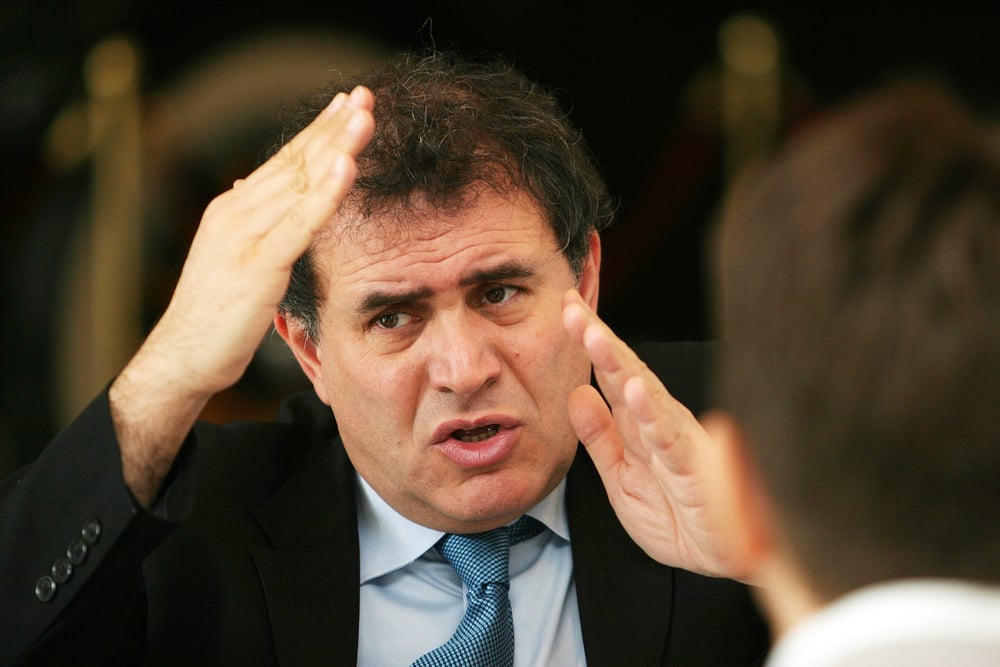
Nouriel Roubini, the economist who called the 2008 financial crisis and spent the next decade warning anyone who’d listen about stagflation and collapse, now sees U.S. GDP approaching 4% by end of the decade.
The driver isn’t fiscal stimulus or deregulation.
Roubini told Bloomberg on Tuesday that it’s a technology revolution spanning AI, robotics, quantum computing, biomedical research and space exploration.
He estimates those productivity gains could lift U.S. potential growth by 200 basis points, against just 50 basis points of drag from tariffs and immigration policy.
“Tech trumps tariffs,” he said.
Prediction Markets Aren’t So Sure
The “US recession by end of 2026” Polymarket currently prices a 24% chance of recession on $222,000 in volume—a meaningful chunk of money saying Roubini’s 4% dream hits a wall before it gets started.
On Kalshi, the GDP growth in 2026 market gives roughly 6% probability to full-year growth extending past 4%.
Back to Polymarket, the contract for GDP growth in Q1 2026, has 2-2.5% at 34%, and 38% of over 3.5%, giving Roubini’s optimistic predictions a glimmer of hope.
Marx Was Right, Says Roubini
However, Roubini’s optimism comes with a dark structural caveat.
Roubini invoked Karl Marx to explain what happens next.
As AI and automation shrink labor’s share of income, he argues, workers lose the purchasing power to buy what the economy produces.
Aggregate demand collapses from within.
Roubini expects Universal Basic Income to scale significantly over the coming decades as governments exhaust every other option for managing permanent structural unemployment.
Redistribute from the winners to the losers, or face the consequences.
“The alternative is a revolution,” Roubini said.
Why Traders Should Care
If the man formerly known as Dr. Doom is right, all of that may be forgotten quickly. A 2% productivity boom more than justifies all the capex and makes the current selloff look like a buying opportunity.
Image: Shutterstock