
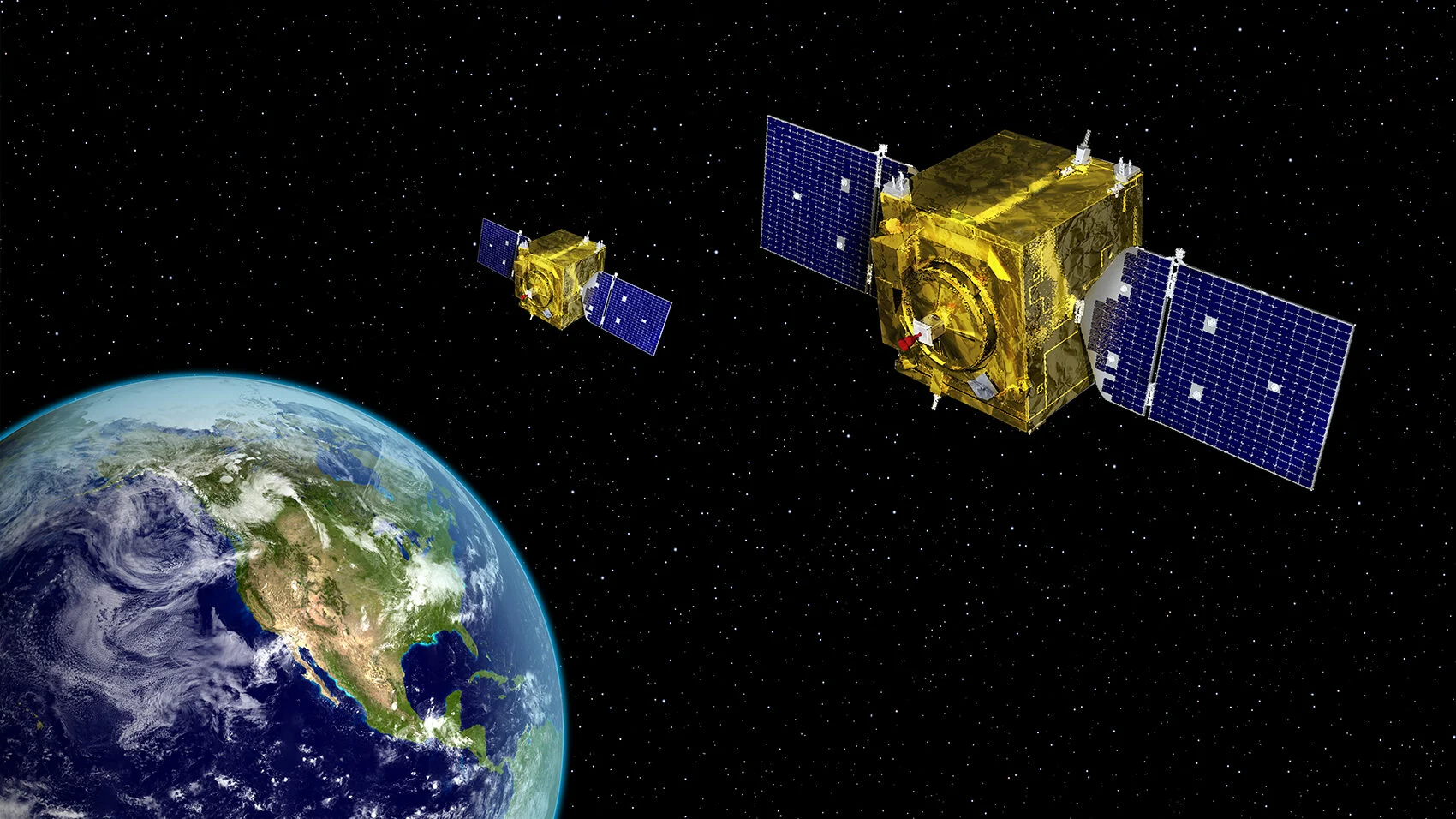
WASHINGTON — The Defense Innovation Unit (DIU) wants to buy commercially produced satellites to take close-ups of other spacecraft in geosynchronous Earth orbit (GEO), according to a new solicitation.
The goal of the new Geosynchronous High-Resolution Optical Space-Based Tactical Reconnaissance (GHOST-R) program is to rapidly put on orbit the capability keep near real-time tabs on the whereabouts of both “adversary and friendly” satellites, as well as take good enough pictures to be able to discern their purposes, explains the call for industry proposals published on Monday by the Pentagon’s in-house accelerator.
And DIU would like to do so at a lower price point than the Space Force’s current space domain awareness programs for GEO, some 36,000 kilometers (22,000 miles) in altitude. Those current programs are the venerable Geosynchronous Space Situational Awareness Program (GSSAP) neighborhood watch constellation and its planned successor known as RG-XX.
The proposed new satellites for DIU “must reduce costs compared to existing and planned programs of record while achieving high-resolution image collection, allowing for increased collection frequency and detailed characterization of resident space objects (RSOs) in GEO. The successful deployment of these capabilities will significantly improve GEO RSO Characterization, Battle Damage Assessment (BDA), Positive Identification (PID), and Combat Identification (CID),” DIU states.
Bidders must be able to provide within 24 months of an award a “minimal viable product” comprising a “high-resolution electro optical (EO) image” of a GEO-stationed satellite “using a commercially operated space vehicle,” according to the solicitation. The resolution is for a precise image of a medium-sized (about 700 kilograms) satellite taken from “no closer than” 10 kilometers.
Within 36 months, the winning vendors need to be able to transition their satellite and ground operations from a contractor-owned/operated system to a government-owned/operated one. Finally, within in 48 months, the satellite must demonstrate the ability to perform at least one pass by a target spacecraft per week “through the first year of government operations,” according to DIU.
The proposed satellites should meet Defense Department cybersecurity requirements and be designed for a three-year lifespan, and the bus and primary payload systems must show a “proven space heritage” by 2028, the solicitation adds. Competitors also need to show a plan for scaling up a constellation that can maintain “a 30-day revisit rate” for every GEO space object listed in US Space Command’s publicly available catalog, Space-Track.org, over a 10-year period.
Interested vendors have until March 3 to send in a proposal.