
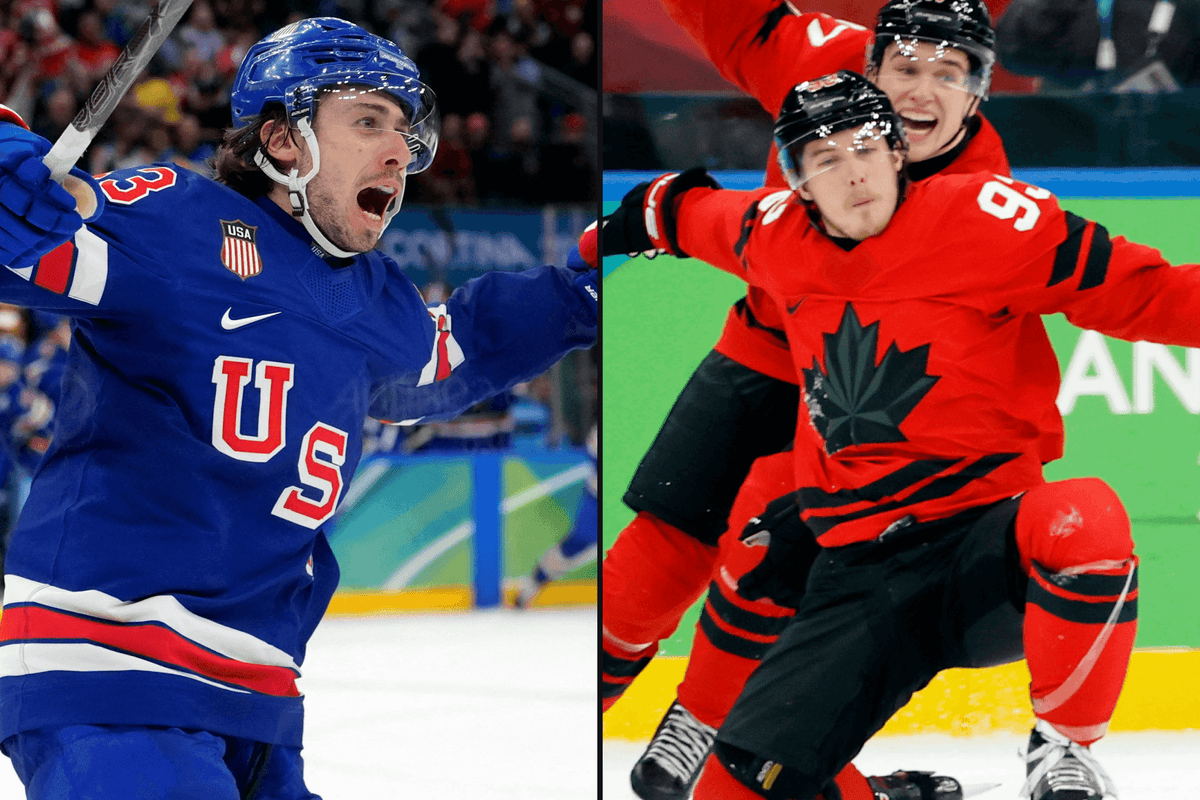
After an electric set of quarterfinal matchups, the stage is set for what should be two terrific semifinals. It’s Canada vs. Finland and the United States vs. Slovakia for the right to play for gold on Sunday.
While there’s a clear favorite in each game, nothing is a given in a winner-takes-all matchup.
Below, we break down how likely each team is to win, how the two teams stack up and what their path to victory looks like.
Here’s what to expect from each matchup.
Canada vs. Finland

The odds
As we saw in the quarterfinals, nothing is a given in these games. Those assuming Canada could just walk through any team were met with a scare against the Czech Republic. The Canadians needed some late-game heroics from Nick Suzuki, Mitch Marner and Jordan Binnington to get the job done. The Finns needed something similar against Switzerland and will meet an even taller task against Canada.
The point is not to be surprised that Canada isn’t a mega-lock here. By Olympic standards, this game is expected to be close, where just 1.2 goals separate the two teams. Canada is expected to win and is clearly the better team, but in hockey, anything can happen when the margins are that thin. Finland is going to be a tough out.
How Canada wins
Canada has relied a lot on its star power, and that will be its biggest advantage going into any game. As long as Connor McDavid, Nathan MacKinnon and Macklin Celebrini are firing on all cylinders, Canada has a massive edge.
Where Canada is at its best, though, is being able to send waves of pressure with all four lines. The bottom six struggled against a Czech team that wasn’t very deep; they’ll need to be a lot better against a Finnish team that has more NHL talent across the board.
Patience will also be key against one of the best defensive teams at the Olympics. Canada had a hard time off the rush against the Czech Republic and the Finns are even better at containing that. Add some elite in-zone defense and Canada may have a more difficult time overwhelming Finland with its attack. Getting more out of the bottom nine will be crucial to wearing Finland down.
It’s also going to take Jordan Binnington’s best effort to keep this game more comfortable. Binnington started strong in a shutout win against the Czechs and ended strong in the quarters, but everything in between has been a mixed bag. Binnington is giving up a lot of rebounds and it’ll be on Canada’s defensive structure to limit the second chances as much as possible.
How Finland wins
Finland is going to need to have the game of its life defensively. They’re well-equipped for that up and down the lineup with plenty of defensive stoppers, but Canada is a different kind of test. Without Aleksander Barkov, it’s going to be a tall order, but not an impossible one — the Finns just need to lean on their strengths.
If the Finns can contain Canada’s offense, generating offense of their own will present an even bigger challenge. Canada was vulnerable against the Czechs off the rush, and Finland can execute the same game plan if they can stay within their structure while soaking up pressure. The speedy Roope Hintz hasn’t scored yet in this tournament and this would be a perfect moment for his first.
Capitalizing on Canada’s mistakes is Finland’s path to success, and the best bet for that is pouncing on a blue line that lacks mobility and a goaltender who gives up a lot of second chances. Force turnovers, put pucks on net and crash the net for rebounds. Between Mikko Rantanen, Artturi Lehkonen and several bottom-sixers, Finland has the bodies to make that happen.
There’s a strong chance Finland gets outshot in this game, but if they can keep the chances tighter, they have a shot. Getting a vintage performance from Juuse Saros will be a must to bring it all home.
The X-factor
It’s still unclear whether captain Sidney Crosby will be well enough to suit up for Canada. Crosby left the quarterfinal matchup with a lower-body injury and did not return. While Canada should be able to survive without him — their odds don’t shift much because they’re a super-team where it’s harder to make a dent — Crosby’s absence would still be a massive one that leaves a hole in Canada’s middle six. It would be one less weapon for Finland to worry about, paving a slightly easier path to gold for the Finns.

United States vs. Slovakia

The odds
The United States are heavy favorites to advance to the gold medal game after drawing surprise Group B winners Slovakia. The Slovaks started the tournament in a similar category as Denmark and Latvia and while they’ve proven significantly more throughout the tournament, there’s still a substantial talent deficit here. The U.S. should win this game clearly and decisively.
“Should” is the key word there. Slovakia has defied the odds all tournament, starting with a massive underdog win against Finland where they had just a 17 percent chance to win. They have the power to do that again, but the Americans will be their toughest challenge yet, given the level of NHL depth from top to bottom.
How the U.S. wins
The United States has been one of the best offensive generators of the tournament, between its rush game, cycle chances and five goals per game. But a lot of that is inflated by playing weaker preliminary opponents.
As much as the U.S. generated against Sweden (39 shots and 26 slot shots) the team didn’t convert on enough of its chances. So this group needs more pop to quiet narratives about top goal scorers being left at home. And after going into a defensive shell for more than half of the third period while defending a 1-0 lead, the U.S. needs to play a more proactive style.
The problem is, Team USA isn’t dressing its best offensive threats, with Kyle Connor on the outside looking in and Clayton Keller playing a pretty limited role. That puts more pressure on the big guns to produce. Auston Matthews, Jake Guentzel and Matt Boldy buzzed against Germany, but had a quieter quarterfinal. Both Jack Hughes and Quinn Hughes have been dynamic, but Matthew Tkachuk hasn’t been as noticeable offensively.
What helps is that Slovakia is a weaker defensive team than Sweden, so there’s more leeway to play to their strengths and do some damage. But Slovakia is also a more high-octane opponent to keep up with. So the U.S.’s defense, which has been a strength so far, is all the more important — as long as it doesn’t come at the expense of its offense. The U.S. limited Sweden to only 11 slot shots; playing that passively is too risky against Slovakia.
How Slovakia wins
If this Cinderella run is going to continue, then the four driving forces behind it have to keep thriving: Juraj Slafkovský, Dalibor Dvorský, Simon Nemec and Samuel Hlavaj.
Slafkovský has become a force on the international stage with seven points in five games and leads the team in scoring chance contributions. Nemec’s offense has been a real difference-maker, while Dvorský has boosted Slovakia’s rush game.
That got Slovakia here. Now the team needs a stronger second wave to stack up to the Americans. Second-liners Pavol Regenda, Milos Kelemen, and Martin Pospisil combined for eight scoring chances against Germany, which helped make up for a quieter game from Slafkovský. The team needs that supporting cast clicking at the same time as big guns to create more sustained pressure.
Slovakia has generated looks in transition, but needs to clean up its rush defense and make sure those chances aren’t leading to enough extended zone time. Slovakia has only generated 2.5 cycle chances per game, while giving up double that — and that was the case on Wednesday against Germany, too. Team USA is even stingier defensively and dangerous offensively, so the pressure is on.
The X-factor
This could all come down to goaltending. Connor Hellebuyck, who has a reputation as one of the best regular-season goalies in the world regardless of his workload, has been solid for the U.S. in three starts. But as last postseason showed, he still struggles in some high-pressure situations. As well as he played against Sweden in the quarterfinal, it’s only going to get harder from here. Hlavaj has been a lot busier in net for Slovakia, facing 29.5 shots per game, but he has responded with some really stellar play. As well as he played against Germany, Finland and Sweden, the U.S. is a different animal offensively, and his AHL numbers this season aren’t exactly inspiring.

Scoring chance data tracked by Dimitri Filipovic.