
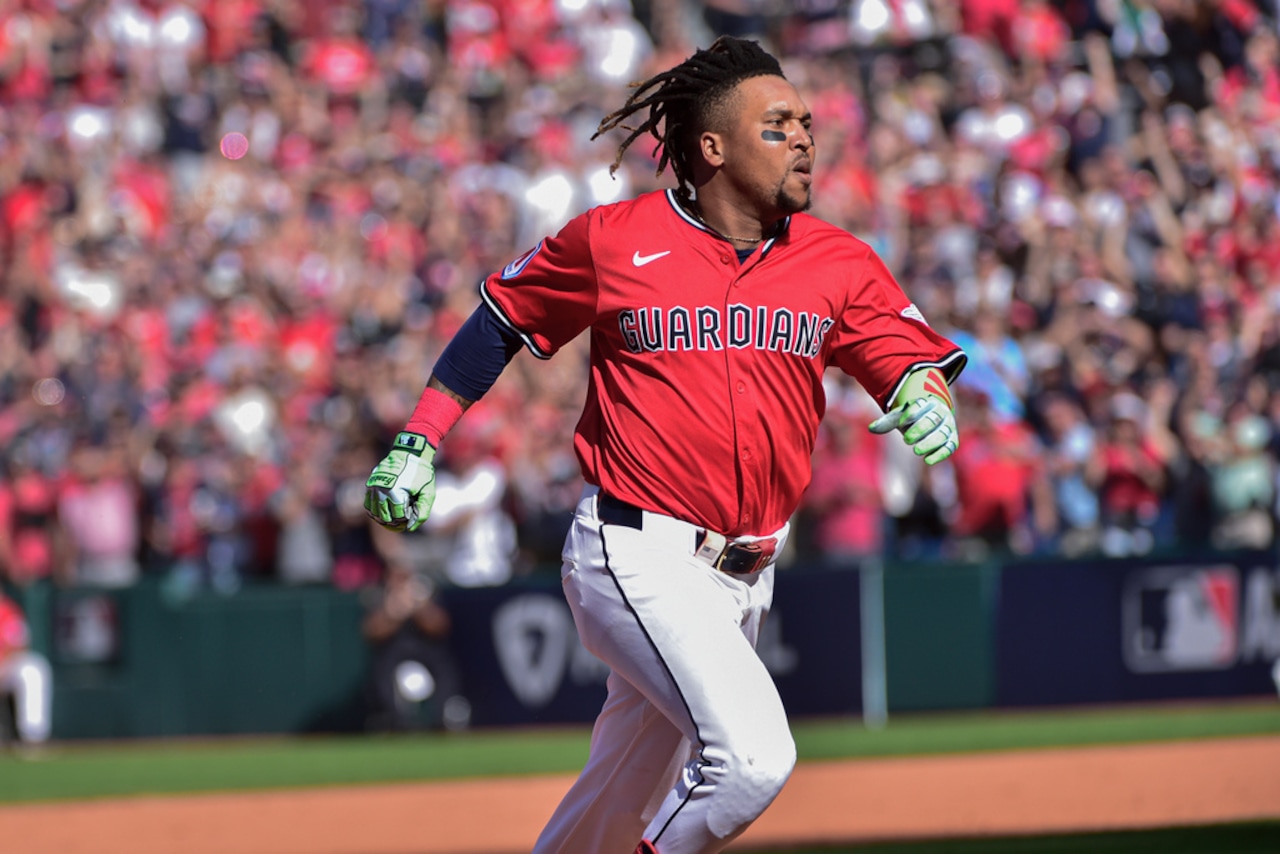
CLEVELAND, Ohio — Aaron Judge wears it. Derek Jeter wore it before him. For the Yankees, the “C” on the jersey is a sacred institution — a franchise tradition that signals hierarchy, honors greatness, and carries the weight of the pinstripes’ storied history. But in Goodyear, Ariz., Guardians manager Stephen Vogt has a different take. And on the latest Cleveland Baseball Talk Podcast, beat reporters Joe Noga and Paul Hoynes broke it all down.
Vogt was asked if he would ever name an official captain in Cleveland? The answer revealed something deeper about how this franchise actually operates.
Hoynes laid out Vogt’s thinking directly: “I got the impression that he had nothing against the practice, but to him it just didn’t fit the sport, his idea of a baseball team. He said, obviously, José (Ramírez) is our captain. He’s our best player. We go as José goes. But he said, could say the same thing about (Austin) Hedges. You could say the same thing about (Steven)Kwan. You could say the same thing about (David) Fry.”
That response is telling. Vogt didn’t dodge the question — he essentially answered it by reframing it entirely. Leadership in a baseball clubhouse isn’t a title. It’s a culture. And in Cleveland, that culture is distributed. Ramírez carries the team’s heartbeat. Austin Hedges provides the veteran steadiness. Steven Kwan represents the players at the league level. David Fry brings the energy. None of them need a patch sewn onto a jersey to do what they do.
Noga took the observation a step further, giving voice to what was arguably the sharpest take in the whole conversation: “I got the impression that the idea of a captain in baseball is kind of performative, kind of cheesy, kind of ‘let them have their little tradition’ talking about that team over in the AL East. But you know, the Yankees, the Red Sox are teams that have done this in the past and continue to do it now. That’s great for them, but that’s not how this club operates and hasn’t operated really for a while.”
That’s not a shot at the Yankees. It’s a clear organizational identity statement. The Guardians do things their way. They always have. The franchise that competes year after year on one of baseball’s leaner payrolls doesn’t build its culture around titles — it builds it around accountability, shared investment, and guys who step up because they’ve earned the respect of their teammates, not because a front office designated them the leader.
And Noga had the perfect, unforgettable real-world example to punctuate the point. Remember when the Guardians’ center fielder Myles Straw was getting pelted with debris by Yankees fans during that now-infamous moment at Yankee Stadium? Aaron Judge — the captain, the franchise face, the guy wearing the C — came out to try and calm things down. It didn’t help much. As Noga put it: “The C on his chest didn’t do much to prevent that.”
It’s a great line. And it’s a fair point. Leadership isn’t a patch. It’s presence. It’s what happens when things go sideways and someone steps up because that’s simply who they are.
Hoynes did some digging into Cleveland’s history on the subject, surfacing what might be the only true precedent: the Doc Edwards era, when Joe Carter and Mel Hall were both named captains. “It was like the good angel and the bad angel sitting on each of your shoulders,” Hoynes said with trademark dry wit. That experiment didn’t exactly set off a lasting tradition in Cleveland.
The broader point Noga raises — that captains don’t fit baseball the way they fit other sports — is worth exploring. In basketball, captains speak for their team in heated confrontations. In football, there’s the ceremonial coin flip at midfield. In baseball? Every hitter steps to the plate and handles his own business with the umpire. The game is built around individual accountability wrapped in a collective framework. A designated captain, in that context, is almost structurally unnecessary.
Besides, every Guardians player on the field in Arizona yesterday was already wearing a big ‘C’ on his chest. One that stood for Cleveland.
For the full conversation on Vogt’s spring training media sessions, the Guardians’ leadership dynamics heading into 2026, and everything else happening in Goodyear, tune into the latest Cleveland Baseball Talk Podcast.
Read the automated transcript of today’s podcast below. Because it’s an AI-generated transcript, it may contain errors and misspellings.
Podcast Transcript
Joe Noga: Welcome back to the Cleveland Baseball Talk Podcast. I’m Joe Noga, joined by Paul Hoynes. Hoynsie, busy day out in Goodyear, a busy day around baseball. Busy day in the Eastern District of New York where Emmanuel Clase and Luis Ortiz entered not guilty pleas in their federal case regarding pitch fixing and inappropriate gambling. You know, situation out there. What have we found out? With this rewritten indictment that includes one of their co conspirators, Class A and Ortiz now could be facing a trial that could get pushed back into October.
Paul Hoynes: Joe, the judge in charge of the trial has, you know, indicated that she is ready to move this trial back to October. But they still, she still left the May 4 date open. But from all indications this thing is going to get moved back if that happens. Joe, I if is real, MLB is not going to make it probably won’t make a decision on any penalties against Ortiz and Class A until a decision is rendered by the judge, a judicial decision or you know, a legal decision. So this means the guardians, Class A and Ortiz are just dangling in limbo again for a whole nother season. We went through this for a half season last year when they were put on admin non disciplinary leave in July and now, you know, the drumbeat continues. What’s the old saying, Joe? The wheels of justice grind fine, but they grind exceedingly slow. So we’re in the middle of that.
Joe Noga: Yeah. And it seems like there won’t be any resolution in terms of the, the salary that is owed Emmanuel class A, the 6.4 million that he’s owed in the final year of his contract. It doesn’t seem like that’s going to be resolved before the beginning of the regular season. Right now during spring training players don’t get PA but you know, once the season starts sensibly, the guardians would be on the hook for, for that amount. Unless something happens like Ortiz and, and Class A are put on the, the commissioner’s restricted list. Players on the restricted list don’t accrue service time and they don’t earn their salary at that point. So that’s I guess one option. Do we have any indication that, you know, maybe something like that could be happening before the beginning of the regular season?
Paul Hoynes: Thinking, you know, from what I’ve heard Joe, there, there’s a possibility that they could have a resolution on Class A and Ortiz’s contracts by the, you know, the end of spring training. And as you said, nobody gets paid during spring training. Players payroll, players start getting paid starting on the season opener. So there is a, there is a chance at some that a resolution could be reached. But right now, you know, no one is saying anything. So there’s a, you know, it’s just, you know, as business as usual and you know, talk to the Guardians are kind of still in the dark on this. You know, we’ll just have to see what happens, you know, come March 26th when the regular season opens, if the decision has been made by them.
Joe Noga: Clase and Ortiz were in court yesterday to enter their pleas. They were there separately. They did not talk to reporters. And you know, there’s, there’s nothing really changes. It was a sort of a rewritten, superseding indictment that they pleaded not guilty to. Again, there’s the, the court date, like you said, likely to be pushed back to October. But Judge Matsumoto in the Eastern District did keep things open for that May 4th trial date, but likely to delay things until after the season is over. We can, we’ve got a whole, a whole other, you know, 10 months to talk about things. So we’ll keep, keep an eye on that. What Will and Joe, you know, we
Paul Hoynes: still don’t know if the judge is going to approve the separation of the two cases. He’s and his attorneys want to be separated from class A. The U.S. you know, sent a, you know, filed a motion, you know, deny, you know, to oppose that. They want to try Class A Ortiz and any other co conspirators together. So they still have to get a resolution to that as well.
Joe Noga: Yeah, we’ll, we’ll find out what happens there eventually here in the coming months. All right. Also in New York and you know, it’s sort of a baseball wide happening last, last night Bruce Meyer, who was formerly the general counsel, who is actually the deputy executive director for the MLB Players association, was unanimously selected as the interim director of the MLBPA to replace Tony Clark, who resigned earlier this week amid scandal rumors of an inappropriate relationship with his s who was an employee of the association. And with the overhanging federal investigation into a misappropriation of funds within the just, you know, you talk to a couple of folks out there in Goodyear, this is what the, the players had hoped would happen in terms of a quick resolution to getting somebody in place ahead of the labor negotiations that should be ongoing throughout the year.
Paul Hoynes: Yeah, you know, Stephen Kwan is the player rep for the Guardians has been this is his third year on the and we talked to him after yesterday’s practice and you know, he was in favor of having a resolution as quickly as possible to fill the void left by Tony Clark. And he was, you know, hopeful that it would be a unanimous decision. And it seems. It sounds like things passed quickly last night, Joe. There was a, a vote and they, they have. Bruce Meyer, as you said, is the new interim executive director and Matt Nussbaum is the interim deputy executive directors. They are ready to proceed with the business as usual and get ready for the negotiations that are coming after the 2026 season when the basic agreement expires.
Joe Noga: Now, Meyer is the guy responsible for basically negotiating the last. The last couple of deals. He’s been the lead negotiator for Tony Clark in the last couple of deals there. So there’s some cohesiveness, there’s some consistency here. Meyer was, you know, quoted as saying that he doesn’t think anybody else will be, you know, would be in line to be negotiating this, this upcoming deal besides him anyways. So, you know, it makes sense that he steps into this, to this spot, at least to get this, this CBA put in place. You know, beyond that, you know, maybe there’s, there’s a change in leadership after that. This is a guy who’s got, you know, 30 years experience working with the NHL as, as a, a negotiator there, you know, and came over and he’s, he’s been basically by Tony Clark’s side for a few years here and really responsible for the last couple of trips through this cycle of negotiation and getting a CBA in place.
Paul Hoynes: Yeah, yeah, he has done. He joined the union in 2018. He has negotiated the basic agreement in 2020 and 2022, and also the basic agreement for the minor League players in 2023. So, as you said, Joe, he’s got experience on the job.
Joe Noga: Right. Moving over to the Guardians and what we learned from Guardians camp yesterday, sitting down, talking to Steven Vogt, he’s decided where his starting pitchers, plural, for the split squad games that will open up Cactus League play. He’s decided where those guys will go on Saturday. What did we learn?
Paul Hoynes: Logan Allen will stay in Goodyear at Goodyear Ballpark and face the Reds. And Joey Cantillo will go to Maryvale, Arizona and face the Brewers. Vote. Will go with. Will go with the traveling split squad. And Tony Arnerich, the new bench coach, will manage the team in Goodyear.
Joe Noga: Yeah, and you know, the body double, Tony Arnerich, will be in Goodyear. I’m sure he’ll be mistaken a few times for Stephen Vogt, but that’s the game that will be on tv. So most of the, the folks back here in Cleveland will get to see that, that game that Logan Allen pitches in and that, you know, it’s likely that when, when you look at the, the players on the rosters for those, those two squads, probably a lot of the veteran guys will stay back in, in Goodyear, I would assume Jose Ramirez, Stephen Kwan, probably Austin Hedges will be back in, in Goodyear and Cantillo will get some of the younger guys. And so I think you might head up the road there to, to see that game.
Paul Hoynes: Yeah, Joe, I’m going to go to Maryvale and, you know, Bazzana is going to play there. Chase DeLauter is going to play there. They’re expected to play there, I should say. And, you know, I’d like to really get a look at those guys and just see, you know, just see how the spring unfolds for them. You know, Bazzana is not going to be here very long. He’s got to go to Japan to play with Team Australia. So he’s going to play in three of the first four games this spring. So just want to get a look at him and see, you know, how he’s progressing. And the same with the Lauder. Not sure if, if he’s going to play center field or right field, but this is a guy that, you know, there’s a lot of high hopes around him this spring and like to see how he starts it.
Joe Noga: Yeah, and they’re going to, they’re going to take care of him and take it slow with the, with Chase DeLayuter, obviously, so don’t blink. He might be out of the game, you know, pretty quickly at some point. But, yeah, the point you make about Bazzana, he’s, he’s going to get his work in. I think Vogt said he’s going to play in something like 10 games over the stretch of like two weeks or something like that. So he’s going to get a, a good chance to get his feet under him and get hit the ground running. We did get a chance to talk to a few pitchers. We sat down some zoom interviews and we talked to Parker Messick, we talked to Matt Festa, we talked to Hunter Gaddis and, and you had a chance to, to sit down with Gavin Williams. Let’s start with Festa because we’ve just been talking about the WBC. Festa is part of Team Italy, and you can’t see me right now, but I’m doing the hand motion with the, the three fingers pinched together. Baseball team is going to be one of the most fun teams I think in the World Baseball Classic. They’re not a team that really is in serious maybe contention for trip deep into the elimination round. But watching them compete against teams like Great Britain, you know, the competition that they will be facing over in Houston, I think they’re going to play Team Brazil at some point as well. That’s where they’re going to be playing. Most fun and unique thing that Festa said they’re going to bring back the, the espresso machine that’s going to be in the dugout again. He’s going to try and get one out in the bullpen. Matt Festa said. They will, they will. You know, they’ll be talking like the, like a New Jersey Italian. I mean that, that’s what it’s going to sound like the entire time and drinking espresso and you know, who knows if they’ll have what the, the Olympics are over there right now. I mean obviously it’s a good time to be an Italian athlete. So Matt Festa and Team Italy should be fun to watch.
Paul Hoynes: Yeah, that’s, that’s interesting. I almost forgot that Festa was going to the WBC. You know, that’s, I’m happy for him. I hope he enjoys himself. And this is a guy that had really Joe, such an under the radar season last year for Cleveland came out of nowhere. They made that deal with Texas, I believe in sometime in April got him and he just stepped in and pitch. He pitched in that pen like he, he’d been there forever.
Joe Noga: Well, that’s sort of one of the things that, that he brought up was this is, this will be his second time playing in the WBC for Team Italy. He played there the last time the, the tournament happened. And he’s got a really good close relationship with Francisco Cervelli, the Italian manager, the coach there and the coaching staff. This is, he sort of made for this role. I guess we saw that last season. He was, Matt Festa was a guy who just took the ball in Cleveland. Whether they needed him in a leverage situation late or if they needed him in, give him a few innings in a game that’s a blowout to save the bullpen for the next day or even coming in early, put out a fire. He did that a couple of times as well. He pitched in a variety of roles and I think that’s what makes him attractive for a WBC team because these games can turn into, you know, basically bullpen games. Your starters aren’t going to go very deep and especially for teams Like Italy and, and Great Britain and you know, some of the teams that aren’t really loaded with a lot of major league talent. You know, it’s going to be, you know, dicey sort of pitching it up, sort of, you know, putting together some of these innings, piecing together some of these innings. And Matt Festa is a guy who can really glue some of this together. If you’re a team like Italy.
Paul Hoynes: Yeah. You know, look at, he’s a workhorse. He made over 60 appearances last season, I believe. Just did a great job for him. And he’s been around. Like you said, Joe, he’s, he’s pitched for various big league teams. So, you know, he’s a, he’s a, he’s a quality veteran guy and I’m sure he’s going to, he’ll help team Italy and Cervelli’s. You know what, he’s the former Yankee catcher, right? Yeah. So, you know, they must have a good relationship.
Joe Noga: And you know who else has a good relationship with Cervelli is Augustin Rivero, the, the Guardians interpreter who came up in the, the Yankees or was a part of the Yankees minor league system. He and Cervelli are pretty close. And so Festa, I think goes trading stories of having played with Cervelli. Augie knows him. So, you know, a lot of. It’s always six degrees of separation between doggy going.
Paul Hoynes: Is Augie going to.
Joe Noga: I don’t think Auggie’s going. Augie’s Colombian. He’s not Italian. So yeah, not, not necessarily the same. But yeah, I think the, the Colombian team is, is on a different path there as well. So yeah, Festa to the World Baseball Classic. We will, we will be on the lookout for the espresso machine for sure in the dugout there. Wanted to talk about Parker Messick and the revelation from Messick that he’s some, it’s something we hear a lot of in, in spring training is, you know, are you working on any, adding any pitches? Did you add any pitches in the offseason? And Parker Messick said that he, he’s working on refining his arsenal in the off season, but he also is trying to work in a little cutter and to give him another direction, another, a sort of way to attack hitters. So you hear it from a lot of guys. Oh yeah, I’m working on a cutter. That’s a, that pitch is a two edged sword man. Because if you fall in love with it, you know a guy like Aaron Civale who always seemed to get beat when he, when he threw a cutter that didn’t cut. And it’s a dangerous pitch to play with. If you can throw it right, it gives you a lot of an advantage. It certainly was the genesis for Gavin Williams sort of having the breakout season that he had last year. So, yeah, I wonder if Parker Messick adding a cutter and throwing that maybe just a little bit, working it in maybe during spring training is going to help him.
Paul Hoynes: It’s interesting that you brought that up, Joe, because Stephen Vogt was talking about pitchers adding different pitches and that, you know, the pitcher is probably the luckiest baseball player because every Christmas Santa Claus delivers a new pitch for him. Pitchers are always tinkering. And the thing he said with, you know, a new pitch is don’t try to throw it too much. It sounds like what you were saying about Messick. He also was saying that about Cantillo. Joey Cantillo changed the grip on his slider. Wanted. They want him to have, you know, four pitches that move in different directions. And I guess that’s the same message to Messick.
Joe Noga: Yeah. And Messick talked about being able to, to attack the hitters in, in different ways and, and just keep it in the backs of their minds that, that, that cutter is there. Like you said, he doesn’t have to throw it. The usage doesn’t have to be a super high percentage. But if, if it’s there and they know that they have to keep to stay honest about it, then that gives him a bit more of an advantage. Uh, yeah, it, it’s funny because Cantillo, I, I thought, you know, he had a curveball, he just never threw it. And maybe the, the changes in the grip are going to get him to maybe sort of incorporate that a little bit more into what he does, because
Paul Hoynes: he had a, you know, great success with the curveball and he threw the slider last year, but that was. I only think he threw it like 7% of the time. So, you know, I think they want him to maybe continue to use that a little more. But, you know, not get. Not forget about his change up in fastball. You know, obviously those are his two best pitches. Yeah.
Joe Noga: And, you know, I brought up the point to Parker Messick about Gavin Williams sort of adding in the cutter to his arsenal, you know, at midway through the season and not name Midway, but like during the season, working on it and sort of having that pitch grow during the season. And Messick said he did sort of the same thing with his sinker last year during the Triple A season. He started to Throw his sinker a little bit more and started to gain confidence in that and that helped him out in that way. So, yeah, these guys, it’s not just get up on the mound and chuck it as hard as you can. These guys are, are cerebral and they, they really do think about their craft and practice and work on and develop their craft during the season once the regular season starts. For a lot of guys, it’s just maintaining muscle memory and staying on your routines and stuff like that. But the guys who want to be great and the guys who want to get to the next level are the ones who continue to, you know, make changes and, and develop during the season and that aren’t afraid to do that.
Paul Hoynes: Yeah, you know, I was talking to Gavin Williams yesterday and he said, just, you know, indicated that, you know, he started throwing the sinker in the cutter probably, you know, mid season or working on it, and it said he really made a change. It really helped him. After the All Star break, he went 7 and 1 after the break in 12, in 12 starts. And that really, you know, he said a lot of it had to do with throwing those two new pitches and,
Joe Noga: you know, a big advantage there if, if you’ve got a guy who’s, who’s willing to sort of, you know, open up his mind to all the different possibilities there during the season. All right, I wanted to hit one more note, talk about something that, you know, was brought up to, to Stephen Vogt in his, his morning media session yesterday. It sort of caught my eye. And a lot of guys, he was asked about, you know, naming a captain. And I guess in the course of answering the question, you know, obviously the Yankees have a captain. That’s Aaron Judge. Before Aaron Judge, Derek Jeter was the captain. That seems to be like an organizational thing with the Yankees, and it’s not necessarily the norm in baseball. I don’t think too, too many teams in, throughout Major League Baseball have named captains, officially, ones that wear the C on their jersey or anything like that. So Vote was asked about the idea of naming a captain and would he ever do that in Cleveland. And I guess without officially naming a captain, he named a captain and it was the obvious choice in Jose Ramirez. But, you know, just what did you take away from Vogt’s response to, to being asked about the idea of naming a captain?
Paul Hoynes: Yeah, I got the impression, Joe, that he, he had nothing against the practice, but to him it just didn’t fit the sport, his idea of a baseball team. He said, obviously, Jose is our captain. He’s our Best player. But you could, you know, he said we go as Jose goes. But he said, could say the same thing about Hedges. You could say the same thing about Quan. You could say the same thing about David Fry. So, you know, he said the best part of this team is that it interacts with each other. And he didn’t, he just didn’t feel like there was a need to put the C on anybody’s chest. He just felt that that was not a part of baseball. He said other teams, other franchises have, have their own theories on this, but to him it, it just isn’t a part, isn’t a. Yeah.
Joe Noga: The funny thing is all the guys in camp are walking around with Cs on their chest anyways. They’re wearing the blue jersey, the blue, you know, practice jersey with the Cleveland C on the chest. So that goes to Vote’s point. There is that, you know, there’s, there’s multiple guys in that, that clubhouse that can take on sort of, not necessarily the duties, but the feeling or the, the position of what a captain means to a club without having to, to label them or brand them with a, you know, that, that sort of moniker. I, I got the impression, and I’m not putting words in Stephen Vogt’s mouth or anything like that, I got the impression that the, the idea of a captain in baseball is kind of performative, kind of cheesy, kind of let them have their little tradition sort of, you know, talking about that, that team over in the AL east. But you know, the Yankees, the Red Sox teams, the, that have, have done this in the past and continue. Continue to do it now, that’s, that’s great for them, but that’s not how this, this club operates and hasn’t operated really for a while. Have the guardians or in the past covering the Indians, have you ever known them to, to name a captain?
Paul Hoynes: Yeah, the only time I remember this happening, Joe, is when Doc Edwards took over the guard, the Indians. He replaced Pat Corrales mid season and, and he named Joe Carter one captain and Mel hall the other captain. It was like, it was like the good angel and the bad angel sitting on one of your shoulders. But that, that, that’s the only time I remember that happening. And, but, you know, didn’t they used to call Kuiper Dwayne Kuiper captain Kuip.
Joe Noga: Maybe he was.
Paul Hoynes: I don’t know if he was a captain.
Joe Noga: Was. Yeah. Was that official? I don’t ever. I don’t remember that. I’ll have to dig back through the, the media guide and look back and see if there were any, you know, official captains listed or anything like that. But I, I don’t ever recall that being a big thing in Cleveland. And, and you’re right, the, the idea of it in baseball in general just doesn’t make a lot of sense because every, every hitter that steps to the plate gets a chance to speak to the umpire as he’s, as he’s up there. We’re really not privy to that kind of conversation because we’re not that close. But it’s not like you need one captain to go out and talk to the officials like you do in football or in basketball. Kind of different. Like I said, I, an OHSAA basketball referee for 20 years and we sort of did away with the practice of a pre game captains meeting. After Covid, the state came down and said, you know, you don’t have to do these meetings before games, mostly because, you know, two minutes into the game and as a referee you’re focused on what’s going on. You’re not, you don’t remember what the number of the captain who spoke to you before the game was. And you know, if I’ve got an issue with a player, I’m talking directly to that player on the floor. So, so it’s, it’s a little different in different sports. I think in baseball you can get away with not necessarily having a captain. Hey, I go back to when Miles Straw and the, the, the Guardians were getting pelted with stuff and, and screamed at by the, the Yankees fans out there in center field and Aaron Judge came out there and they continue to yell and scream and throw things. Even though their captain was the one trying to calm things down. The, the C on his chest didn’t do much to, to prevent that.
Paul Hoynes: You know, there’s no coin flip at the start of a ball game, a baseball game. They don’t, they don’t call the captains of each team out to second base and flip a coin. The, the umpires. So I guess you don’t need a captain for that.
Joe Noga: Yeah. Wouldn’t it be great if they did though? That’d be kind of cool.
Paul Hoynes: That’d be cool. Yeah.
Joe Noga: Yeah, sure, right. It would just be something else they could put prop bets on. I guess you don’t, you don’t need another. We don’t need any more opportunities here. All right, Hoynsie, what to expect today in camp. Anything on the agenda?
Paul Hoynes: Yeah, just another day of live bp. This is photo day, so there’s a bunch of photographers out there.
Joe Noga: Are you gonna get your baseball card picture taken?
Paul Hoynes: No, not me. I don’t want to break any cameras, but, yeah, everybody is. You know, the players are getting there early. You know, this is a crazy kind of day that, you know, they get there early. There’s, like, you know, 15, 20 photo stations open, taking all sorts of candid shots and different shots. Yeah, a little different day to day.
Joe Noga: Well, that’s going to wrap up today’s edition of the Cleveland Baseball Talk Podcast. Hoynsie we’ll check in with you again tomorrow here on the podcast.
Paul Hoynes: Good deal.