
SARASOTA, Fla. — Brazo de goma, they called him, because seven days a week, all over the Dominican Republic, he pitched. Every time the call came, he pitched. A few hundred pitches a day, a few hundred dollars, all to sustain his mother, his sons and his dreams.
He pitched live batting practice to teenagers, as many as three sessions each weekday, then took the mound for community clubs and scout teams on Saturday and Sunday. And he did it for years, never lifting weights or running or even stretching to get ready.
Brazo de goma. Rubber arm.
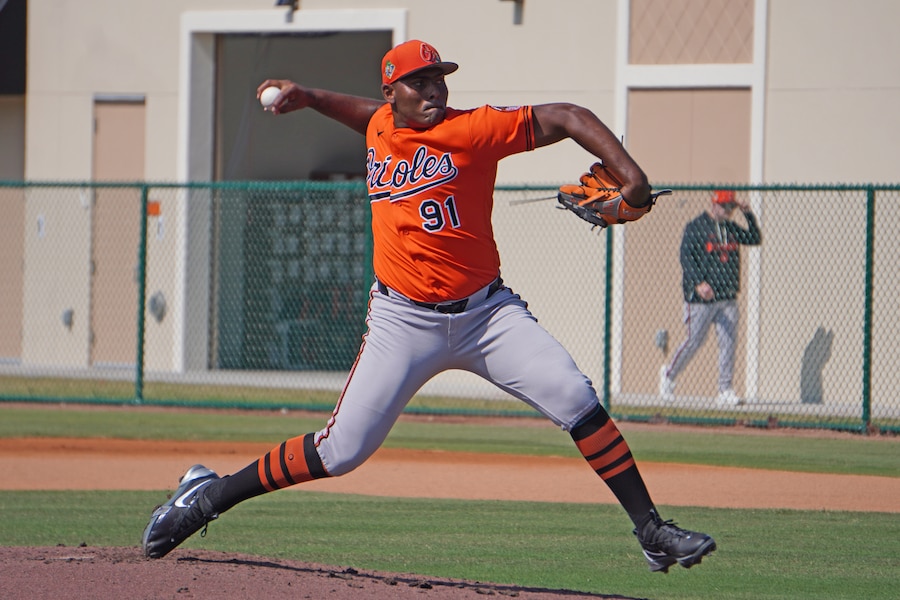
Jean Carlos Henriquez spent a decade out of pro baseball after being released from the Tampa Bay Rays’ Dominican program in 2015. That rubber arm first cut hair to support his family and later pushed papers at a bank. Through it all he pitched, and last year he finally got back into organized baseball in the Dominican Republic. The Orioles signed him almost immediately, making the 32-year-old Henriquez a compelling presence as a nonroster invitee at big league camp this month.
“It still feels like a dream to even just be here right now,” he said via club interpreter Brandon Quinones.
A towering man who moves around the clubhouse with the posture of a left tackle and a serious way about him, Henriquez needed prodding to share his full story. He warned it would take hours, and as he told it, his features softened. When he pitches, he turns his back to the batter and pauses, twisting himself back toward the plate. A conventional delivery wouldn’t make sense with this one.
Henriquez was 21 when, after two seasons in the Dominican Summer League, Tampa Bay released him. In a country where baseball is central to the culture, a release isn’t the end of the road for young ballplayers, only a diversion point. They can help train players, amateur or professional, or fill out independent league teams with an eye toward latching on somewhere, be it the U.S., Japan or elsewhere.
But Henriquez had a family to worry about. He kept throwing but worked as a barber to provide for his family, which by then included his son Evans Zahir. It wasn’t until 2019 when an opportunity to pitch materialized with Toronto of the Intercounty Baseball League, a semipro league based in Ontario, Canada. The pandemic meant he couldn’t go back in 2020, and Henriquez took a job at a bank. By then, he had a second son, Carlos Abdiel, to support.
The baseball dream remained intact. He never turned down an opportunity to pitch, in batting practice or in a game, and he made it into a full-time job in 2021. He estimated he’d make $300 or $400 a day throwing batting practice at academies or workouts, tossing as many as three sessions per day.
“Monday through Friday, live BPs alone, in a single day it would be about 300 pitches,” Henriquez said. He began working with B&E Baseball Academy in San Pedro de Macoris, working with the unsigned teenagers preparing for professional baseball.
“I would go and pitch in the morning, and then pitch again in the afternoon,” Henriquez said. “It started out that way, and they would pay me for each and every time that I went.”
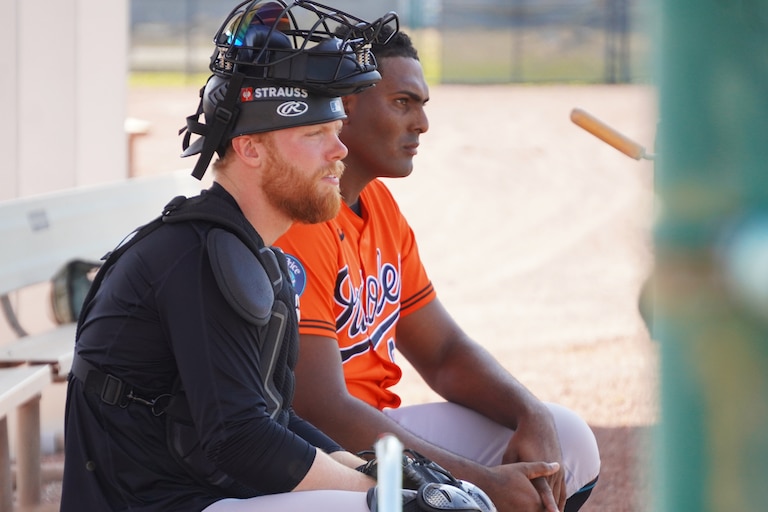 Ethan Anderson, left, and Jean Carlos Henriquez prepare to face live batters on the backfields at Ed Smith Stadium. (Paul Mancano/The Banner)
The pay was a little better in Santo Domingo, around two hours south of his hometown, San Francisco de Macoris, where he lives with his mother, Ana Mercedez, so he began taking BP gigs there. They paid even better in Boca Chica, he found, so he concentrated his work there. Eventually, he was a contracted batting practice pitcher for the Chicago White Sox and Minnesota Twins — and all that pitching made Henriquez believe there was life in that brazo de goma
“I would really use the live BPs, Monday through Friday, to prepare myself for the weekend games because that’s what really counted,” he said. “That’s where the scouts were, watching the games. I’d use that as preparation and, when I’d go pitch, I’d try to show out.”
A brazo de goma is valuable in the neighborhood games around the Dominican Republic, where a ringer like Henriquez can make all the difference. He built a reputation on those fields, but his next real chance in organized baseball didn’t materialize until last summer with Reales de Santiago, a summer league club that essentially serves as a scout team for the high-profile Dominican Winter League. Their general manager, Francisco Rosario, is a scout for the Orioles, and Henriquez pitched well enough there that the Águilas Cibaeñas drafted him for their winter ball roster.
Henriquez, a 32-year-old LIDOM debutant, first took the mound on Oct. 17. His fastball was 98 mph, and his dead-fish splitter missed bats. The Orioles like to pounce early when outliers emerge in winter ball, figuring they’re low-cost, low-risk pitching depth and waiting could welcome competition. Their pro scouting department flagged the video of Henriquez the next day, dug in and signed him after one outing.
“Once the Orioles signed me, it was mission accomplished,” he said, though he hardly coasted. His arm strength improved without the daily live BP sessions, allowing him to run his fastball up to 100 mph. He had a 2.05 ERA in 17 appearances.
And then, for the first time in his life, he came to the United States for spring training. The Orioles’ complex is worlds beyond where he has pitched before, and his is a big league uniform. A picture of him in his uniform circulated around Dominican social channels this month, celebrating his rise.
“There’s really nothing like this,” Henriquez said.
Even in an open competition for spots in the Orioles bullpen, Henriquez’s path to the major league roster is murky. He’s shown a four-pitch mix but had command issues in early camp outings, and he’s been told to focus on his defense. Given his unique background, a spell in the minors would at least allow him to acclimate to the life of a pro pitcher in the U.S.
A brazo de goma brought him this far, and to Henriquez, a decade removed from when his pro career ended the first time, there are plenty of twists in front of him.
“I know that if they have that confidence in me, enough confidence to put me on the big league squad — which is something I’m still striving for — I know I’d be ready,” he said.