
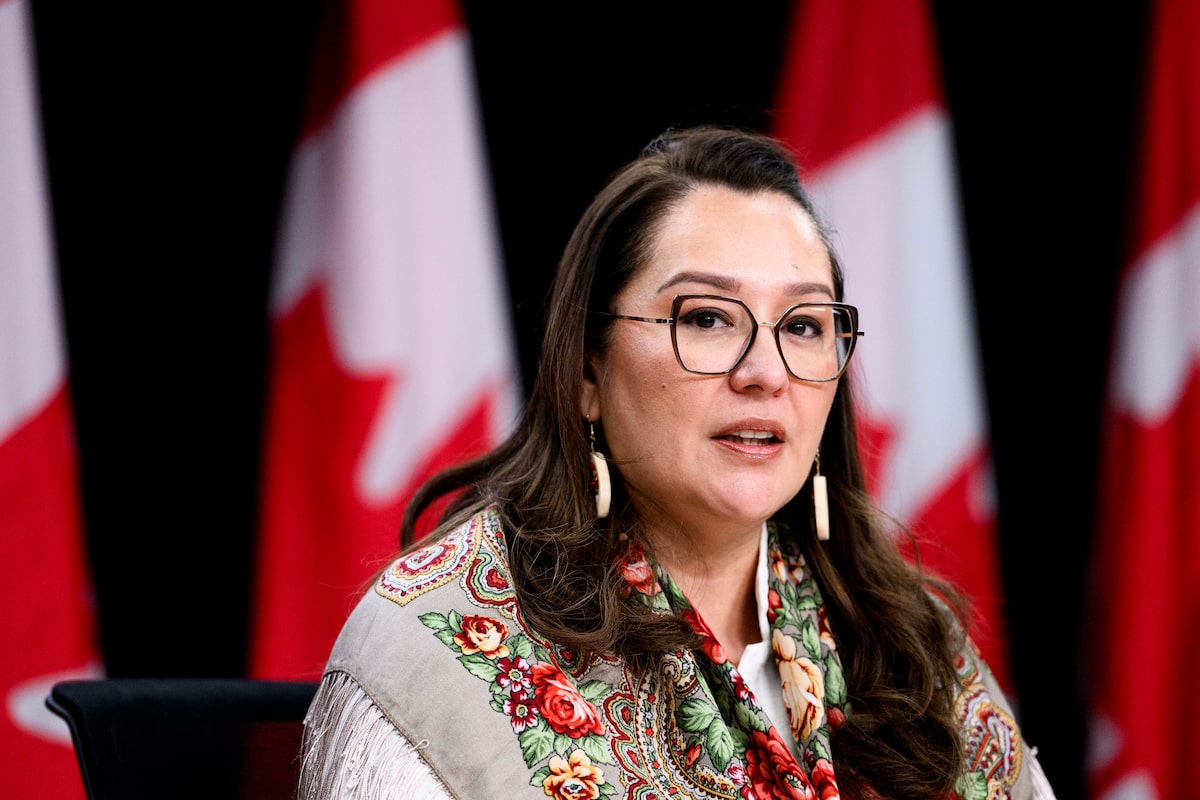
Minister of Indigenous Services Mandy Gull-Masty will announce the funding initiatives inKuujjuaq, Que., on Thursday.Spencer Colby/The Canadian Press
The federal government announced Thursday it will provide nearly $230-million in funding for a variety of programs meant to strengthen Inuit communities, including $50-million to support the first Inuit-led university.
Indigenous Services Minister Mandy Gull-Masty made the announcement in Kuujjuaq, Que., at a meeting of the Kativik Regional Government, an authority for most of the Nunavik region in Quebec. Representatives from the Makivvik Corporation, which legally represents Inuit in Nunavik, were also present.
Inuit Tapiriit Kanatami, or ITK, the national organization that represents Inuit, said last week that the main campus of the proposed Inuit Nunangat University would be located in Arviat, Nunavut, which is along the western coast of Hudson Bay.
Inuit Nunangat is the name for the region that spans the Inuit homeland in Canada. That encompasses Nunavik (northern Quebec), Nunavut, as well as northern parts of Labrador, the Northwest Territories and the Yukon.
The university is set to open by 2030 and serve roughly 100 students. While funding for the university was mentioned in the fall budget, the specific amount was not detailed. The $50-million will come from the budget’s Build Communities Strong Fund.
“We are investing in generations of Inuit learners, leaders and builders,” Ms. Gull-Masty said.
She also announced $27-million over five years to support tuberculosis elimination in Inuit Nunangat. In 2018, the federal government and ITK jointly committed to eliminating the disease by 2030.
The funding will go toward better prevention, screening, diagnosis and prevention of the disease, with the work carried out in partnership with Inuit organizations.
The 2030 pledge was made because Inuit Nunangat continues to have disproportionately high rates of tuberculosis, attributed partly to overcrowded housing, food insecurity and lack of adequate health care access.
Nunavik, in particular, continues to face high case numbers. Its Regional Board of Health and Social Services told The Globe and Mail that there have been 15 cases since the start of 2026. There were 117 cases in 2025 and 95 cases in 2024.
First Nations youth programs lose Jordan’s Principle funding after changes to eligibility
Maggie Emudluk, the chair of the Kativik Regional Government, said she was pleased to see the funding.
“I’m very happy to see that more efforts or more funding will be injected to Inuit Nunangat to combat this terrible disease,” she said. “It’s curable, and I’m sure the health board will have more funding to address this.”
ITK had asked for $131.6-million over five years in its prebudget submission.
Ms. Gull-Masty also committed $115-million for a one-year extension of the Inuit Child First Initiative, which provides children with equal access to health, educational and social supports without delay. It is based on Jordan’s Principle, which serves First Nations children.
Over this year, Ms. Gull-Masty said she intends to work with Inuit partners to determine the program’s outcomes and targets. The government and Inuit organizations are also co-developing a long-term solution.
“If we are going to define a program to try to meet the needs of Inuit children, it has to be done by investing the time to be sure that the program reflects the realities and outcome that communities are looking for and not solely driven by the perspective of government, because that is reconciliation,” Ms. Gull-Masty said.
Families have faced challenges accessing the program because the government imposed a new operational bulletin in February, 2025, which largely increased the documentation requirements for requests.
Ms. Gull-Masty acknowledged the challenges the bulletin created. She did not share details, but said in future announcements there will be new measures to “allow for parents and families to have easier access in the application process.”
She also announced $30-million in top-up funding for Nutrition North Canada, which aims to make healthy food more affordable in remote communities, and $6.3-million for the Northern Isolated Community Initiatives Fund, which is meant to support people working on practical solutions to grow, process and distribute food locally.
ITK president Natan Obed, who could not attend the announcement, said that he welcomes the funding.
“These investments reinforce the need for long-term funding to address the inequities in Inuit Nunangat that are at the root of the food insecurity and poverty we experience, as well as the ongoing tuberculosis crisis,” he said in a written statement.