
Welcome to the third annual edition of the “Not Top 100,” which consists entirely of players who, while not considered Top 100 Prospects, are those we believe have a good chance to contribute to a major league roster. This year, we’re taking things a step further by building the team using only players with Triple-A experience.
Our primary motivation in creating the Not Top 100 is to push back against misconceptions that the only valuable prospects in baseball are those that make Top 100 lists. In fact, the actual difference between a prospect ranked No. 150 and a prospect ranked No. 100 isn’t as great as you might think.
Extra consideration was awarded to players satisfying these conditions and also ranking outside of the Top 30 prospects for their respective organizations. These six lists combine for over 160 different players. 56 players were on all six lists.
Ok, with those stipulations in mind, we now present the 2026 Not Top 100 team.
Position Players
Eduardo Valencia, C, Tigers
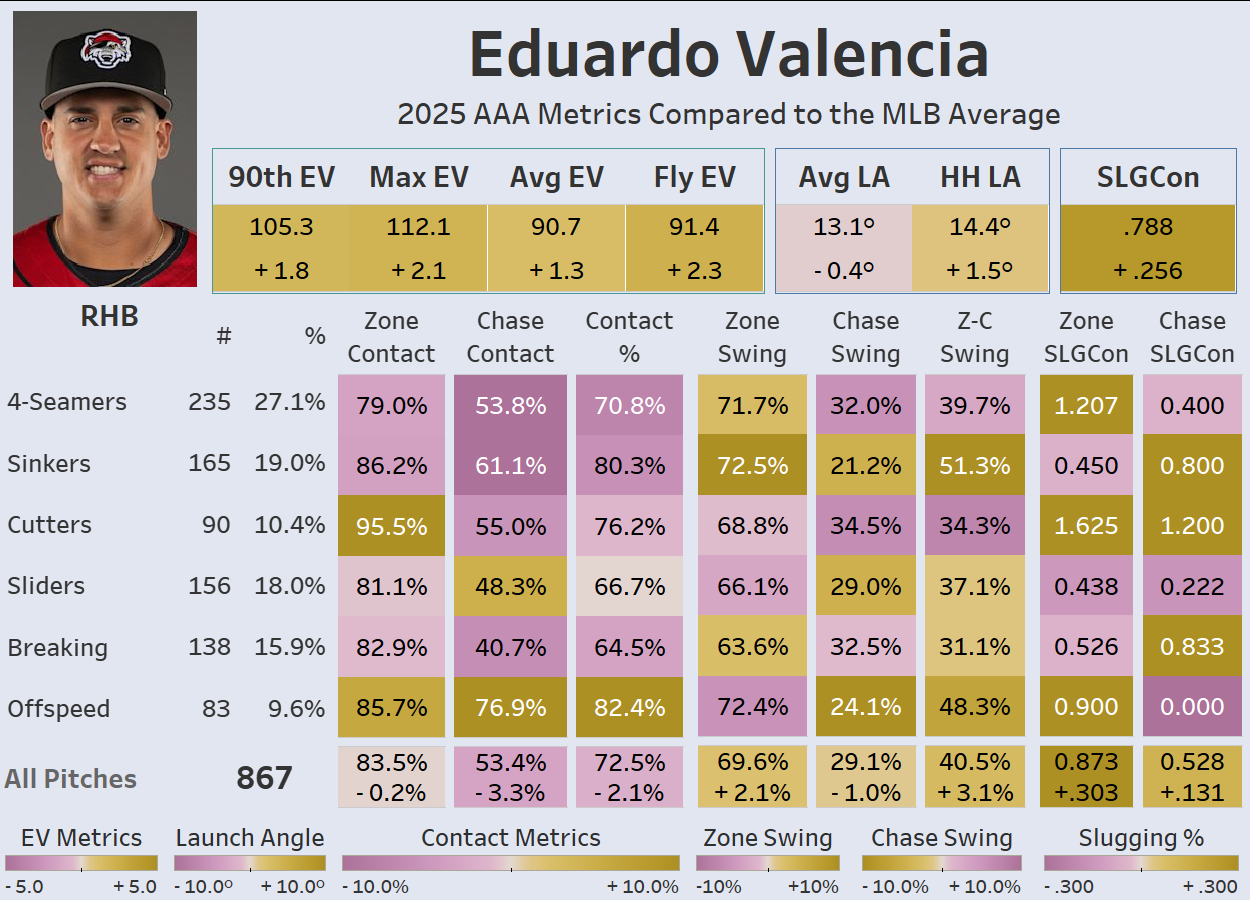
Valencia currently ranks 29th for the Tigers due to concerns about his viability behind the plate. Further, his lack of a track record prior to 2025 makes it difficult to project him going forward. In 2024, Valencia played most of the year in A-ball, putting up an average batting line as a 24-year-old. Fast forward a year, and he’s transformed himself into a force, slashing .311/.382/.559 with 24 home runs across Double-A and Triple-A. His run production was almost 60% better than league average.
Baseball Prospectus’ fielding metrics have Valencia as a roughly average catcher, if not slightly above average. So, he may have a chance to stick at catcher, though he’s unlikely to be more than a backup option there. What’s quite clear, though, is that Valencia’s bat is very real. His production at Triple-A was largely backed up by his underlying metrics.
Let’s begin with the top-line power metrics. Both his maximum and 90th percentile exit velocities indicate roughly 60-grade raw power, with better results on fly balls and higher launch angles on his hard-hit balls. That indicates he could have 60-grade game power, as well, if it all translates to the majors.
He combines that with swing decisions that are a tick above average, both in terms of aggression in the zone and avoiding chase. The big question mark pertains to Valencia’s bat-to-ball, where he showed roughly MLB average zone contact rates with some swing-and-miss against fastballs. This all adds up to a potentially average-or-better major league bat if he can hold on to the massive gains he made.
Abimelec Ortiz, 1B, Nationals
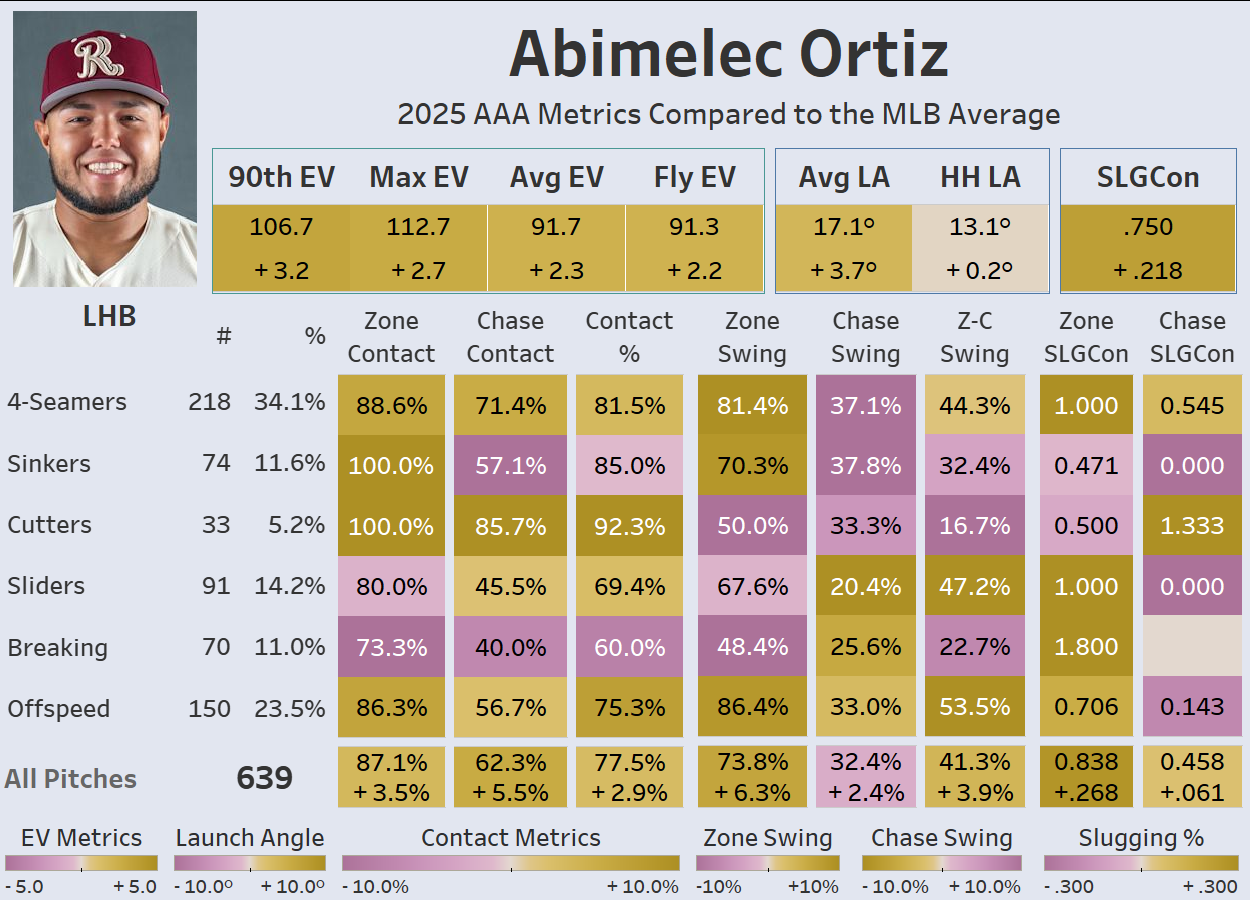
Ortiz was perhaps the least heralded of the prospects in the MacKenzie Gore trade, but he’s no slouch. He has easy 60-grade raw power, perhaps touching 65. This shows up in games, too, as Ortiz has hit 76 home runs over his last 328 games. While he hit seven of his 25 home runs last season against lefties, he also had a .188/.305/.393 slash line against same-handed pitching, so we may be looking at a strongside platoon bat.
Ortiz is a bit aggressive but doesn’t chase non-fastballs, and he makes plenty of contact, suggesting he might be a 50 hit/60 power guy. The Nationals don’t have a ton of options at first base and designated hitter, so a strong spring might earn him a starting role.
Ernesto Martinez Jr., 1B/DH, Yankees
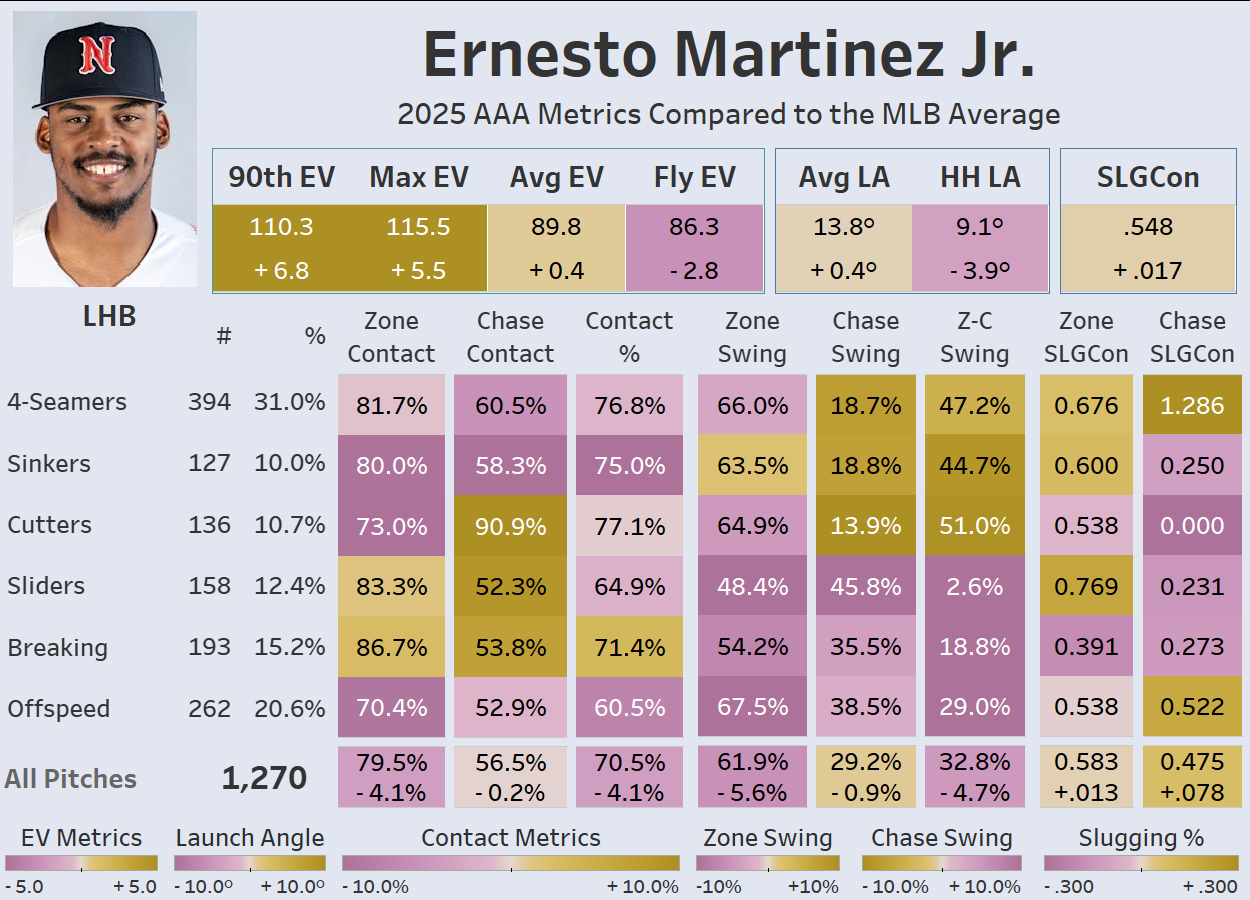
The Yankees scooped up Martinez on a minor league contract, likely due to his true 80-grade raw power. However, despite his enormous power potential, he’s never been able to turn it into meaningful production.
On the one hand, Martinez’s 90th percentile exit velocity is almost the equal of Aaron Judge. On the other hand, his average flyball exit velocity is a paltry 86.3 mph—well below the major league average. Furthermore, when he does hit the ball hard, it’s often on the ground, meaning he wastes most of his hard-struck balls.
Put more simply, Martinez needs to have a more loft-oriented swing in order to turn his raw power into game power. In most cases, this is a profile that is unlikely to succeed. If it were an easy thing to fix, Eric Hosmer would be a Hall of Famer and every team would be chasing Martinez.
However, the Yankees recently had success converting Spencer Jones from a similar profile into a high launch angle, damage-on-contact monster. From 2022 to 2024, Jones averaged between 8-10 degrees of launch angle. Last year, after a swing change, he raised that to 15 degrees, with a superb 18.6-degree average launch angle on his fly balls.
This pick is definitely a moonshot with a low probability of panning out. It’s a hunch that the Yankees have a player development plan for Martinez. Time will tell if it works.
Mikey Romero, 2B, Red Sox
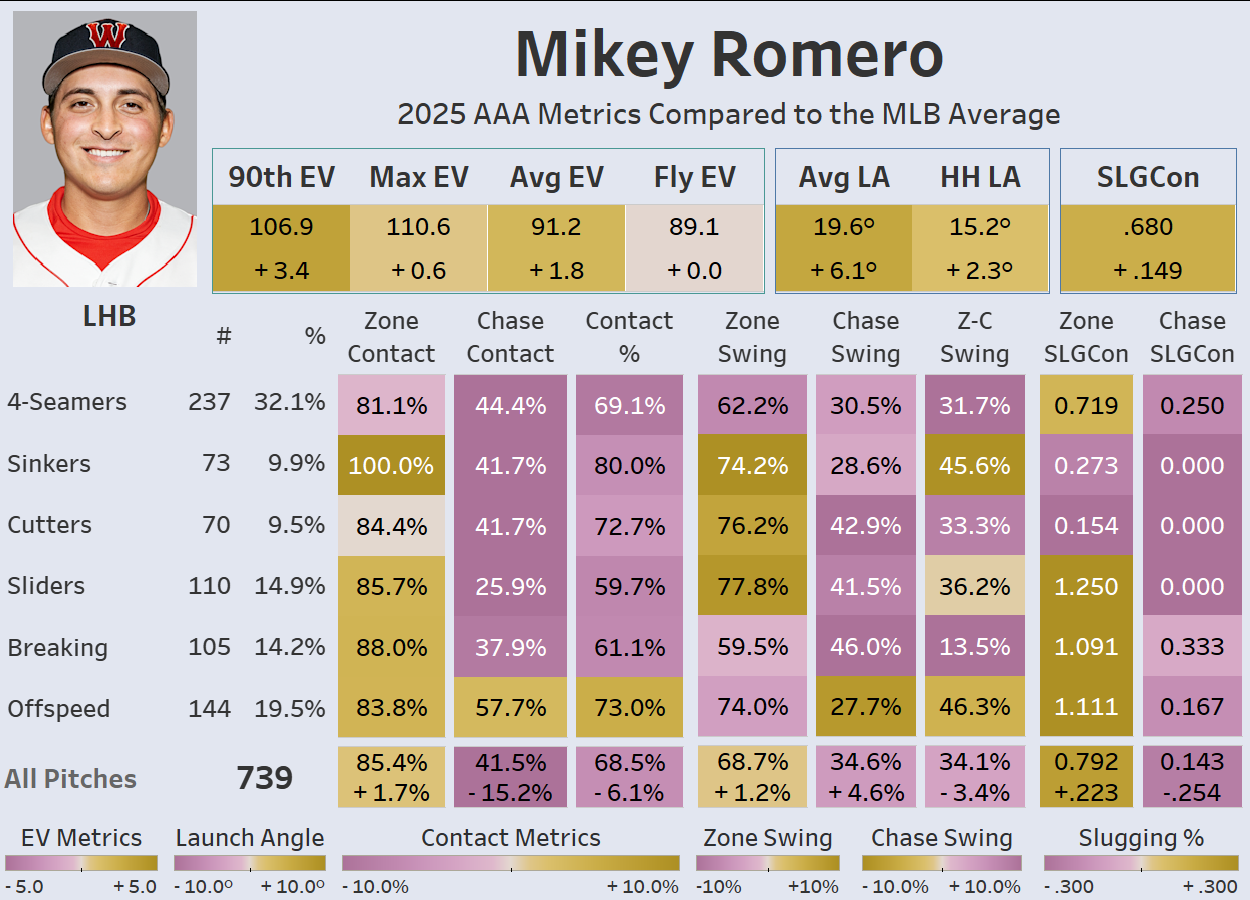
Romero is the quintessential “sneaky pop” type of hitter. He gets the ball in the air and has enough thump that he can probably get to 15 homers a year in a full-time role. His data suggest he doesn’t have a ton of barrel adjustability, given the stark contrast between his in-zone and out-of-zone metrics. Both his quality of contact and ability to make contact craters when he chases, despite a relatively small strike zone.
Romero also doesn’t suffer against lefties, though the sample size is small:
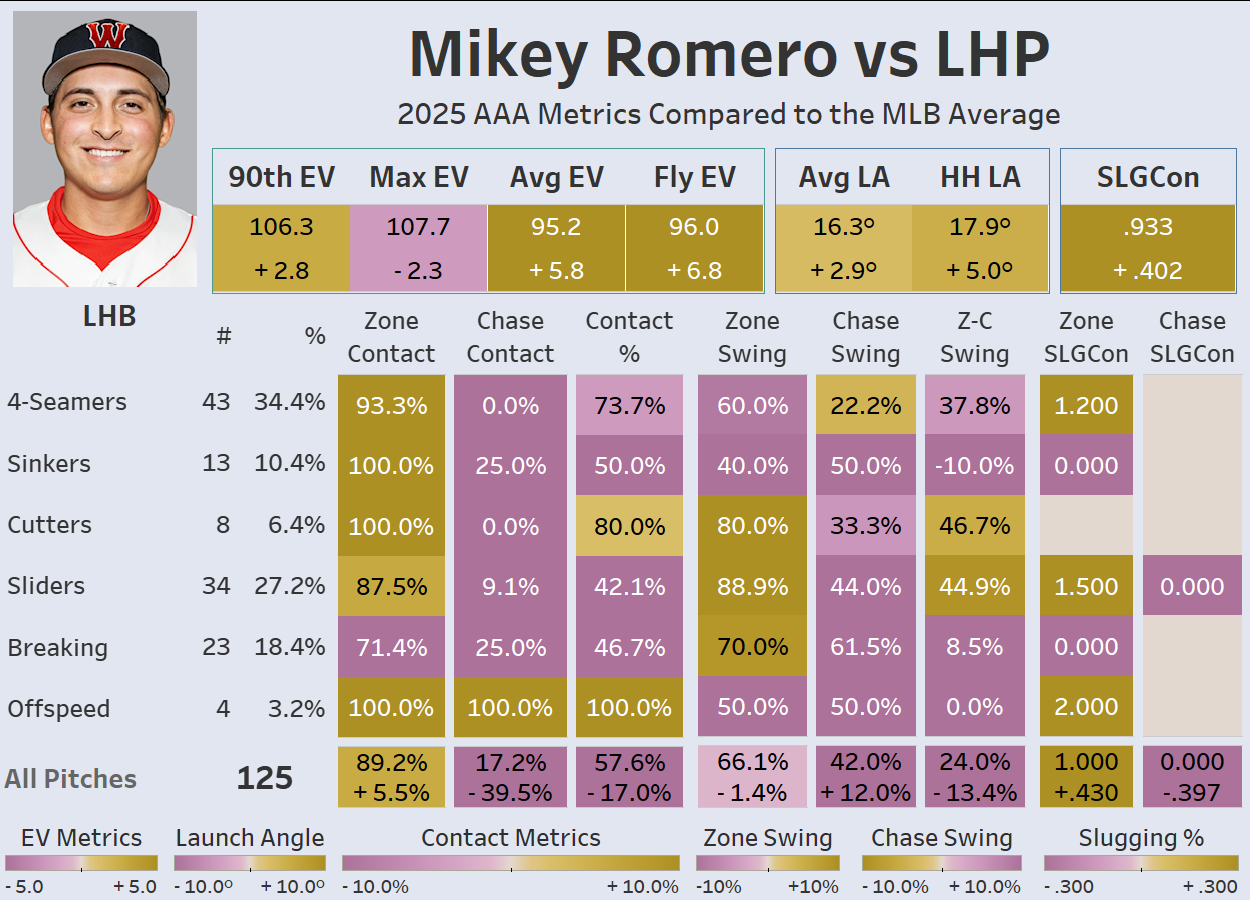
His in-zone vs. chase discrepancy grows, but his power numbers are superior. This suggests he could be an everyday player who might surprise a lot of people with how productive he is.
Brice Matthews, SS, Astros
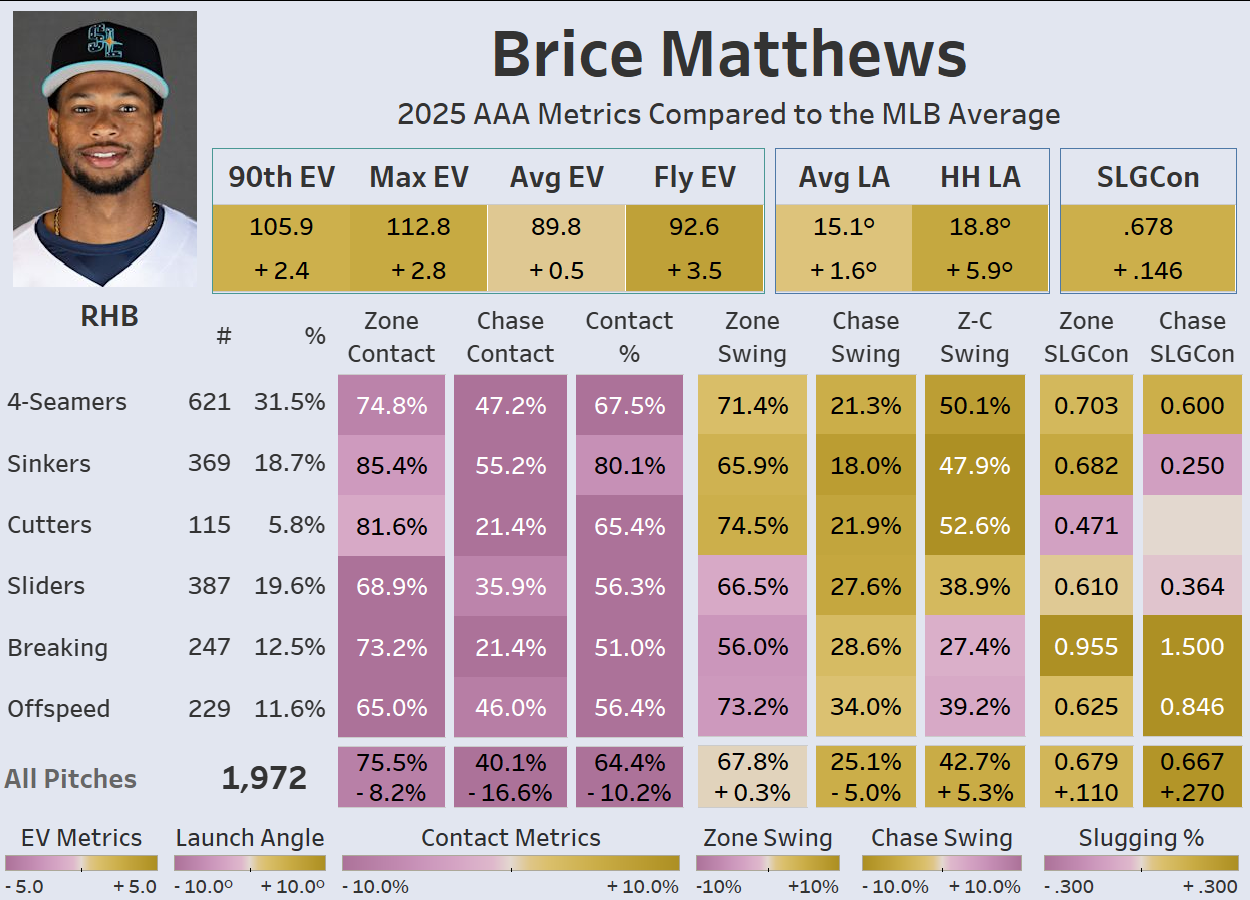
Matthews’ profile in Triple-A is fairly straightforward to analyze: plus power or better, plus swing decisions and an optimized swing geared at maximizing power. The obvious red flag is his inability to make consistent contact. He had a brief cup of coffee at the end of last season, so we can see how these tools translated to the majors:
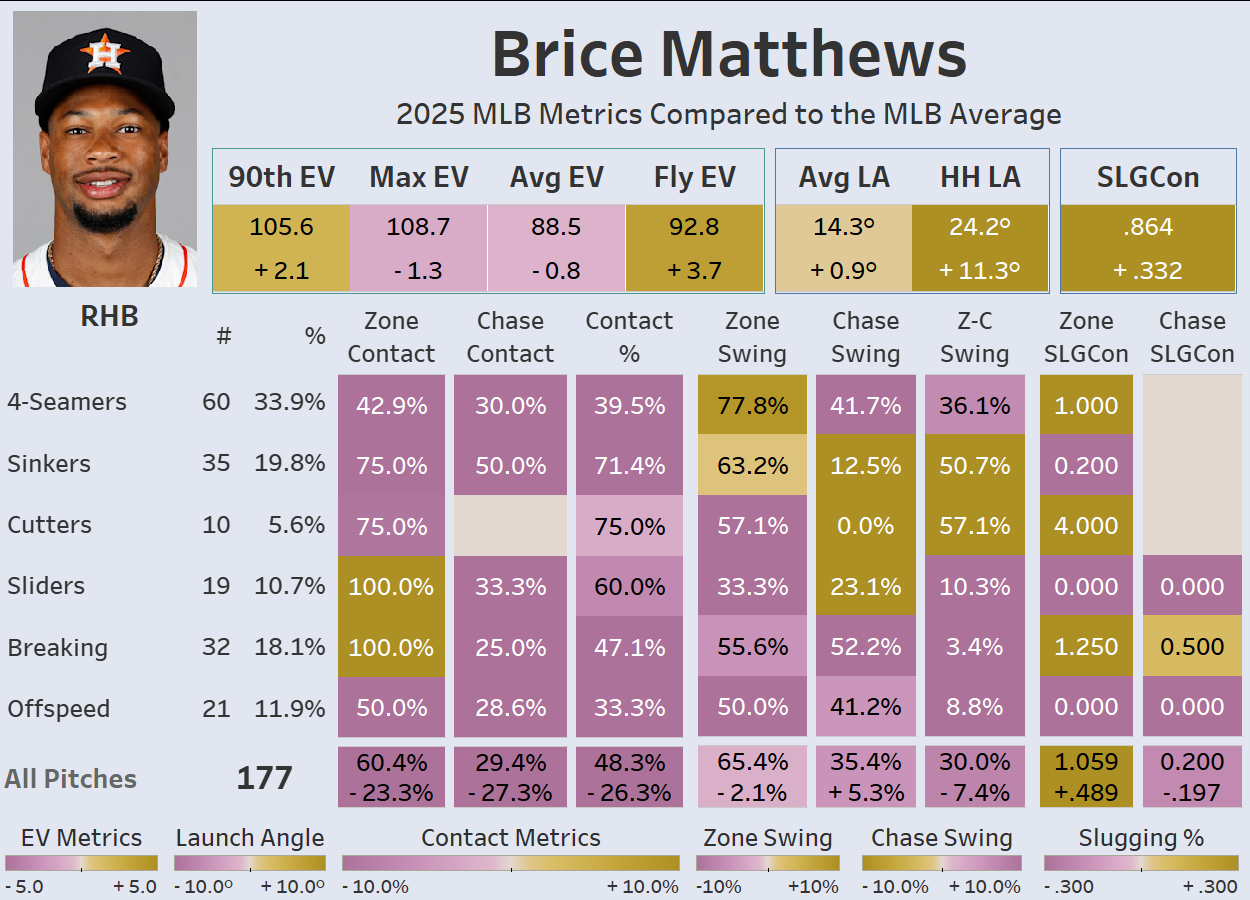
The raw power held up, as did his ability to drive the ball in the air. He maintained his flyball exit velocity and his hard-hit launch angle, but he really struggled to make contact. His chase rates against breaking balls and changeups spiked, too. For the fantasy baseball readers out there, this is the type of player who comes out of nowhere and puts up a 20/20 season if he can get enough playing time.
Hao-Yu Lee, 3B, Tigers
Let’s play the Player A/Player B game. We’ve given away one already as Lee, but the other player may surprise you. The metric in bold indicates which player is doing better in that metric while in Triple-A:
Metricplayer aplayer BAge23.023.090th Percentile EV105.5105.9Maximum Exit Velocity112.2110.4Zone Contact %83.0 %87.0 %Zone Swing %69.7 %69.1 %Chase Swing %28.4 %30.3 %Avg Launch Angle11.6 degrees9.1 DegreesHard Hit Launch Angle11.0 degrees8.5 DegreesFly Ball Exit Velocity89.8 mph92.5 mph
Player B makes more contact and better contact in the air. Player A has better swing decisions, as well as generally better launch angles. Raw power is roughly equivalent, though Player A showed a higher max.
Player A, of course, is Lee:
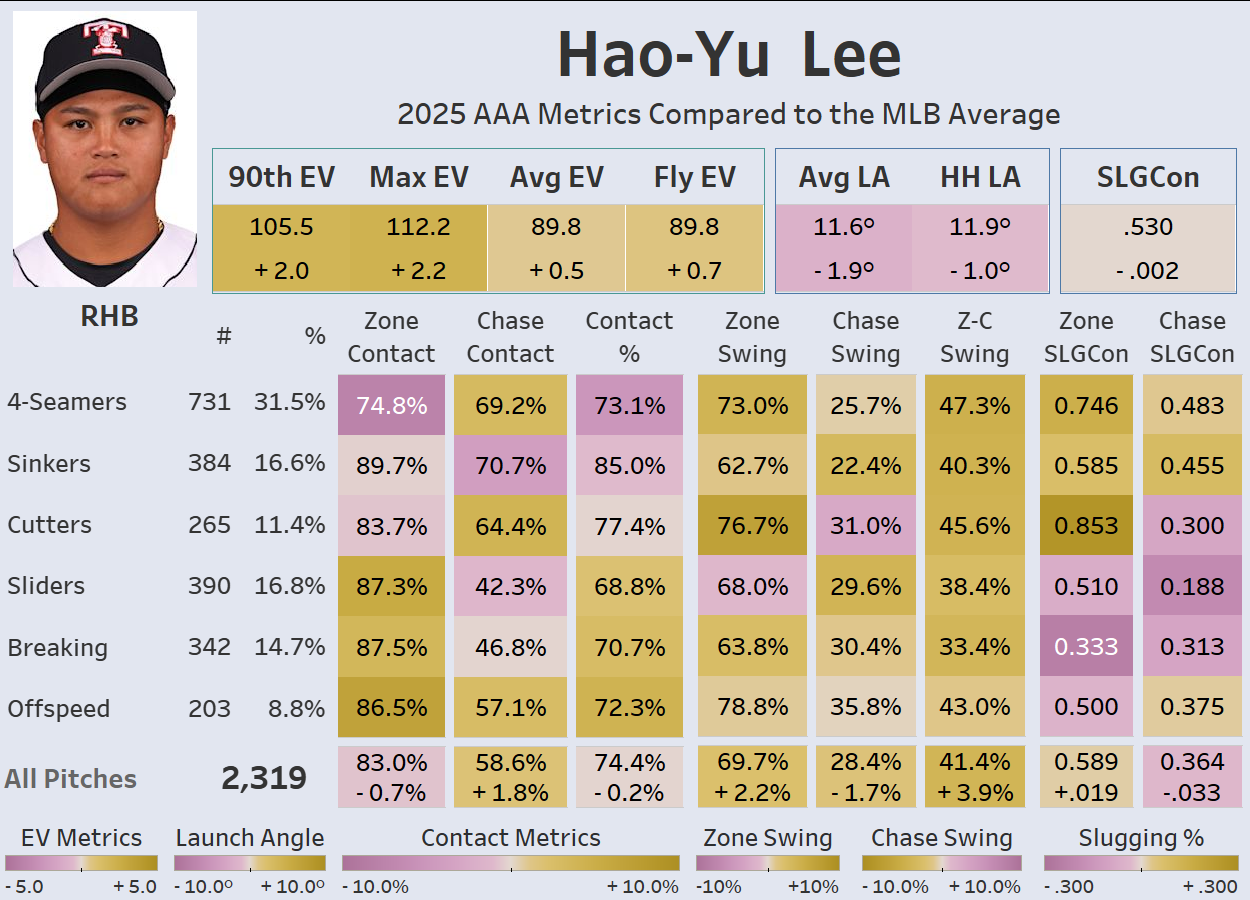
Player B is a consensus top 20 prospect, ranking between 10 and 21 on the lists mentioned above. We’re talking about Mets No. 2 prospect Carson Benge.
This is not to say that Lee is a top 20 prospect. Benge has produced more on the field, ticks more scouting boxes and projects to have more defensive value. However, Lee’s metrics are similar enough to Benge’s that it wouldn’t be a shock if he was able to produce similar value with the bat.
Yohendrick Pinango, OF, Blue Jays
Pinango does two things really well: hit the ball hard and make lots of contact.
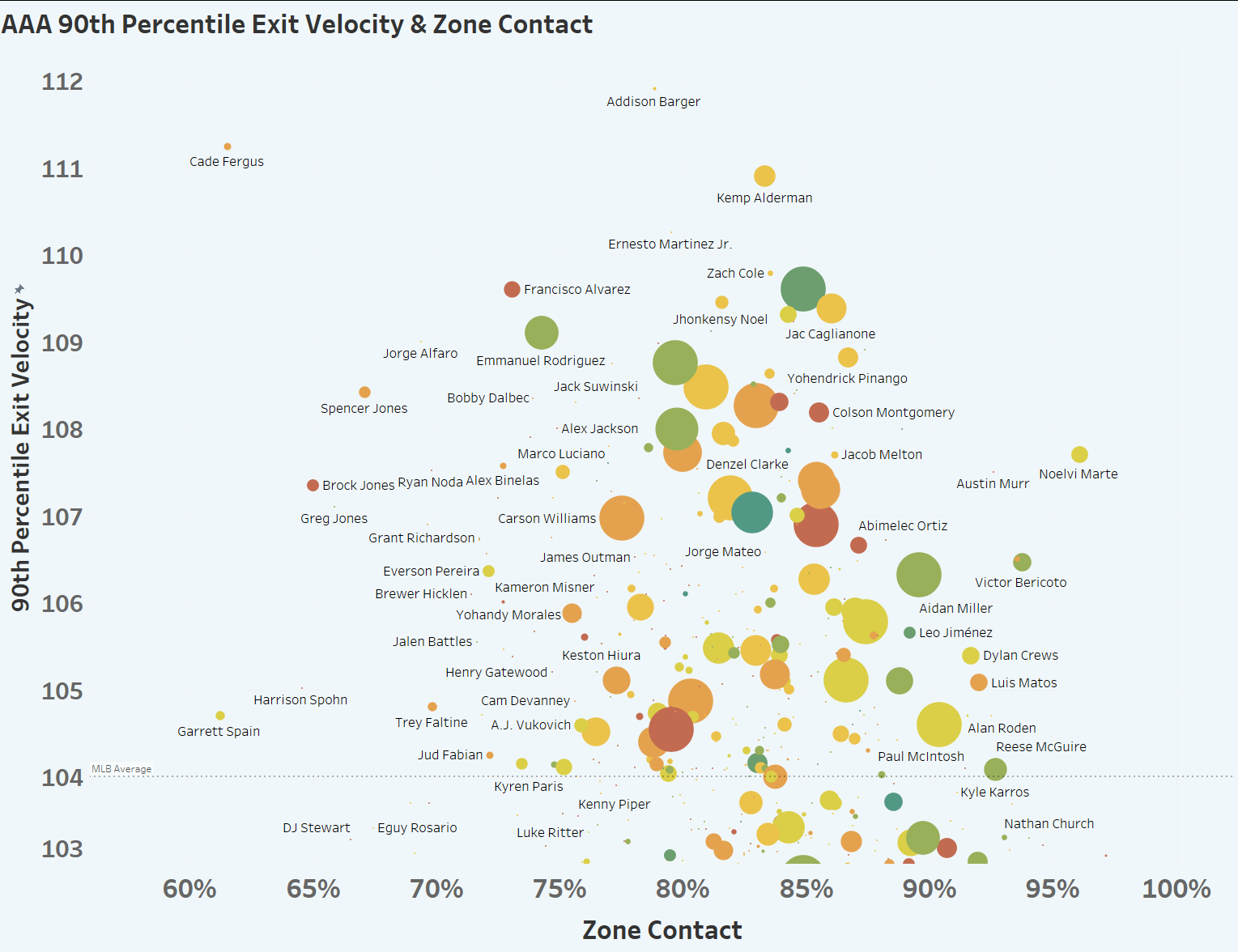
Last season, Pinango was clustered in the same area as Jac Caglianone, Colson Montgomery, Coby Mayo and Jacob Melton. There aren’t a lot of hitters with 70-grade or better raw power and a zone contact rate against fastballs over 90%. However, he has a fatal flaw:
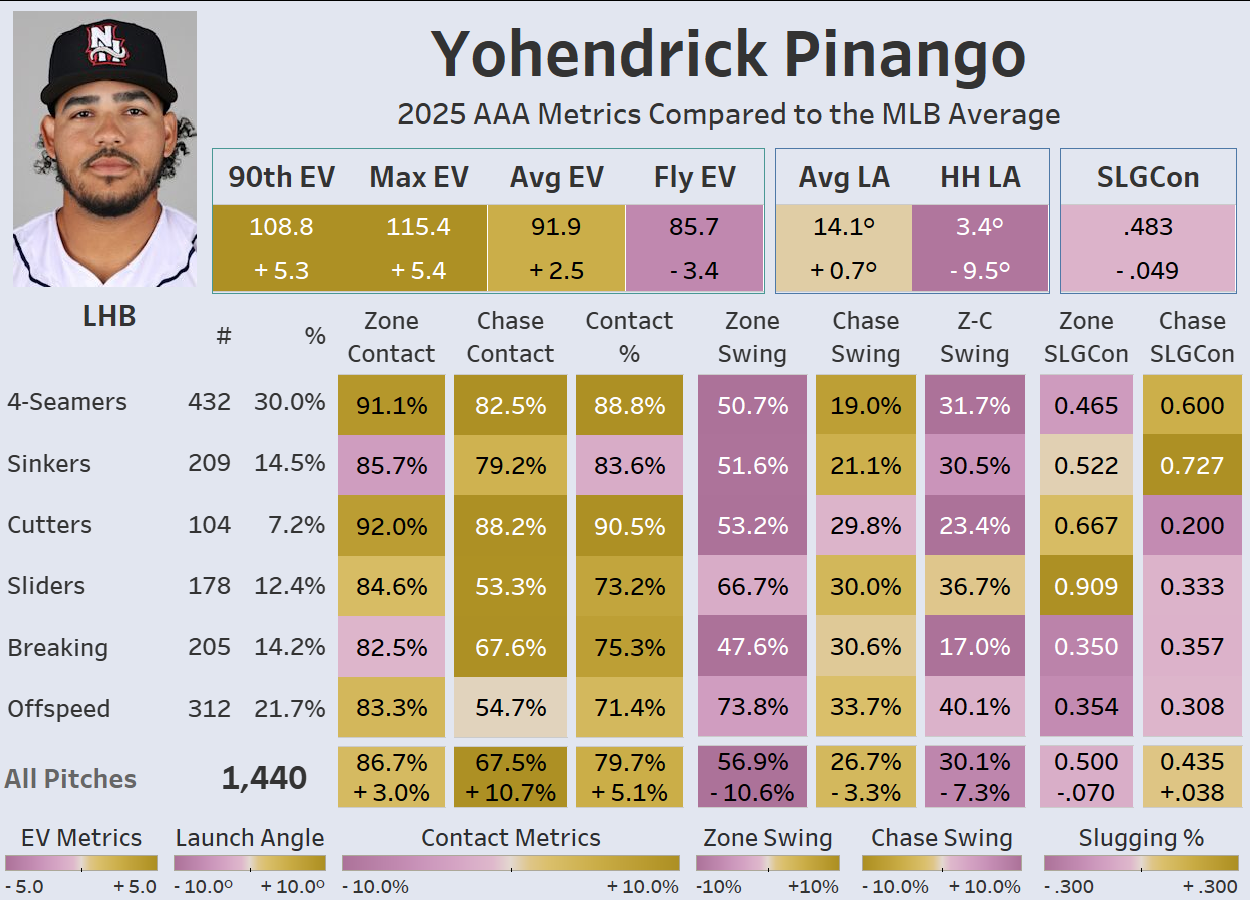
Much like Martinez, Pinango’s best contact is on the ground. In many ways, hard-hit launch angle is often the most important metric for a young power prospect. In this regard, Pinango is roughly a 20. For context, his hard-hit launch angle is roughly equivalent to Justin Crawford’s. This severely limits his power potential. He’s likely also limited to a platoon role, as his contact rates are significantly worse against lefthanded pitchers.
He’s a high-probability major leaguer, with significant upside if he can figure out how to get more loft on his hardest-hit balls.
Nelson Rada, OF, Angels
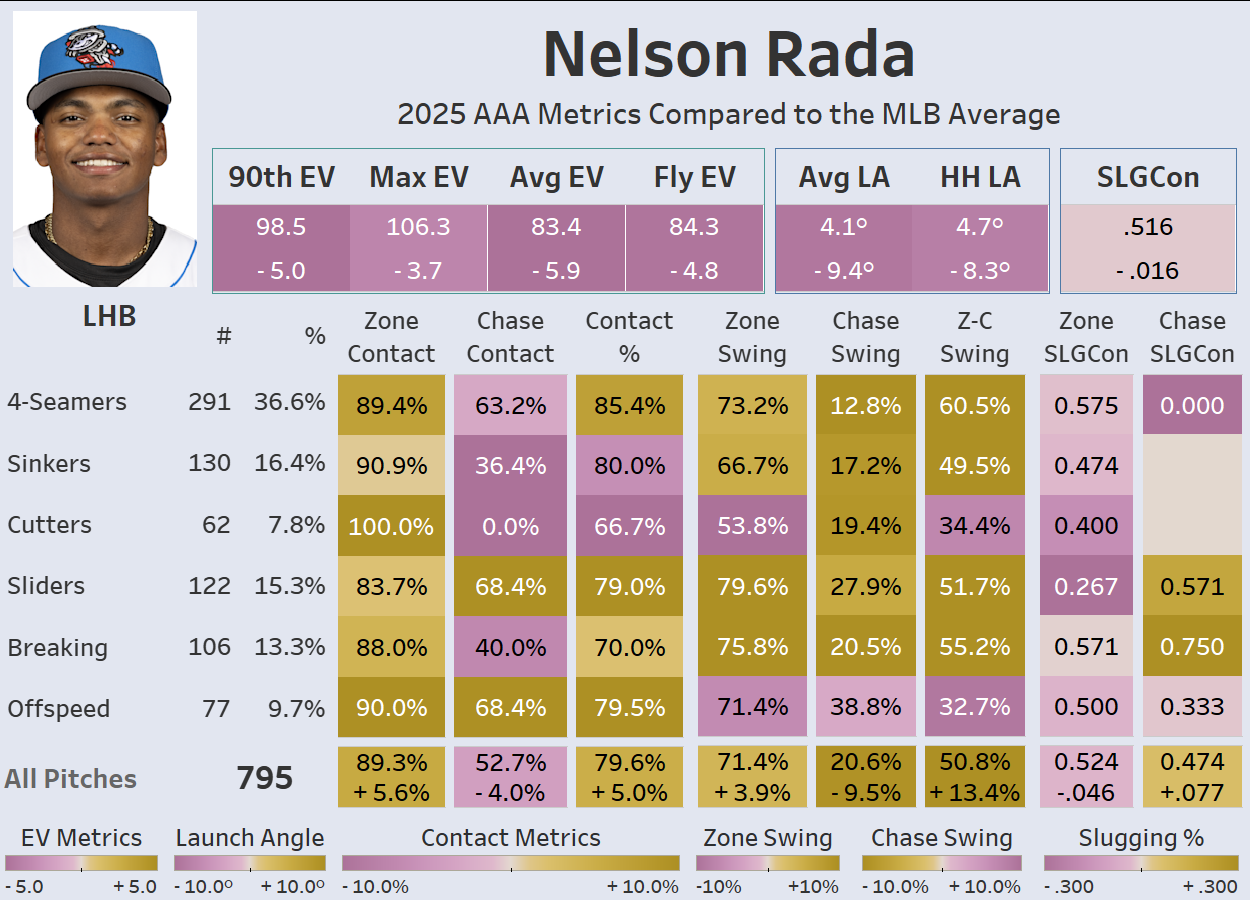
Rada would be my pick for the most underrated prospect in the game. His combination of contact and plate discipline makes him a good bet to be at least an average bat at the major league level. He’s also extremely young for Triple-A, which, while not uncommon for Angels prospects, is typically an excellent indicator of future success.
A good example of what Rada might look like at the major league level is Xavier Edwards:
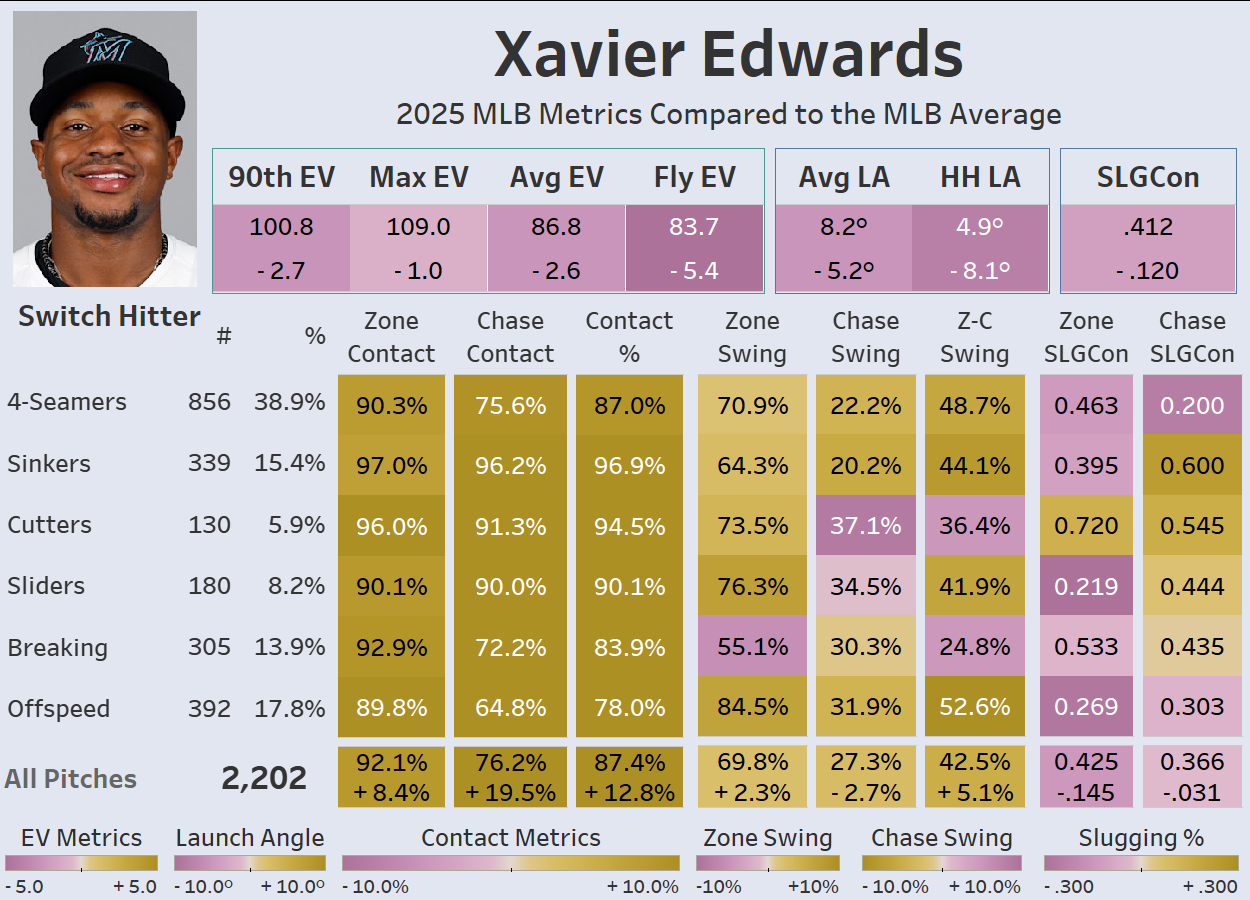
Edwards has accumulated 4-5 wins already in less than two seasons. The combination of roughly league average offense at a premium defensive position is often good for 2-3 wins. It wouldn’t be a stretch to see Rada play a solid center field while putting up a good batting average with enough walks to keep him around league average with the bat.
Kemp Alderman, OF, Marlins
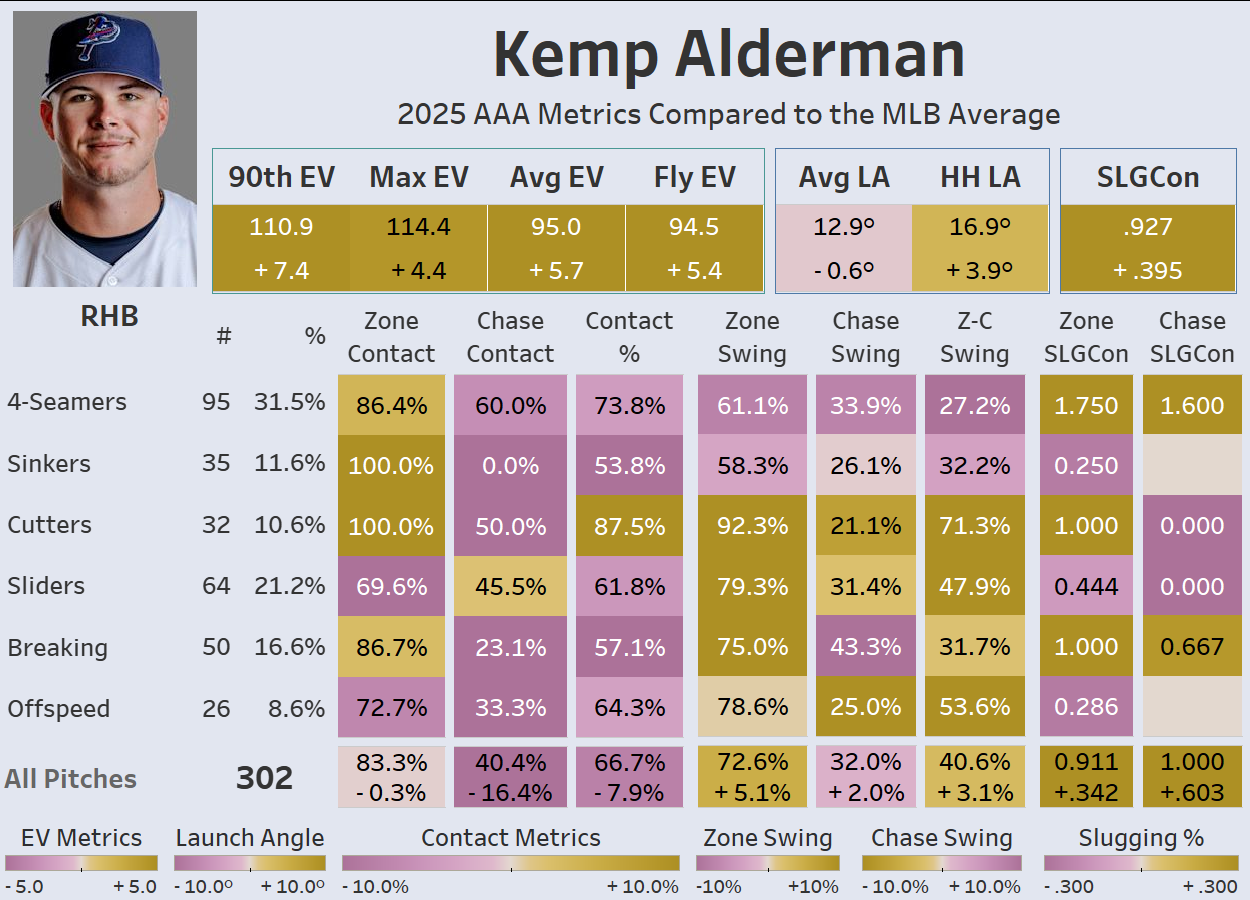
Alderman is my “pick to click” from this list. Only three players posted a 90th percentile exit velocity above Alderman’s 110.9 mph: Oneil Cruz, James Wood and Aaron Judge. It’s also higher than any prospect in the Top 100. More importantly, he makes his best contact in the air, with a plus-plus 94.5 mph average exit velocity on his fly balls. There is some swing-and-miss to his game, but he’s close enough to average that his power will play.
He’s a couple years older than Lazaro Montes, but they have similar archetypes. Personally, I’d take Alderman over Montes, given his proximity and superior raw power. Alderman also projects for more value on the defensive side of the ball. Montes is a consensus Top 100 prospect, ranking mostly between 43 and 97 on the various lists above, with ESPN ranking him at No. 108.
Zach Cole, OF, Astros
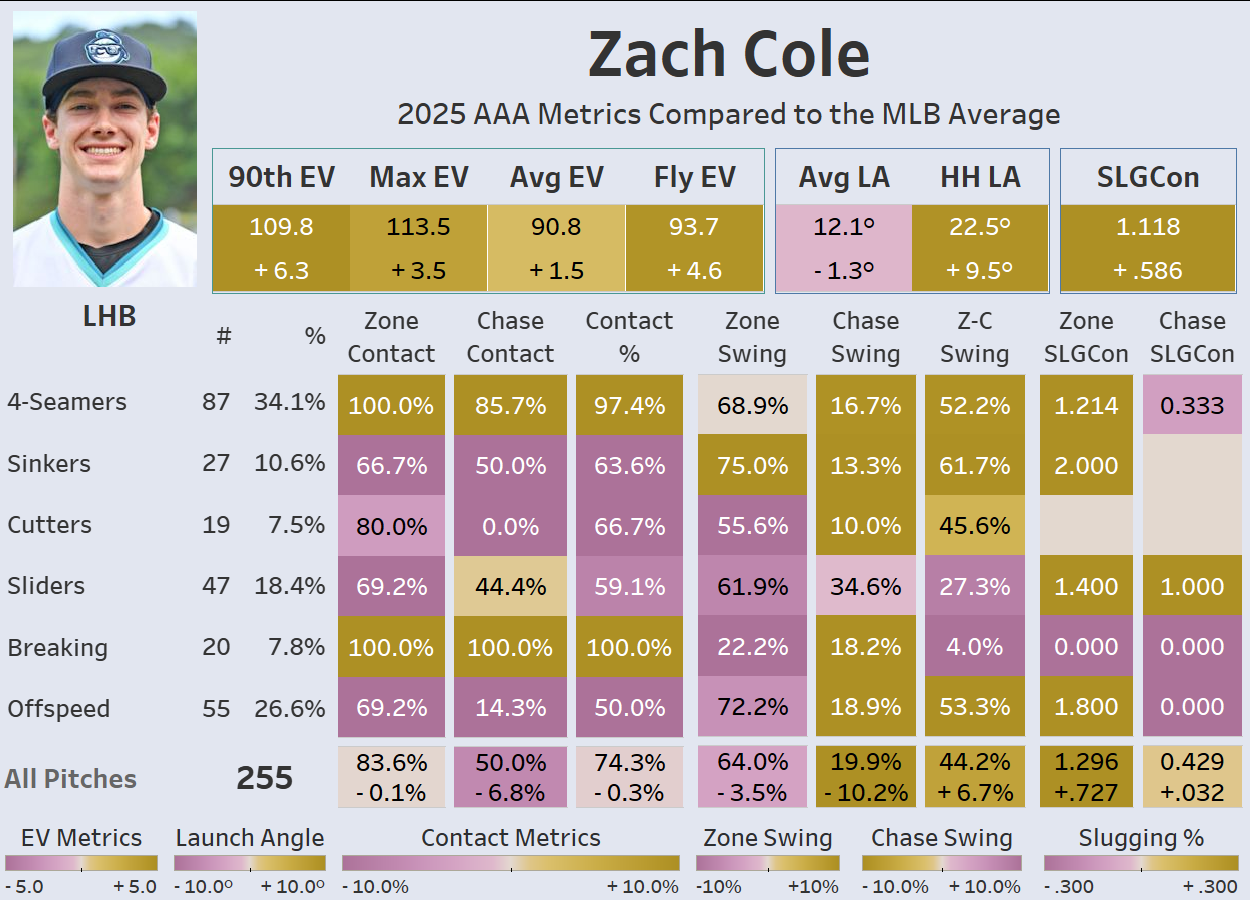
We’re including Cole as a platoon outfielder. His Triple-A batted-ball data is eye-popping, as it’s top-of-the-scale raw power that was fully backed up by plus-plus bat speed in the majors. He also posted a 28.7 ft/sec sprint speed, putting him in the 83rd percentile.
His data regressed some after his promotion, but the batted-ball data was remarkably similar:
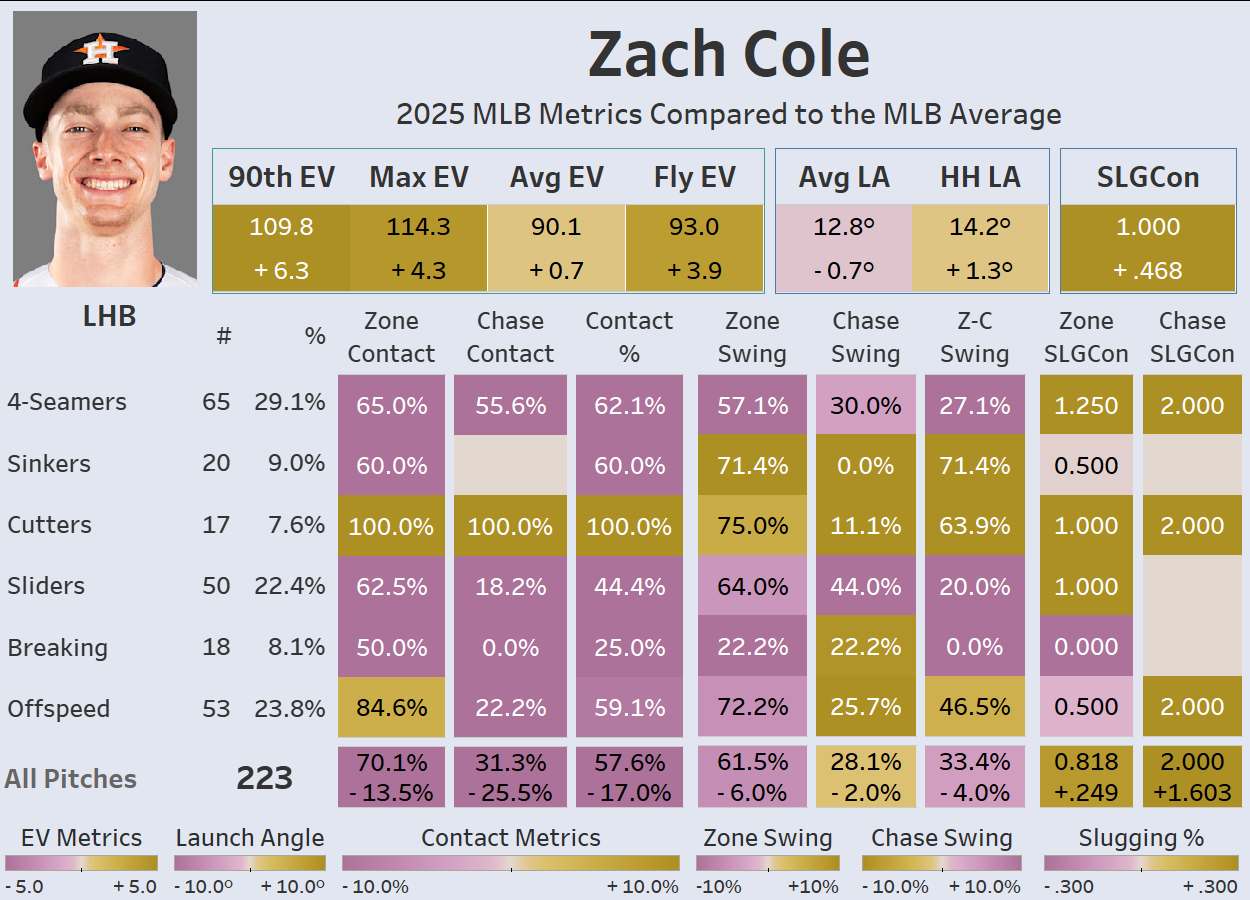
Most importantly, Cole didn’t chase, even after his promotion. Good discipline with strong flyball exit velocities usually results in high-impact bats. Swing-and-miss is an obvious red flag, but if he can get to 75% zone contact, he could very well crack 25-30 home runs with a palatable batting average.
Starting Pitchers
Miguel Ullola, RHP, Astros
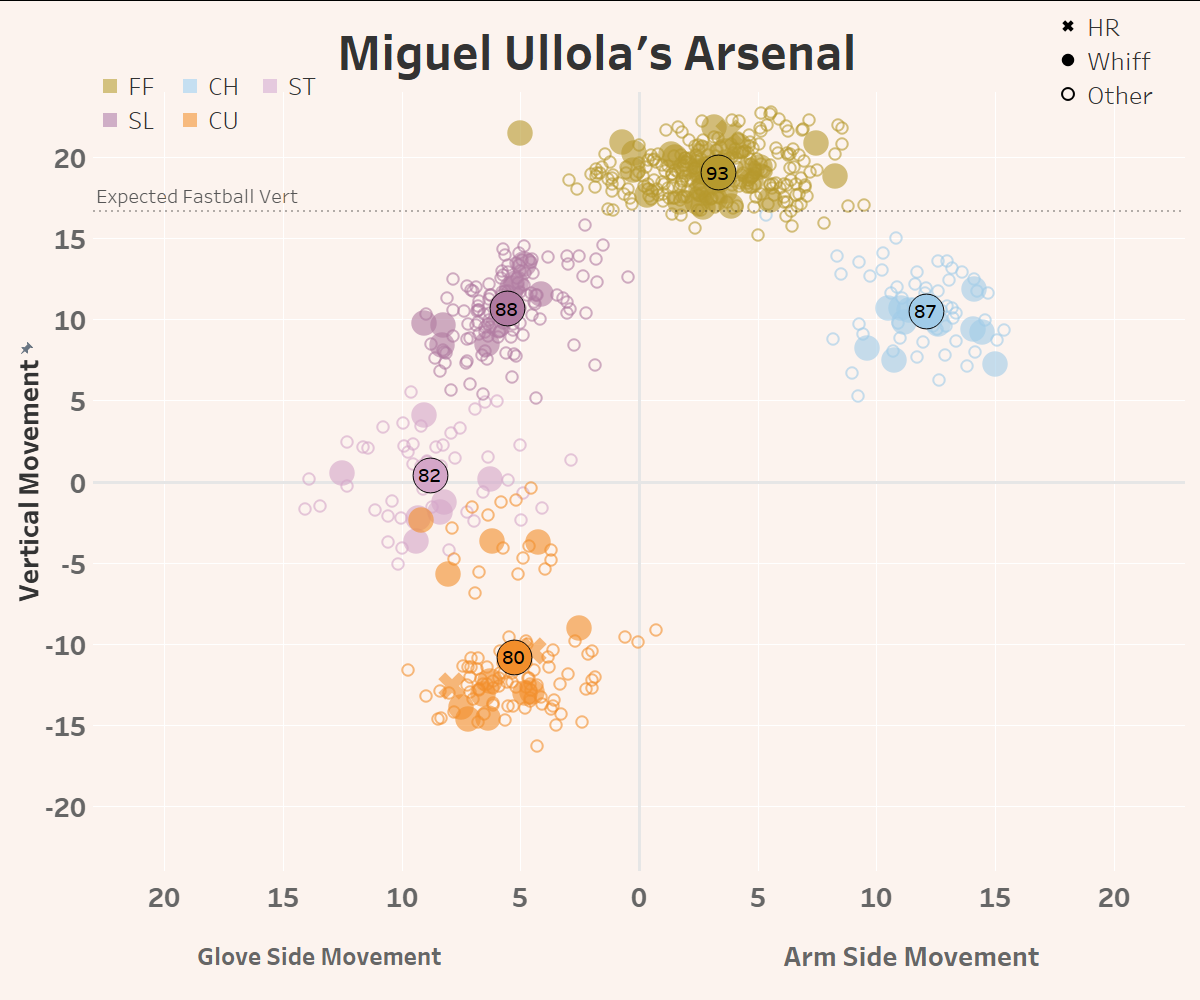
Ullola features five whiff-generating pitches, headlined by a solid fastball he throws 44% of the time. He struggled to throw it for strikes, throwing it in the strike zone only 40% of the time to help result in a BB/9 rate north of six. While that’s clearly unsustainable, projection systems are somewhat optimistic on his prospects despite the walk rate. Let’s take a look at what The Bat X over at FanGraphs projects for various rookies:
nameProjected ERAprojected K%Jonah Tong3.5828.2%Trey Yesavage3.7727.3%Nolan McLean3.7823.3%Miguel Ullola3.8428.0%Brandon Sproat3.9420.7%Cam Schlittler4.0523.7%Bubba Chandler4.1123.5%Rhett Lowder4.6419.5%Gunnar Hoglund4.8719.5%
Though other projection systems are more skeptical, in the list above, Ullola projects for the fourth-best ERA and second-best K%. The Astros have a long history of turning unheralded pitchers into valuable rotation pieces. Ullola looks to be the next man up.
David Sandlin, RHP, White Sox
StuffPro from Baseball Prospectus has Sandlin with six pitches plus or better. Perhaps the Red Sox have a different model or are prioritizing other things, as they traded him to the White Sox for Gage Ziehl. This provides a clear path to playing time for Sandlin, who was a starter all the way through Double-A and struggled a bit with a mid-season bullpen transition.
Sandlin sits 97 mph with the fastball, touching 100 with above-average ride on the fastball. He struggled to throw the pitch for strikes in Triple-A. His sinker has the identical spin axis to his fastball, coming out a touch slower with about 10 inches more run and a healthy dose of seam-shifted wake. There’s likely room for optimization there, but as is, it’s another good pitch.
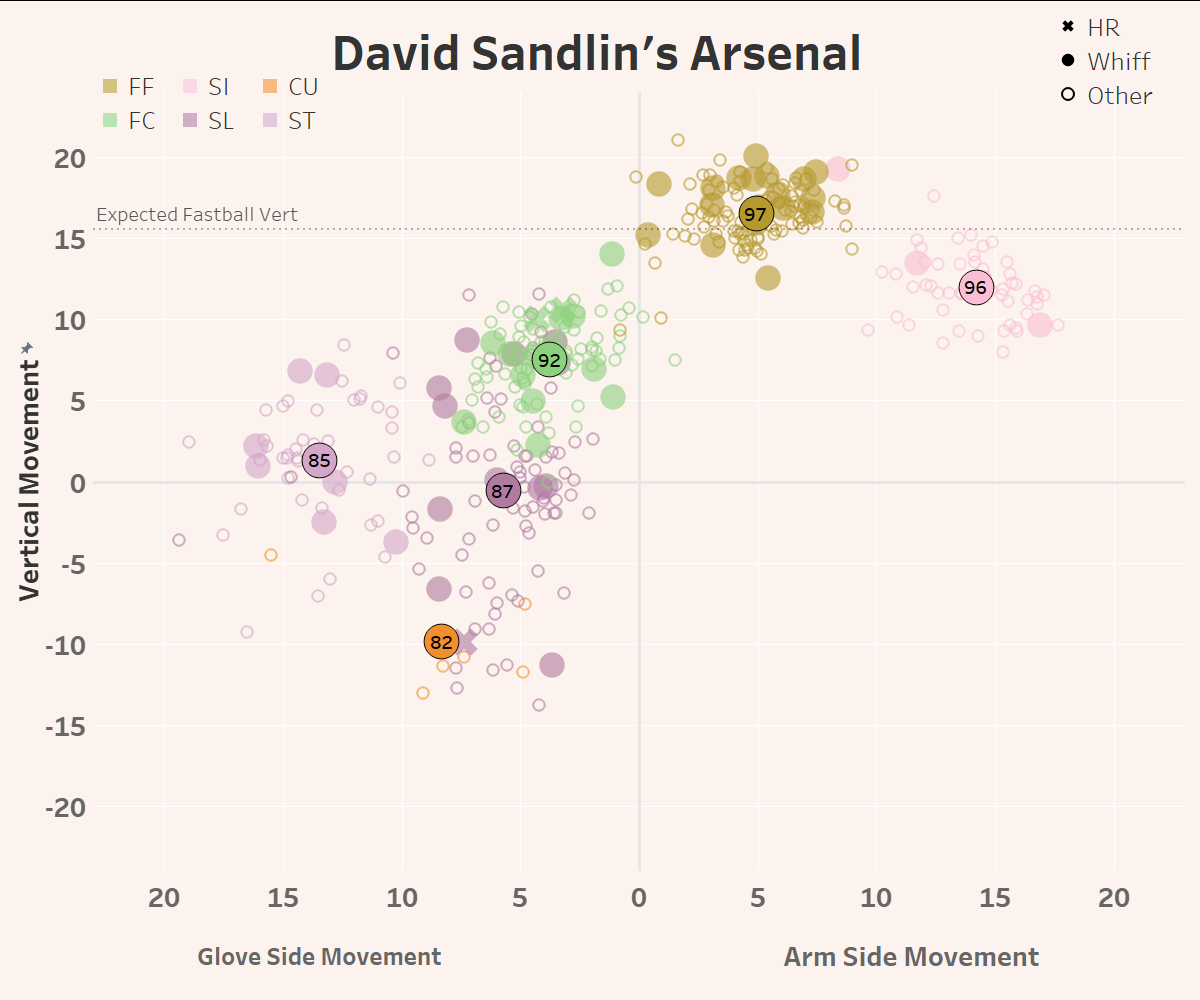
He mixes in four secondaries off the fastball: a cutter and slider, along with a curve and sweeper. The curveball was used sparingly, but the slider and cutter both induced whiff rates above 30%, with the sweeper clocking in at 28.6%. It’s an electric starter’s arsenal, and an uptick in command could make him a viable midrotation arm.
Luis Perales, RHP, Nationals
Perales is another stuff monster the Red Sox traded away. Perales has truly electric stuff, though the command may be a ways off, as he’s still working back from elbow surgery. His arsenal is headlined by a riding 99 mph fastball to go with very promising 91 mph cutter and a slower slider around 88 mph. His changeup/splitter is a little weird, as it doesn’t feature much horizontal movement. He may ultimately be a bullpen-only arm, but there’s enough of a pitch mix that he should get a chance to start.
Andrew Morris, RHP, Twins
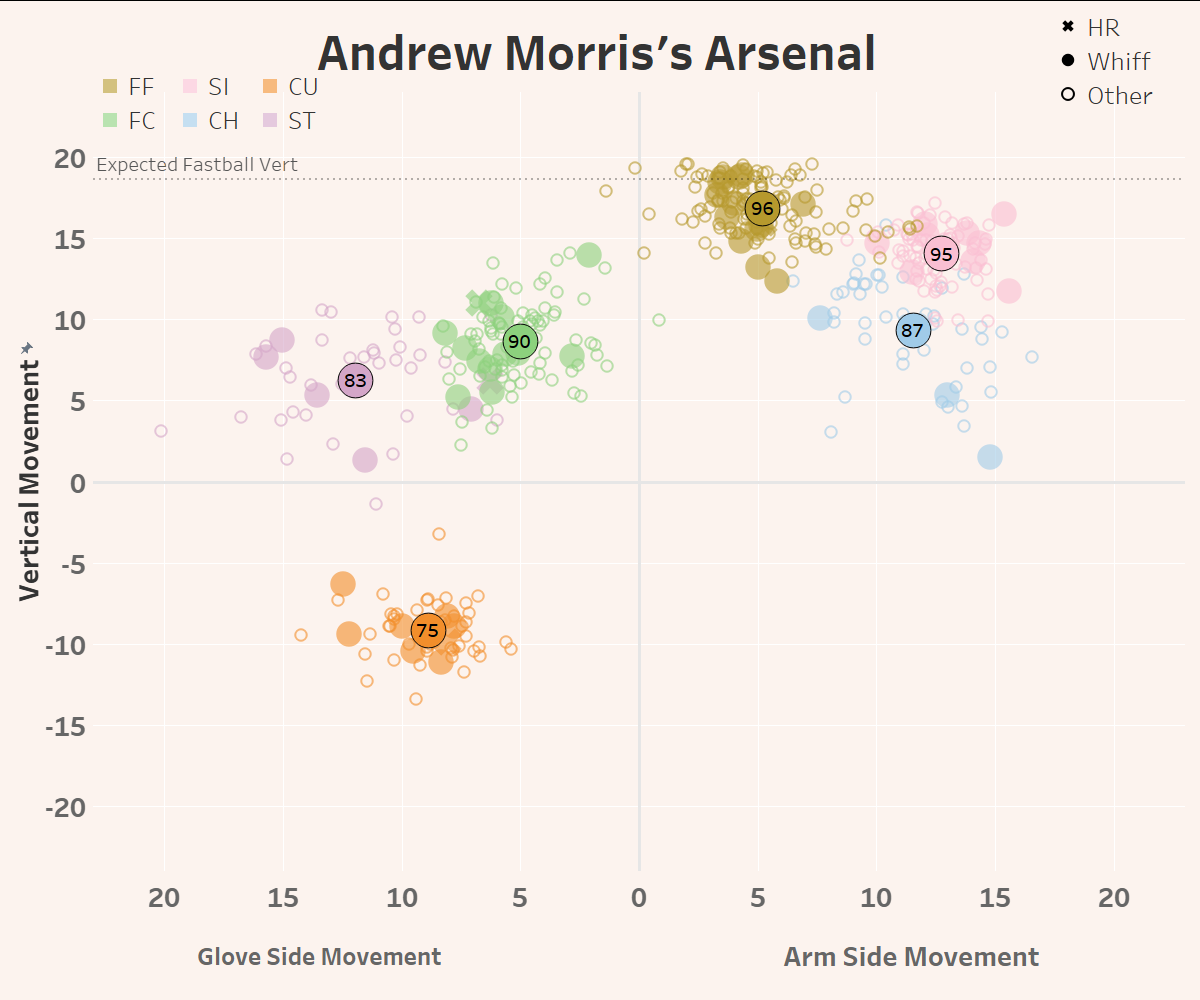
Morris is neither a pronator nor a supinator. This means he struggles to get plus vertical movement of pronators or the plus horizontal movement of supinators. That’s an oversimplification, but in Morris’ case, it means both his fastball and sinker are below-average pitches from a stuff standpoint despite good velocity.
That being said, all six of his pitches generated whiff rates (per swing) north of 23% and swinging-strike rates (per pitch) north of 10%. Those aren’t spectacular numbers, but they indicate Morris has advanced pitchability. He mixes in all six pitches, with no pitch being thrown more than 30% of the time.
Chris Bassitt has had a long career with this template, though his pitches are more refined, and his arm angle allows for more extreme east/west movement. Morris isn’t far off, and pitchers with command of six pitches can have long, if unspectacular careers.
Trevor McDonald, RHP, Giants
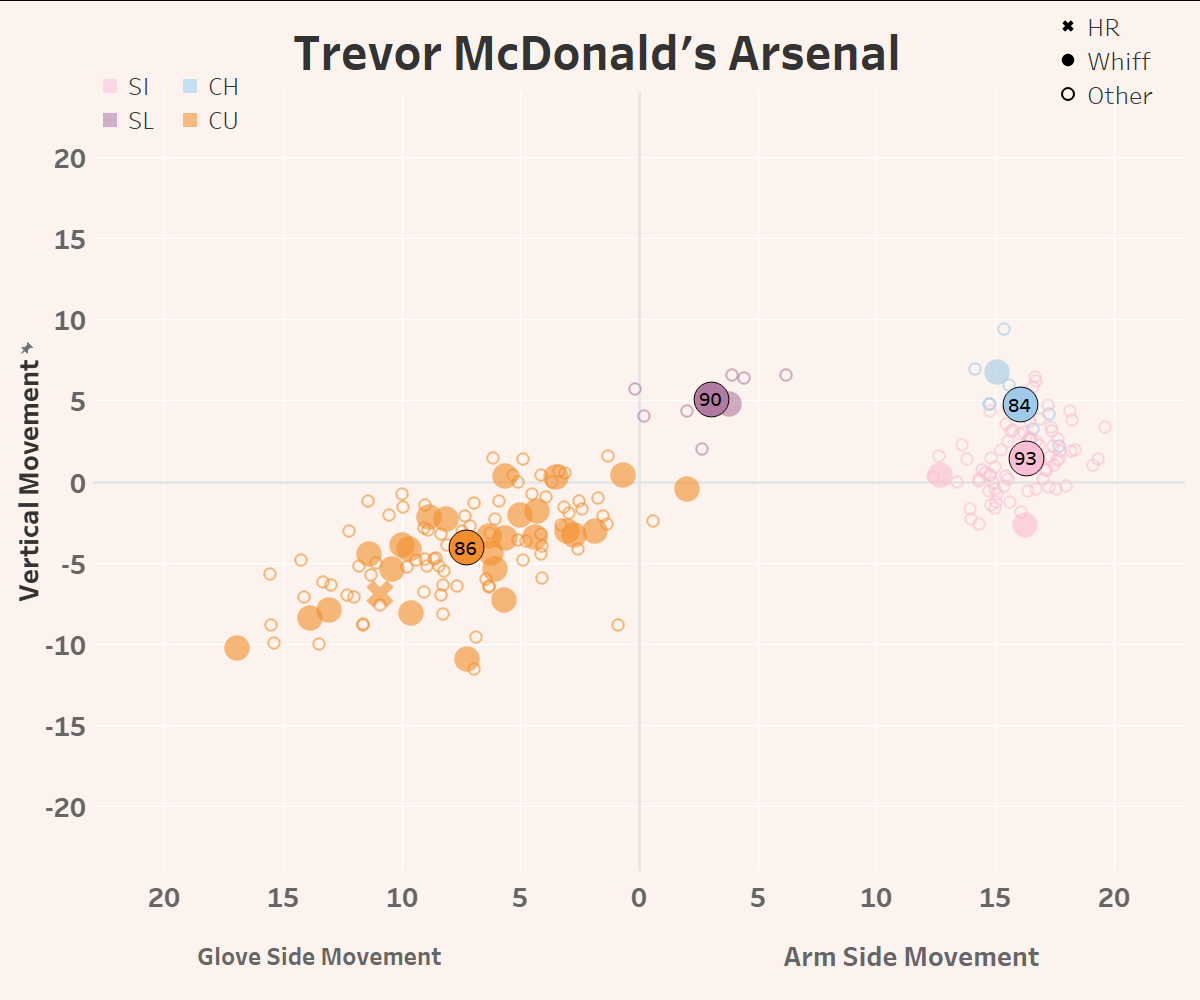
McDonald debuted at the end of last year, appearing in three games. He dropped his fastball and mostly went sweeper-sinker, to great effect. He got whiffs, limited walks and induced tons of ground balls. Of all the players on this list, McDonald probably has the highest probability of being a long-term major league starter. His sinker gets huge depth, sitting near zero inches of IVB, which makes it extremely difficult for hitters to lift.
He’s also more than a two-pitch pitcher, as his changeup was an absolute weapon in Triple-A and chewed up lefties to the tune of 42.2% whiffs/swing and 23.2% whiffs/pitch. Neither lefties nor righties could do much damage against the sinker, which has “bowling ball” qualities. He threw 70 sweepers to righties last year for the Giants, getting 19 whiffs and inducing tons of swings. That’s an elite 27.1% swinging-strike rate (per pitch) despite 56% usage against righties.
McDonald changed his release height from about 5.1 feet in 2024 to 5.5 feet in 2025, which appears to have fully unlocked the sweeper and added a touch of effectiveness to the sinker. The change in arm angle looks to have increased the seam-shifted wake effects on both his sinker and sweeper.
Surprisingly, he doesn’t get a ton of depth on the changeup, despite the sinker and sweeper suggesting he should be able to. It’s possible this shape just works for him, as it was dominant in Triple-A, though it wasn’t as effective in his major league debut.
The sinker/sweeper pair with the changeup as a reliable third pitch is enough for McDonald to be an effective starter for a long time.
Bullpen
Fantasy baseball aficionados may want to pay special attention to this section. We’re going to list a bevy of arms that have a good chance to impact major league bullpens. This is the hardest demographic to project, but it’s always good to be aware of these guys as they can sometimes ascend to closer status if things break their way.
Anthony Nunez, RHP, Orioles
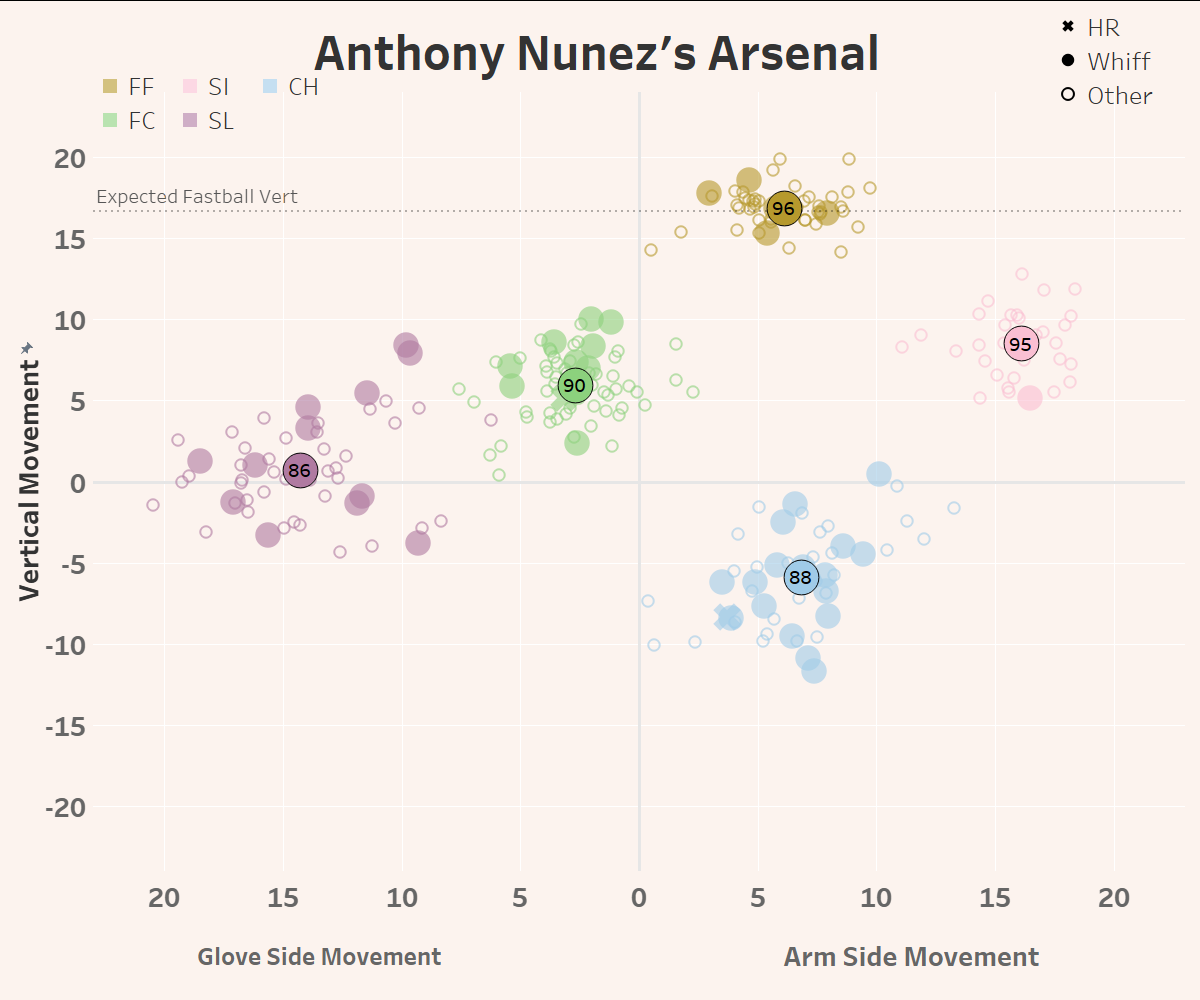
Nunez only started pitching late in 2024. And yet, he has a dynamic arsenal that looks like it was built in a lab. Now he looks poised to be an important piece of the Orioles’ bullpen. Both of Nunez’s fastballs are plus from a stuff standpoint, which is only the tip of the iceberg for his arsenal. His kick-change is a double-plus weapon with huge depth. It completely baffled Triple-A hitters, getting chase swings on 63% of pitches he threw out of the zone. His bridge cutter is his command pitch while being a swing-and-miss offering on its own. The sweeper is dynamite, with huge seam-shifted wake movement and elite spin rates. He mixes all five pitches, with no pitch exceeding 25% usage.
This is an incredible arsenal that would look great for a starter. As a one-inning guy, having to deal with five dynamic pitches is a nightmare for opposing hitters. It would not be a surprise if he ends up closing games for the Orioles by the end of the season.
Daniel Espino, RHP, Guardians
Espino made a triumphant return to the mound late last season. His stuff isn’t quite as glorious as it used to be, but his velocity and offspeed pitches were definitely back. Health will always be a question mark, but he has the talent to be one of the best bullpen arms in baseball.
Brandan Bidois, RHP, Pirates
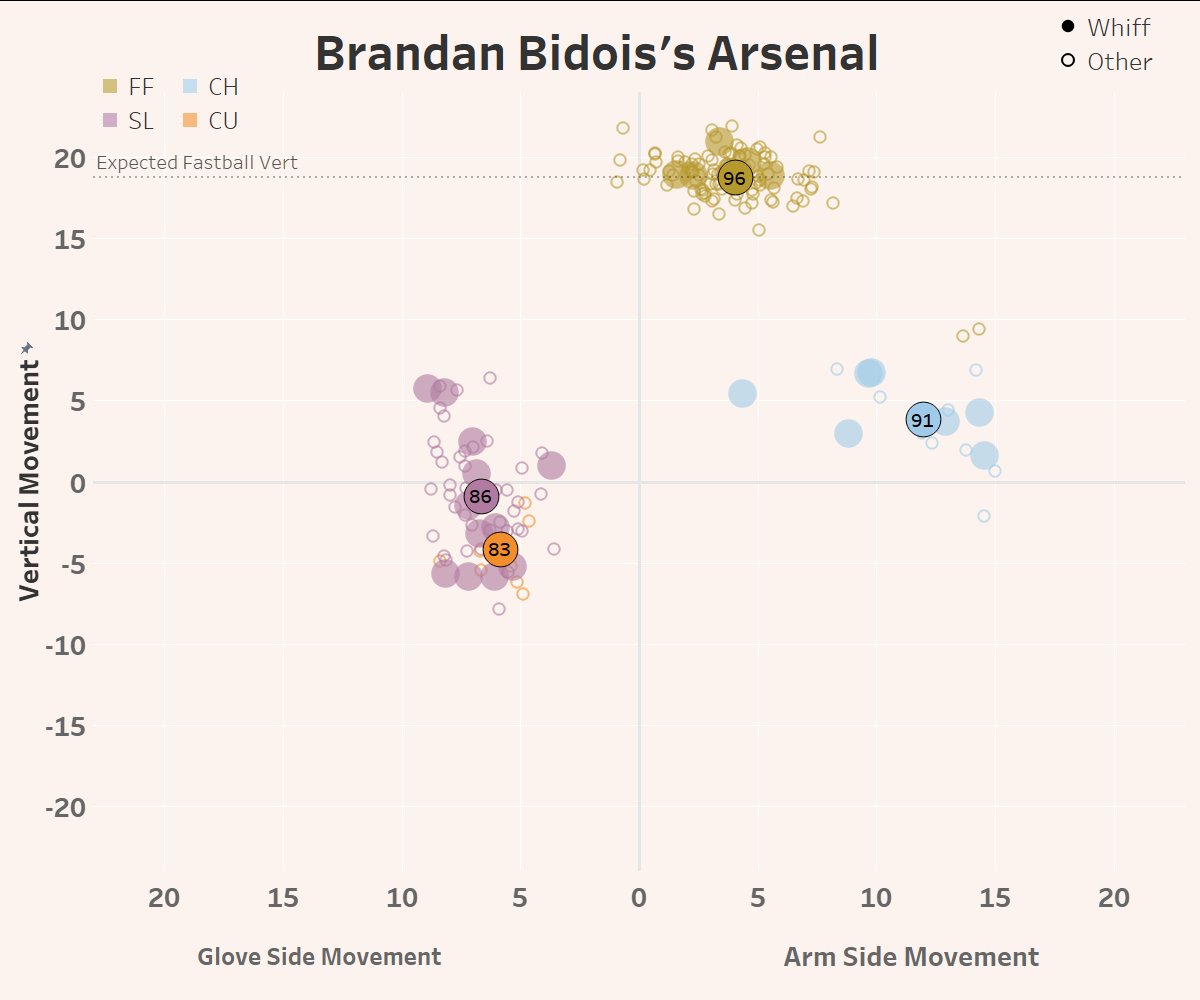
Bidois features a 96 mph fastball with almost 19 inches of induced vertical break, which is roughly average for his release point. It plays down due to terrible command. However, both his deathball slider and changeup are plus-plus weapons. The changeup features 15 inches of vertical separation off the fastball, with only a 5 mph velocity differential. The deathball slider was good for a 46.2% whiff rate, getting whiffs in zone at a healthy clip while inducing plenty of chase.
Nigel Belgrave, RHP, Marlins
Belgrave struck out 92 batters over 68 innings across Double-A and Triple-A last year. He’s not likely to be a closer, but he could be a very effective righty-on-righty pitcher:
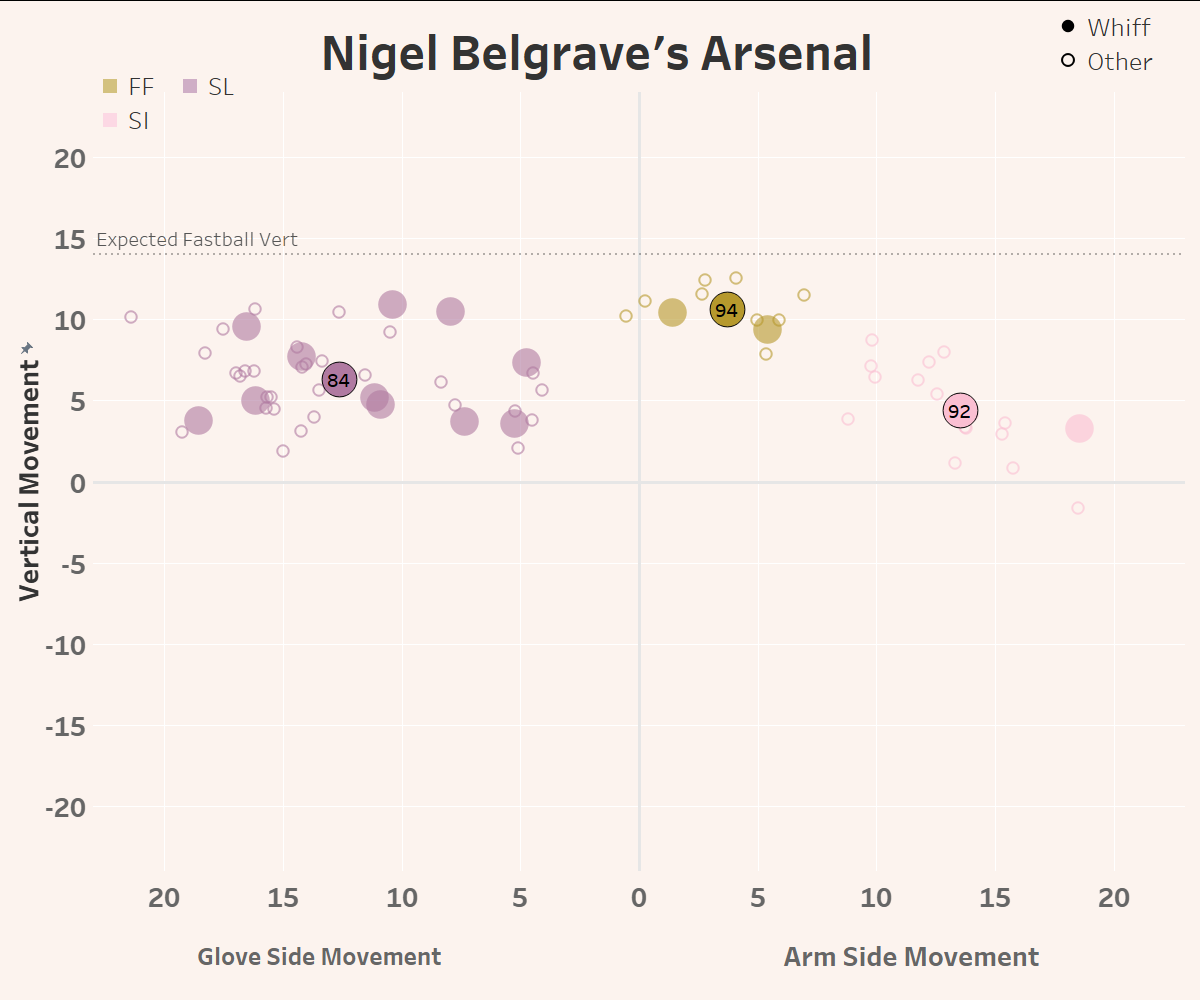
It’s predominantly the sweeper, with an almost comically narrow band of vertical movement across his arsenal. There are extreme east/west supinators, and then there’s Belgrave.
Ronan Kopp, LHP, Dodgers
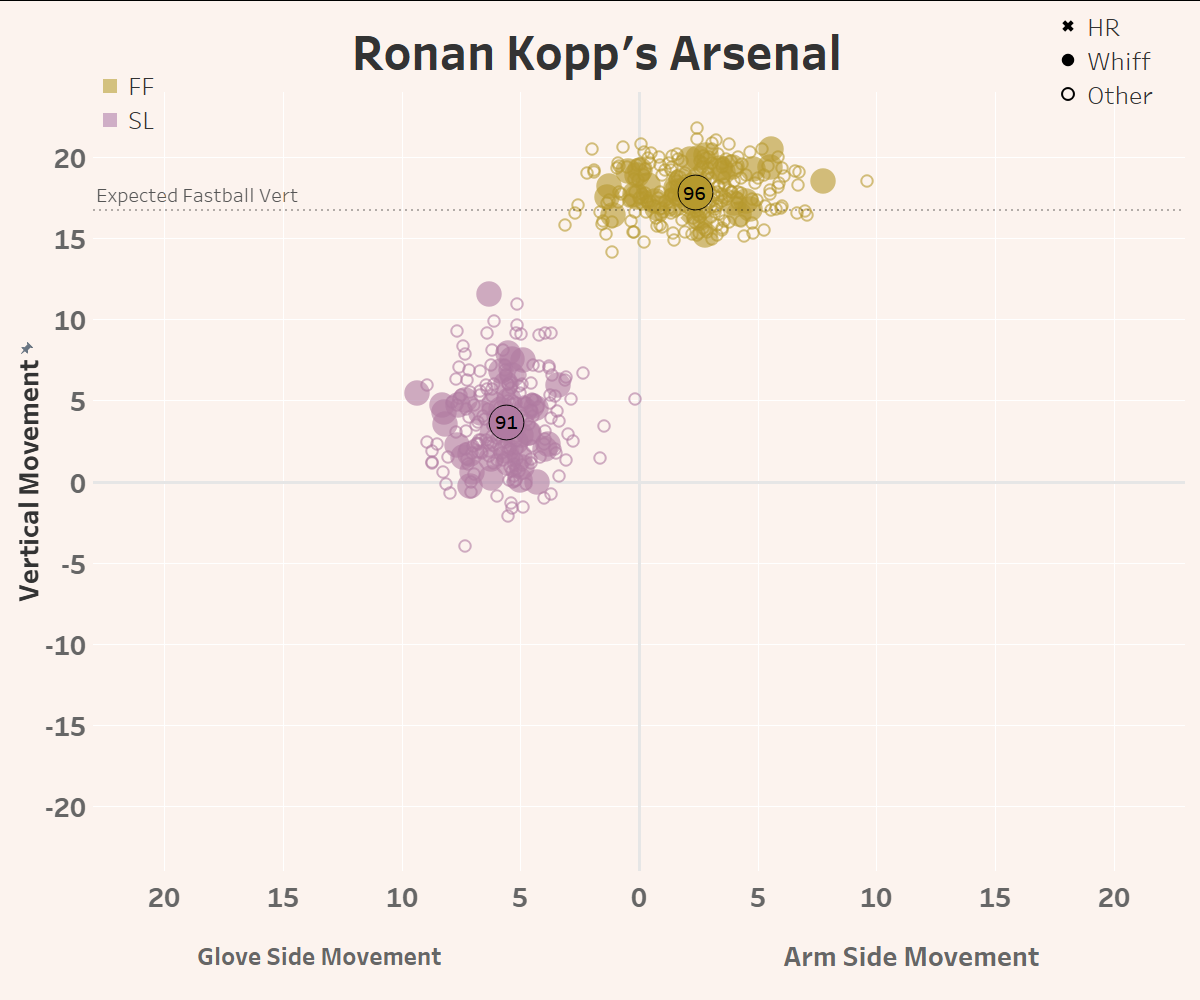
Kopp struck out 91 batters in 57 innings last season, but he also walked 42. He does a great job limiting home runs, and the slider is a double-plus weapon. He needs an uptick in command to be viable, but the fastball/slider pair is good enough for most major league bullpens.
Jhancarlos Lara, RHP, Braves
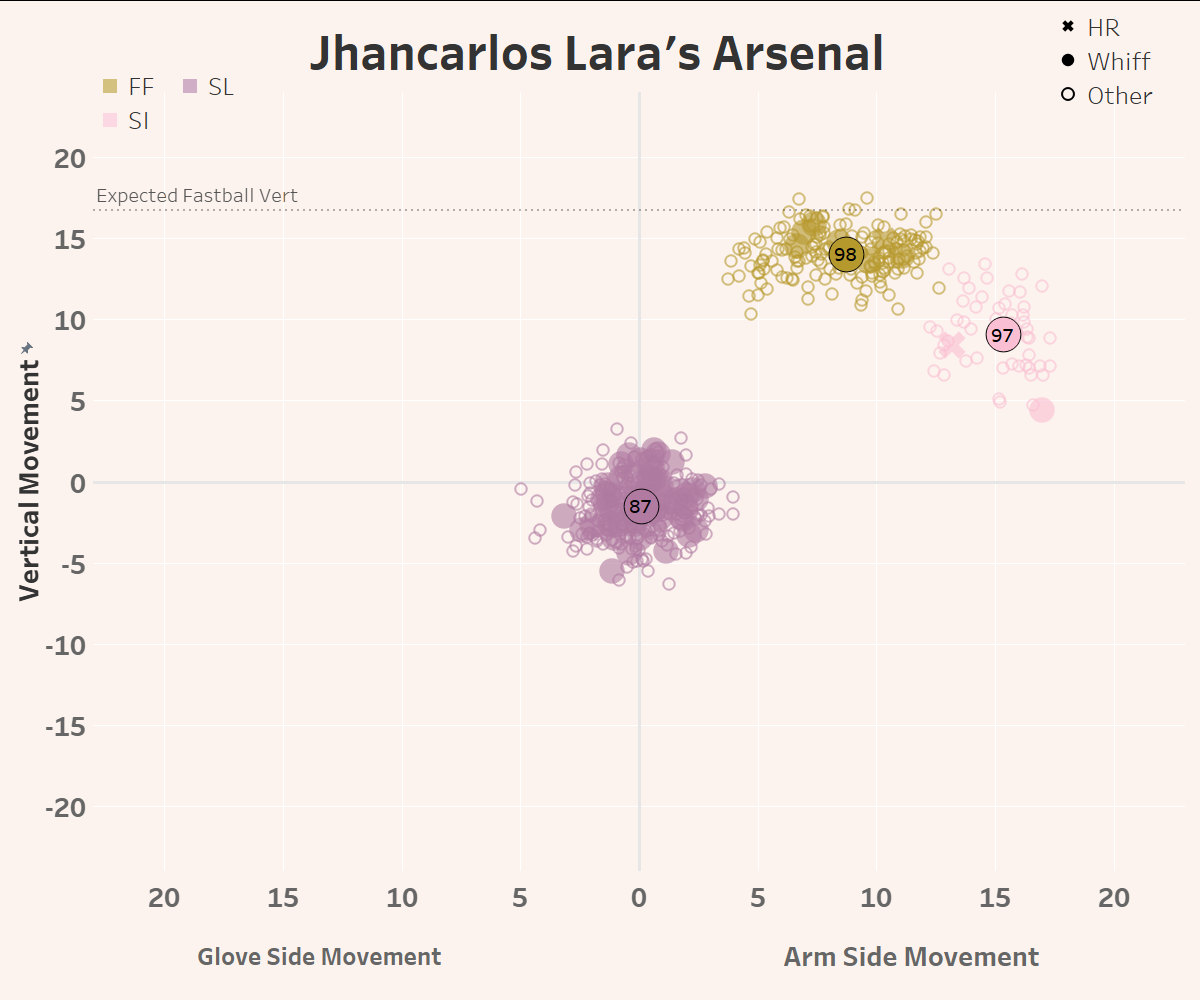
We don’t have Hawk-Eye data for Carlos Marmol, but it’s not a stretch to compare Lara to the longtime Cubs reliever. Lara has terrible command, great velocity and an unhittable slider. He threw the slider 56% of the time at Triple-A, getting whiffs on 52% of swings and almost 20% of pitches. It’s so good that it generates well above-average whiff rates in zone, as well.
It’s been a while since Marmol toed the rubber, but Lara may be bringing back those vibes pretty soon.
Andrew Walters, RHP, Guardians
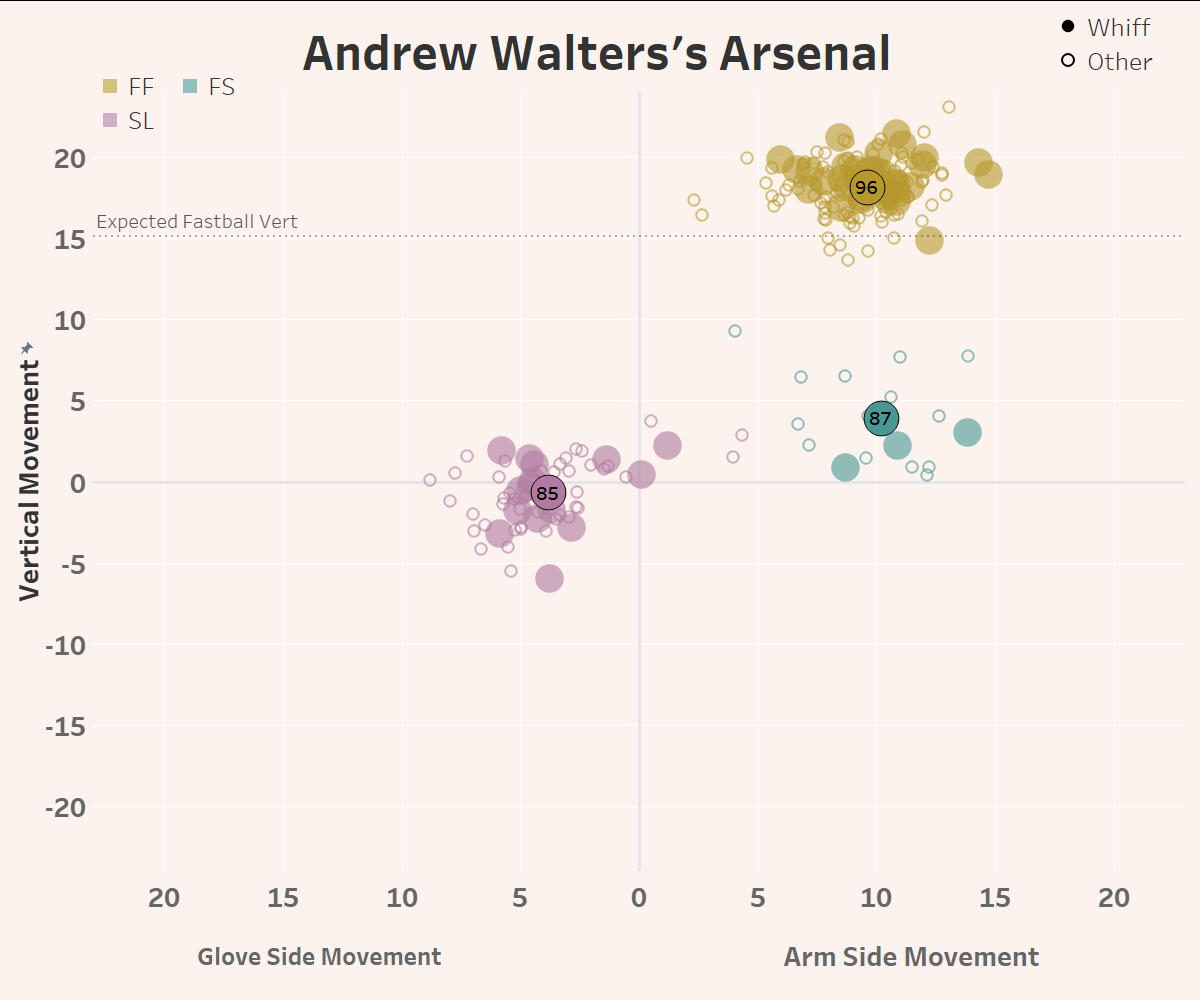
We’ve saved perhaps the best for last. Walters hasn’t been healthy, but he has “future closer” written all over him.
He works with three double-plus pitches. His fastball generated in-zone whiffs 31.1% of the time, the splitter 40% and the slider an elite 54.5%. This resulted in an elite 23.2% whiff rate per pitch (47% per swing). These numbers are fully backed up by Stuff metrics. If the Guardians trade Cade Smith, Walters could be the next closer for the team.