
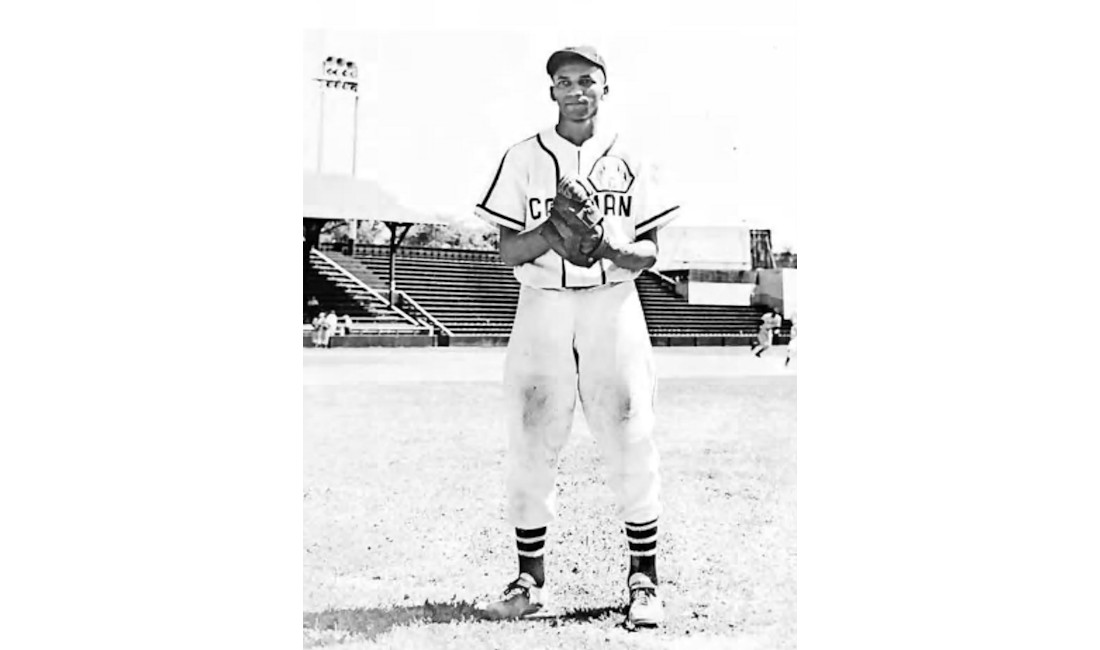
Major League Baseball’s decision in 2020 to acknowledge various seasons of the Negro Leagues as “major leagues” did a lot of great things and righted some long-standing wrongs. But it was not without its frustrations, too. Statistics from that era are so difficult to find and require extensive research, and it’s not done yet. There are games yet to be accounted for still out there, and we may never get the same comprehensive statistics like we have in the American and National League. And the numbers we have don’t reflect the realities of Black baseball. Did Josh Gibson really hit just 176 homers and Satchel Paige win just 131 games? Certainly not. But those are the best “official” numbers we have at the moment. MLB’s decision by itself didn’t really open a window into the Negro Leagues; it wiped off a closed, dirty window. We can see a lot more than we ever could, but there’s much more out of sight. You don’t really open that window until you put those statistics in the context of the world in which they were created. You need to understand the segregation of baseball (and the United States in general) that existed from the 1870s through the 1940s, the barnstorming that supported Negro League teams and the pay scale that often sent Negro League stars to spend the peak of their careers playing in Central or South America.
But let’s also mention the good things. The incorporation of Negro League statistics as major-league statistics created hundreds of major-leaguers overnight. It didn’t just give people like Gibson and Paige that credibility. It did so for the players who spent 5 seasons with the Kansas City Monarchs, or 5 games with the Newark Eagles — the ones we may have never have known about otherwise. It put players like Nish Williams and Oliver Marcel on the same level as Cap Anson and Ben Chapman. (And I hope they’re still spinning in their graves over it.) More importantly, a handful of living Negro Leaguers were given their long-overdue flowers. One of those players was Ron Teasley, who appeared briefly with the 1948 New York Cubans. He found himself, while in his 90s, a brand-new ex-major-leaguer. He lived a remarkable life of service, using his teaching career to guide thousands of Detroit children. He was appreciated by his community for his accomplishments, but I hope that he enjoyed the love that the baseball fanbase gave him. Teasley, who died on February 3 in Novi, MI, at the age of 99, was honored during the June 2024 game between the St. Louis Cardinals and San Francisco Giants played at historic Rickwood Field in Birmingham, AL. He and Bill Greason were the last survivors of that era of the Negro Leagues.
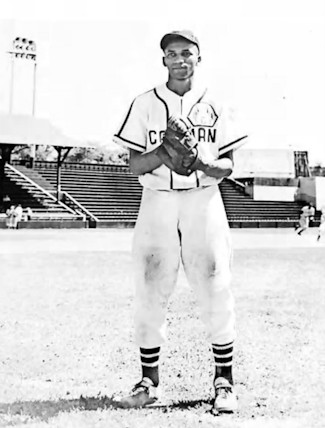 Teasley, while a member of the Carman Cardinals. Source: Detroit Free Press, July 14, 2024.
Ronald Teasley was born in Detroit on January 26, 1927. He played baseball and basketball at Northwestern High School and was named to the All-City basketball team by the Detroit Free Press in 1945. “Teasley’s work during the first term was of such high order that he could not be overlooked,” the paper said. Teasley was a senior in 1945 and was the first African-American captain of the school’s basketball team. He was also a veteran baseball player by then. He grew up watching men play semipro ball at the Kronk Recreation Center, and he joined them when he was a teenager. Some of those men were veterans of the Negro Leagues, and they helped teach him the fine points of baseball, as well as a neighbor named Julius Lanier. “I started practicing with these gentlemen, and then I would want for my neighbor to come home to play catch, so I was always around people who loved the game,” Teasley told Scott Talley of the Free Press in a 2024 article. He was a fast learner and soon earned the nickname of “Schoolboy” from those men. By age 14, he was playing in a national semipro tournament, doing it for free in order to maintain his amateur status. “By the time I started playing baseball at Northwestern, the game was kind of like a piece of cake because of the experience I had earlier,” he added. Teasley continued to play ball whenever he could, showing off his power stroke in various semipro teams. When he was 19 years old, he once banged a triple off Satchel Paige in an exhibition game.
Teasley really came into his own as a ballplayer at Wayne University. His most noteworthy accomplishment was batting .500 for the season in the spring of 1945. Playing first base and outfield, he had 21 hits in 42 at-bats and scored 12 runs. Teasley’s collegiate career was interrupted by World War II, and he served in the U.S. Navy in 1945-46. The Afro-American reported that he was the starting shortstop on a team in Saipan that won the league championship. But he lettered in basketball at Wayne in 1945, 1947, and 1948, and he did the same in baseball in 1945 and ’47. His accomplishments in the two sports earned him induction into the Wayne State University Athletic Hall of Fame in 1986. In March 1948, he put his college education on hold once more when he took part in a tryout camp with the Brooklyn Dodgers. The camp was for players who were to be assigned to Brooklyn’s minor-league teams. The Dodgers had already broken major-league baseball’s color barrier the previous season by bringing Jackie Robinson to the majors, and the other players signed from the Negro Leagues, like Roy Campanella and Don Newcombe, were right behind him. But few other teams had gotten on board with integration, so Teasley and fellow Detroit baseball star Sammy Gee had relatively few options other than to try out at the camp in Vero Beach, FL, and land a spot in the minors. Gee, who was a year younger than Teasley, was in his second season in the Dodgers’ farm system and had also played basketball with the Harlem Globetrotters. Both players were signed by the Dodgers, making them among the earliest African-American players signed to pro baseball contracts, and assigned to the Olean Oilers of the Class-A Pony League. Teasley said they were treated well by the fans as they integrated the Pony League. And both were outstanding — at least for the short time they were on the squad. Gee batted .321 in 21 games, and Teasley played in 23 games and hit .267 with 15 RBIs. He stole 5 bases and was leading the team with 3 home runs when he and Gee were both released on June 7.
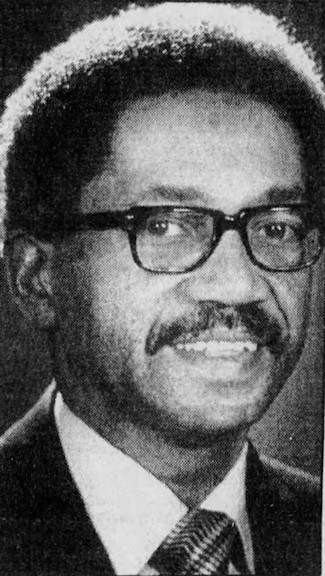 Source: Detroit Free Press, February 23, 1988.
To say that the releases came from out of nowhere is an understatement. Every report about the two ballplayers was laudatory. Great African-American newspapers, including The Chicago Defender, The Afro-American, St. Louis Argus and Pittsburgh Courier wrote about them, making Teasley and Gee two of the most covered Class-A ballplayers in the country. One of the Dodgers’ minor-league managers, Al Campanis — yes, that Al Campanis — praised their skills and their aptitude. “They learned very quickly and had very little difficulty putting into practice the things they learned,” he said. “Teasley is fast and aggressive; he seems willing to try anything. And that counts a lot in this organization. George Sisler told me just before I left the camp to come North, that he looks like he has the makings of a fine first baseman. And Sisler [a Hall of Fame first baseman] should know.”
“Buck Leonard spoke to us after we were released, and he told us that Black players were not going to be kept by major-league teams as bench players,” Teasley said in that 2024 interview. “You had to be Hank Aaron or Willie Mays to make it at that time, and they knew we weren’t Hank Aaron or Willie Mays when they signed us. I wish I could say that everything was peaches and cream, but that was the saddest part, and it was devastating at the time.”
Both ballplayers signed with the New York Cubans of the Negro National League. Gee hit .200 in 15 games at shortstop, while Teasley is credited with appearing in 2 games, one in right field and one in left field. He had 2 hits, including a double, in 7 at-bats, and he drove in 2 runs. He almost certainly played in more than those two games, but those are the only two we currently have on record. The 1948 Cubans weren’t a great team, with a 19-29-1 record, but they had some very good ballplayers. The most famous one is Hall of Famer Orestes “Minnie” Miñoso, but pitchers Jose Santiago and Pat Scantlebury also appeared in the AL/NL in the 1950s. Lyman Bostock Sr. was a utility player for the Cubans, and outfielder Jerry Benjamin and starting pitcher Dave Barnhill were at the tail end of All-Star careers. Teasley returned to Detroit by the fall, and he destroyed pitching while playing for local teams. He headed north to Canada in 1949, playing for the Carman Cardinals of the Provincial Senior Baseball League. We don’t have statistics for his season, but it seems like every game recap makes mention of a tremendous home run he hit. Teasley also found the time to play for Great Lakes in the Detroit Baseball Federation and the New York Komedy Kings, a touring team along the lines of the Indianapolis Clowns. Teasley returned to Carman in 1950, and we do have statistics for that season. He played in 48 games and batted .299 with 3 homers and 19 RBIs.
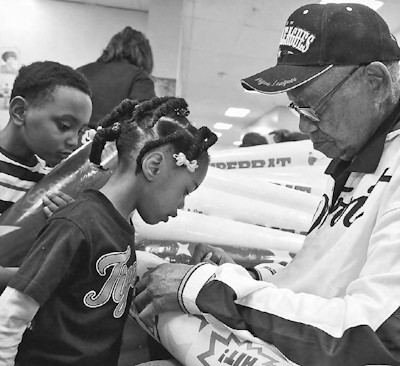 Source: Detroit Free Press, April 13, 2013
After that season, Teasley seems to have kept his baseball to the Detroit area. He spent a couple of seasons playing for the Ford All-Stars while earning his Bachelor of Science degree in education from Wayne State in 1953 and his Master’s degree in 1955. He enjoyed a long career as a teacher in the Detroit school system, coaching basketball, baseball and golf as well. His longest stint was with his alma mater, Northwestern High School. In 20 years there, his baseball teams won 13 district titles and 10 PSL (Public School League) championships. He received multiple accolades throughout his teaching career, including the City League Coach of the Year Award in 1974 after his Northwestern basketball team was ranked No. 1 in the state. He has been honored by multiple Halls of Fame, from Northwestern High School and Wayne State to the Michigan High School Baseball Coaches Association and the Afro American Sports Hall of Fame. His bio at the Negro Leagues Baseball Museum also notes he participated in various Senior Games and was honored by Meals on Wheels.
Teasley and his late wife Marie had three children, Ronald, Tim and Lydia. Lydia is the executive director of the Ron and Marie Teasley Foundation, which provides scholarships for Detroit youths. His children helped him navigate some of his more recent honors, including being honored by the Detroit Tigers before a game at Comerica Park and the Rickwood Field game. “We always ask Dad, ‘How did you do all of that?’” she said in 2024. “Baseball, Navy, back to school; at some point, he pledged Kappa Alpha Psi; then going back to Northwestern to coach and all of the things he did in the community with my Mom. It’s just a heck of a legacy and a love story, and a testament to the character of the man.”
MLB.com has a 2025 video from Teasley himself, if you’d like to hear about his career in his own words.
Follow me on Instagram: @rip_mlb
Follow me on Facebook: ripbaseball
Follow me on Bluesky: @ripmlb
Follow me on Threads: @rip_mlb
Discover more from RIP Baseball
Subscribe to get the latest posts sent to your email.