
View Larger +
PHOTO: Sung Jin Cho, Unsplash
Broadcast giants are pouring millions into lobbying as they push federal regulators to loosen limits on how much of the national TV market one company can control, a change that could reshape local television across the country.
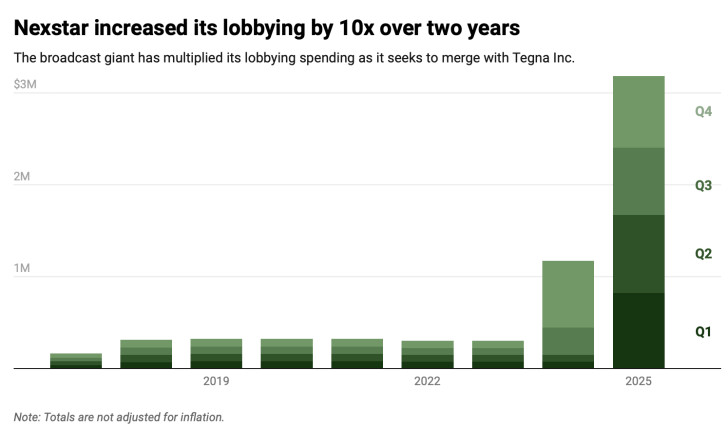
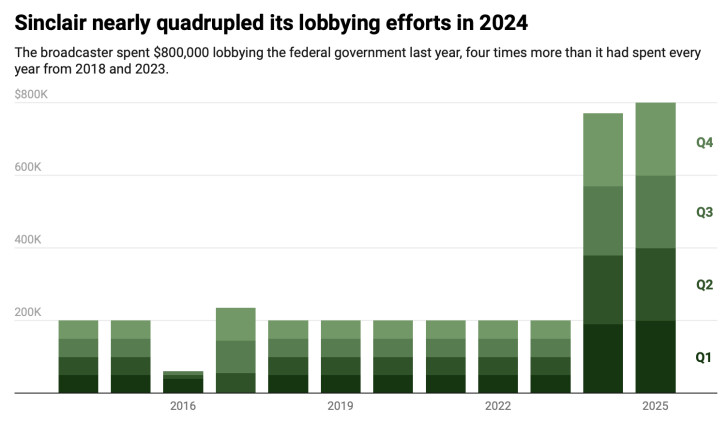
Nexstar Media Group, which owns the most TV stations in the country, spent $3.2 million lobbying the Federal Communications Commission in 2025, roughly 10 times more than it did every year from 2018 to 2023, when its lobbying activity remained steady. Sinclair Broadcast Group, the second largest station owner, last year spent four times its 2023 federal lobbying total.
EDITOR’S NOTE: In Rhode Island, Nexstar owns WPRI-12 and WNAC-64, and Sinclair owns WJAR-10 and WLNE-6
GET THE LATEST BREAKING NEWS HERE — SIGN UP FOR GOLOCAL FREE DAILY EBLAST
Both organizations are lobbying to change regulations that restrict their growth.
National station owners are limited to owning stations that collectively reach no more than 39 percent of the national audience, but a regulatory loophole known as the UHF discount lets some stations be counted as reaching fewer households than they actually do.
Without the discount, Nexstar serves 70 percent of national television households; with the UHF discount applied, however, its reach only extends to 39 percent.
Potential Nexstar-Tegna merger drives record lobbying
View Larger +
IMAGE: Open Secrets
Nexstar’s 2025 federal disclosure reports shows the company lobbied on the ownership cap and a potential merger with Tegna, another major broadcaster.
In August 2025, Nexstar announced a deal to acquire Tegna for $6.2 billion. The proposed merger would send the cumulative household reach soaring past the 39 percent ownership cap. Thus, the deal is pending while the FCC determines whether to change the ownership rules.
To help sway the FCC, Congress and the White House, Nexstar hired lobbyist Jeff Miller, who served as finance chair on President Donald Trump’s second inaugural committee, at the start of 2025. Miller heads Miller Strategies, one of the firms that have benefited most from their close connection with the Trump administration. Nexstar paid the firm $510,000 over the course of the year, although most of its lobbying was handled by the company’s in-house team.
Tegna reported its first year of lobbying in 2025, spending $550,000 exclusively on Miller Strategies. Combined, the lobbying firm raked in over a million dollars from just the potential Nexstar-Tegna merger.
Sinclair multiplies spending as it eyes acquisition
Sinclair spent $800,000 lobbying the FCC last year on issues such as media ownership and the communications ecosystem. When it nearly quadrupled its previous lobbying spending in 2024, it cited the same issues.
View Larger +
IMAGE: Open Secrets
While Sinclair reaches a smaller share of TV households than Nexstar – about 24 percent when the UHF discount is applied – the company still sees the national ownership cap as limiting its ability to expand.
The company has been in conversations with multiple potential merger partners and launched a strategic review in August pointing to a desire to acquire one of its peers. Discussions with E.W. Scripps, a smaller broadcast station owner, began in 2024. The conversations never progressed and, in November, Sinclair announced it would pursue a hostile takeover of Scripps.
Who gets to make the call?
Rudy Brioche, a former vice president and policy counsel at Comcast, said that increases in lobbying from broadcast companies are centered on pending mergers and implementation of the ATSC 3.0 standard, which would change how television is transmitted to households. Before working for Comcast for 16 years, Brioche served as chief of staff at the FCC.
“It is primarily about pending transactions, the ATSC standard 3.0, which is a new technology that would allow broadcasters to use the digital airwaves for other streams of revenue,” Brioche said.
That push for regulatory changes is unfolding as broadcasters see a more favorable political climate in Washington.
Trump’s push for deregulation has created hope for the largest station owners that they may gain more flexibility. The FCC has signaled its intention to do away with the 39 percent ownership cap, and its chairman, Brendan Carr, has shown support for allowing stations owners to expand their reach.
However, the jurisdiction over the ownership cap was one of the topics discussed in a recent Senate hearing that examined the rules around broadcast media ownership in the digital age. The debate in Congress over who has the authority to change the 39 percent ownership cap is central to Nexstar’s and Sinclair’s expansion plans. In 2004, Congress set the 39 percent cap and explicitly prohibited the FCC from using its forbearance authority to avoid enforcing the limit.
Sen. Jacky Rosen (D-Nev.) made clear that the authority to change the cap lay with Congress.
“Just because large corporations like Nexstar and Tegna want to merge, it doesn’t mean they can simply ignore the laws that Congress has put in place,” Rosen said. “In order for there to be a merger that results in ownership above the 39 percent cap, Congress would have to change the law.”
Proponents of change to the ownership cap argue that Congress didn’t set a permanent statutory limit, but instead directed the FCC to modify its rules at specific moments in time, leaving the underlying cap as a regulatory creation that the agency can revisit.
The hearing also featured the National Association of Broadcasters’ chief executive officer, Curtis LeGeyt. NAB, the entertainment industry’s largest lobbying client, has long advocated for allowing station owners to expand past the ownership cap and for deregulation of the broadcast industry.
“These outdated regulations distort today’s video and advertising marketplace,” LeGeyt said. “They advantage giant tech platforms, global streaming services, pay TV providers and national cable programmers, while placing local broadcasters at a severe disadvantage.”
Chris Ruddy, CEO of Newsmax, a relatively small conservative broadcaster, urged members of Congress to protect the ownership cap, saying it blocks monopolization of the industry and promotes localism of stations.
Whether that cap holds may depend not only on Congress but on how the FCC responds to political pressure from the White House and industry. The FCC historically has acted independently from past administrations, but has become increasingly politicized under Trump.
During a congressional probe of the FCC focused on censorship and free speech in December 2025, Carr said the agency wasn’t independent of the administration, a contradiction to the mission statement that included the word “independent” prior to the hearing.
Brioche, who served as former chief of staff at the FCC, noted how much things have changed under Trump.
“It is different from past administrations, because past administrations viewed the FCC as an independent agency. This administration does not view the FCC as an independent agency,” Brioche said. “It views the FCC as a tool, an instrument of advancing its political interest.”
Trump has recently reversed his position: Last November he responded to a warning by Newsmax’s Ruddy against lifting the ownership cap by railing against the potential expansion of station owners because it would help enlarge “Radical Left Networks.”
Nexstar has sought to represent the potential merger as aligned with the administration’s deregulation agenda. Its efforts seem to have worked. Trump reversed his position on the merger a few days before the congressional hearing, writing it would negatively impact the networks he doesn’t like and said, “GET THAT DEAL DONE!.”
Tom Bettag, a lecturer at the University of Maryland and former producer at ABC, said the Trump administration’s approach to regulating broadcasters and journalists was a way to control the media’s portrayal of him.
“His real goal is to control the message that goes out to the American people, and to the degree that he can exercise control over the information that Americans get, he can work his will,” Bettag said. “In theory, he says that he is trying to fight anti-Trump bias, but in fact, his definition of anti Trump-bias is anything that isn’t pro Trump.”