

 (CBC)
Welcome to our weekly newsletter where we highlight environmental trends and solutions that are moving us to a more sustainable world.
Hey, it’s Livia. I’m a highly climate-conscious person. Yet I’ve sometimes found myself wondering about the trade-offs of certain climate solutions — and if we can actually “solve” climate change. So I was excited to get answers from one of the most clear-eyed experts out there.
This week:
The road to sustainability can seem hazy. Data shows where we need to goThe Big Picture: The purple seaside flower with carbon-storing powerLake Louise ice littered with pink plastic after apparent gender reveal partyThe road to sustainability can seem hazy. Data shows where we need to go Hannah Ritchie, a data scientist and the deputy editor of Our World in Data. (Angela Catlin)
“Don’t solar panels and wind turbines generate huge amounts of waste? Aren’t our efforts pointless if China’s emissions keep growing?”
Those are but a few of the questions people regularly ask Hannah Ritchie, a data scientist and the deputy editor of Our World in Data.
“There is this feeling that, in order to tackle climate change, we’ll be creating huge numbers of other massive problems,” Ritchie said.
Sometimes these objections can be weaponized as arguments against the green energy transition. On other occasions, this conflicting information comes from climate-conscious sources who don’t have the full picture, Ritchie says.
But how big are these problems, really? And, more importantly, are they worse than climate change itself?
In her new book, Clearing the Air: A Hopeful Guide to Solving Climate Change in 50 Questions and Answers, Ritchie uses data to put those concerns in context.
We spoke to Ritchie and dug deeper on a few of those questions.
Don’t solar panels and wind turbines generate huge amounts of waste?
Solar panels and wind blades, when they reach the end of their lifespan, become waste if they’re not recycled.
“You’ll often get, on social media, some picture of wind turbines dumped in a field or solar panels maybe dumped somewhere,” Ritchie said.
That has sparked concern that a renewable technology boom equates a boom in renewable technology garbage.
But when you put the numbers in context, the picture is clear: waste from green energy sources is better than the alternative.
For example, when you burn coal, the leftover product becomes coal ash. Breaking down the data, Ritchie shows that coal generates 50 times more waste than solar power — and 500 times more than wind.
Coal ash is also highly toxic. In the United States, some power plants may dispose of coal ash in surface ponds or landfills, or discharge it in waterways.
Plus, the renewable energy waste problem may be solvable. Most parts of solar panels can be recycled, though countries need to invest in an efficient recycling system to make this happen.
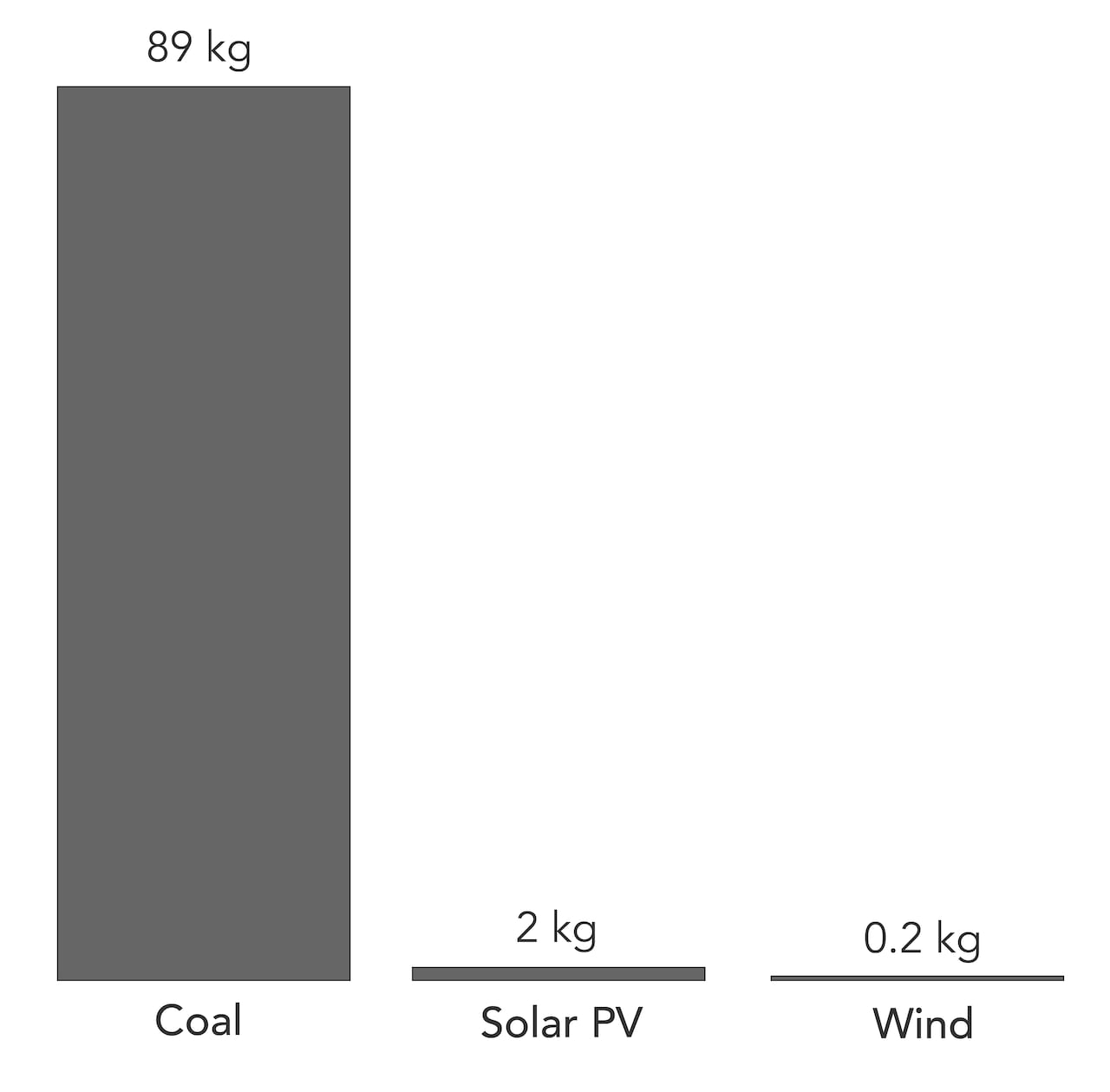 Waste generated by different electricity sources: waste generated per unit of electricity production, measured in kilograms of waste per megawatt-hour. Waste for solar and wind is in the form of panels and turbine blades. Coal is mostly ash. Data sources: Calculated based on industry figures; Center for Sustainable Systems; UMichigan; David Osmond; CleanTechnica; and the EIA. (Submitted by Hannah Ritchie)
Aren’t our efforts pointless if China’s emissions keep growing?
This can be answered with some good news: China’s emissions may have already stopped growing.
“China has been going extremely quickly on deployment of clean power, the rollout of electric vehicles,” Ritchie said.
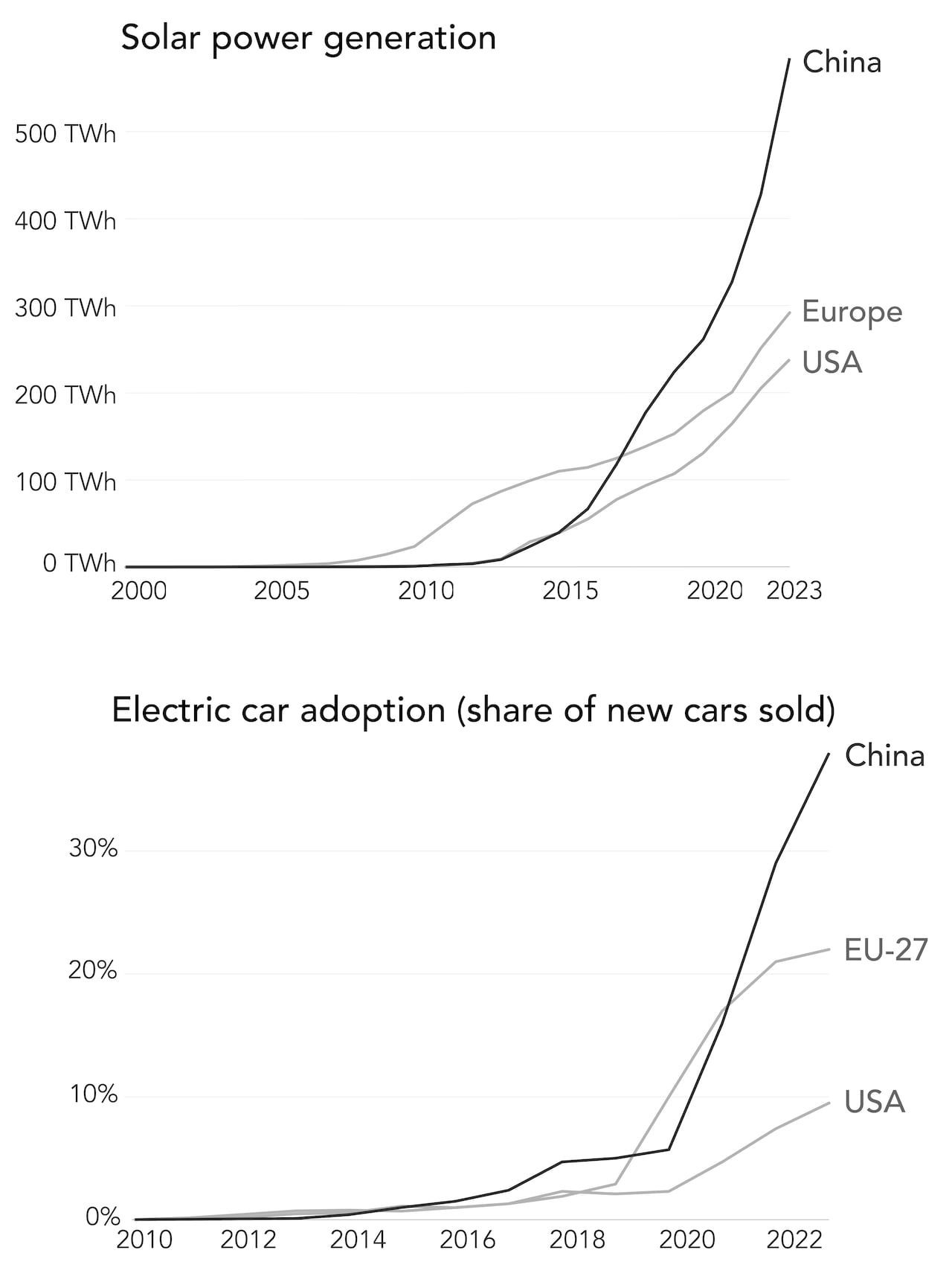 How fast are countries building clean energy solutions? Data sources: Ember Energy and International Energy Agency. (Submitted by Hannah Ritchie)
On top of that, the country’s green technology investment — boosted by tumbling production prices — is spreading across the world.
“Over the past year, you’ve actually seen a huge boom in the imports of solar panels in Pakistan,” said Ritchie. In Brazil, sub-Saharan Africa and other parts that make up the Global South, people are hungry for clean, cheap power, she says, and electrification is trending upwards.
Importantly, Ritchie notes, China’s emissions have recently plateaued, and there are reasons to believe they could start to go down this year.
“Because it’s the world’s largest emitter,” she said, “it would likely be the case that if China’s emissions dropped, global emissions would also drop.”
How can we make better choices?
Ritchie is concerned that we become despondent when we believe there are no good choices — when, in reality, some of those choices could help both the climate and ourselves.
Electrification, for example, offers co-benefits that aren’t talked about enough, Ritchie points out.
“Driving an electric car uses about a third of the energy of driving a petrol or diesel one,” said Ritchie.
That’s because in an EV, the vast majority of the energy in the battery is used to propel the car. In a gasoline car, it’s the opposite — only about 20 per cent is converted into movement, while the rest is lost as heat. In the same way, renewable energy power plants are much more efficient than fossil fuel power plants.
“You have these huge efficiency benefits where you can also get cost benefits,” she said.
The potential for cost savings, in other words, are significant. From travel to heating and air conditioning, “we could have exactly the amount of energy services that we have now or more — but using a fraction of the energy,” she said.
“And that’s purely through this process of electrification and investing in more efficient energy technologies.”
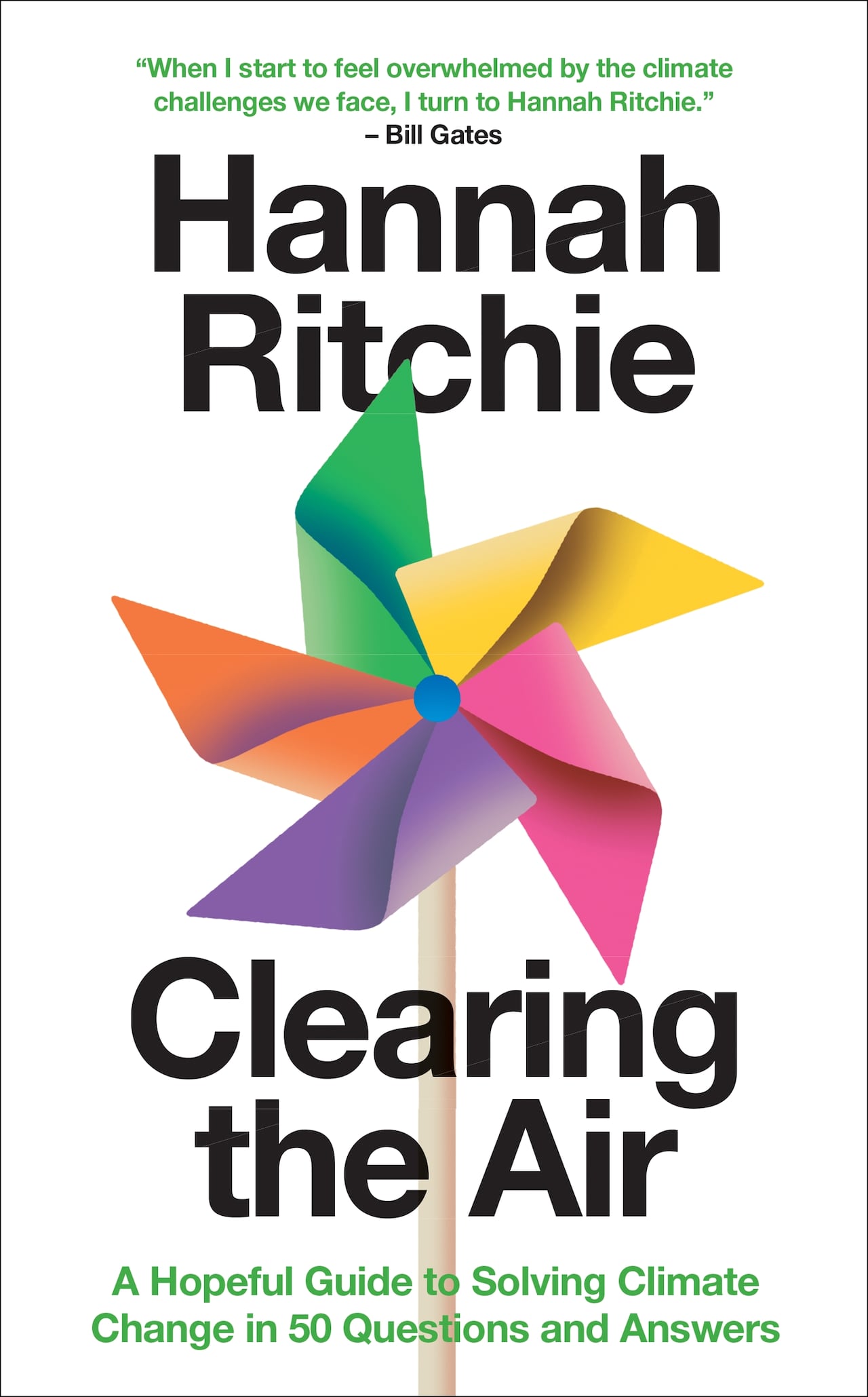 Clearing the Air is published in North America by MIT Press. (MIT Press)
— Livia Dyring

Old issues of What on Earth? are here. The CBC News climate page is here.
Check out our podcast and radio show. In our newest episode: Canada recently switched its approach to electric vehicles. But what impact do EVs really have on the world around us? Cleaner air? Less noise? CBC’s Anand Ram walks us through the evidence and explains how satellite data is being used to measure air pollution in Los Angeles neighbourhoods.
LISTEN | What a ‘nose in the sky’ can tell us about the impact of EVs:
What On Earth26:35What a ‘nose in the sky’ can tell us about the impact of EVs
What On Earth drops new podcast episodes every Wednesday and Saturday. You can find them on your favourite podcast app or on demand at CBC Listen. The radio show airs Sundays at 11 a.m., 11:30 a.m. in Newfoundland and Labrador.
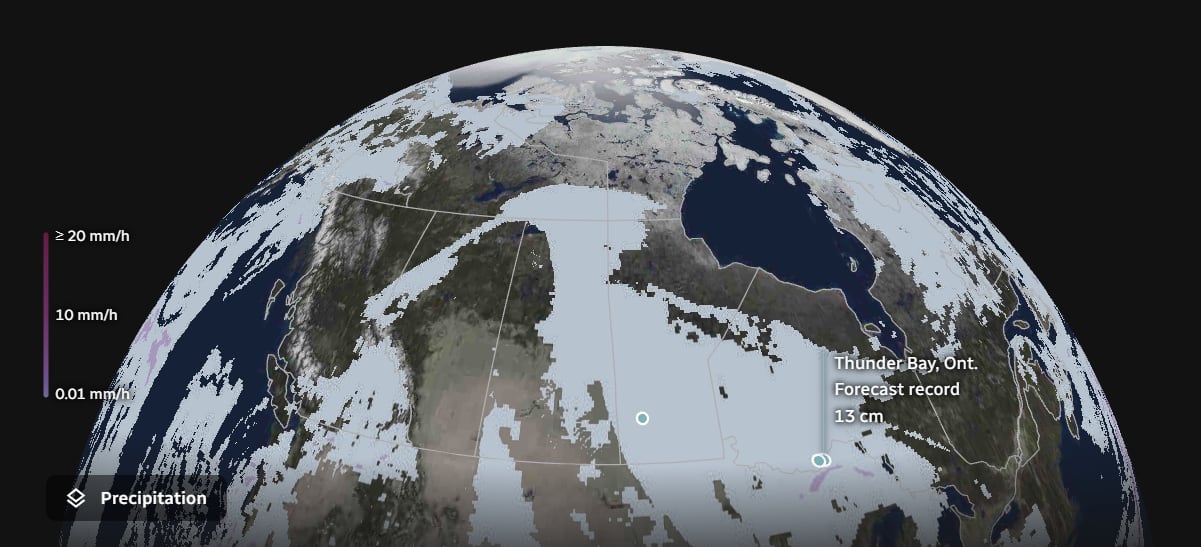
Check the CBC News Climate Dashboard for live updates on record-breaking weather and current conditions across the country. Set your location to find out how today’s temperatures compare to historical trends.
 (CBC)Reader feedback
As Hannah Ritchie mentioned above, there are other benefits to electrification — and last week, Anand Ram wrote about them. From air and noise pollution to having a giant battery for hard times, more EVs on the road means more ways we can measure these benefits using real-world data.
We heard from many of you about other measurable benefits of EVs and potential pitfalls, too.
Jane Evans of Grandora, Sask., points out that where your electricity comes from for an EV matters. She says “our electricity comes from coal-fired plants. In fact, the provincial government just announced plans to keep the coal-fired plants running until nuclear power takes over, possibly in 2050.”
Just under 41 per cent of Saskatchewan’s electricity comes from coal. Daniel Posen, one of the experts we spoke to who did a study on the health benefits of EVs agrees there’s less of a benefit when the grid is 80 to 90 per cent coal-powered. However, he points out both the efficiency of an EV and the lack of tailpipe pollution means “even with a fairly fossil-intensive grid, [such as] a fully natural gas grid, the electric vehicle usually comes out on top compared to a fully gasoline vehicle.”
John Lyons of Toronto points out perhaps one of the most measurable impacts of going electric. He writes, “It costs me $1.50/100 km to drive my electric car. If you don’t want to save the planet would you at least consider saving money?”
Write us at whatonearth@cbc.ca (and send photos there too!)
The Big Picture: The purple seaside flower with carbon-storing power (Susangelastar/Wikimedia)
The salt marshes of the Venice Lagoon form an expansive wetland that appears and disappears with the tides. These vegetated sandbanks have been shaped by river sediments over centuries. They buffer against floods and harbor biodiversity — and have an enormous power to trap carbon.
The mounds can be lush with halophytes — plants that thrive in high-salt environments, such as smooth cordgrass, saltgrass, pickleweed and sea lavender. They suck up carbon from the atmosphere and bury it deep in the sediment. In a recent study, researchers from the University of Padova, in Italy, found that the salt marsh areas with the largest carbon banks were lush with sea lavender, a spindly bush with bright purple flowers. The plant, they say, could be used to enhance and maintain these oceanside carbon banks.
Globally, salt marshes accumulate huge amounts of carbon. Some studies suggest that salt marshes suck up carbon 50 times faster than terrestrial forests. With so much focus on finding technological solutions to scrub carbon from the atmosphere, some scientists are casting their eyes toward these mucky soils — natural solutions that if kept intact can help mitigate the ongoing release of carbon dioxide into the atmosphere and the climatic changes that come with that.
— Hannah Hoag
Hot and bothered: Provocative ideas from around the webRefrigerated trailers haul fresh food and flowers from the farm to your local grocery store, powered by burning diesel. A U.K.-based company has a solution: solar panels. Parks Canada investigating after glitter, streamers left on frozen Lake Louise Kim Steinbacher estimates there were hundreds of pieces of confetti strewn across the ice at Lake Louise. (Kim Steinbacher)
Pink glitter and streamers were left scattered across the frozen surface of Lake Louise on Jan. 31, prompting a Parks Canada investigation.
A tourist from California, who has been coming to Banff National Park in Alberta for more than 30 years, discovered the litter while visiting the lake that day.
“I’d say the Lake Louise area in particular is truly one of the most spectacular places in this world,” said Kim Steinbacher.
Steinbacher was snowshoeing across the lake when she spotted a large area of pink discoloration and confetti pieces on the ice.
Parks Canada says it believes the litter was left behind after a gender reveal celebration.
 Kim Steinbacher at Lake Louise heading out for a snowshoe trip. She later found litter on the frozen lake. (Submitted by Kim Steinbacher)
The debris was visible from roughly 50 to 60 metres away, she says.
She decided to clean it up.
Steinbacher estimates there were a couple hundred pieces of confetti, and says it took about an hour to collect it all.
“It was just the right thing to do,” she said. “I love the area. Nobody wants to see a place as pristine as Lake Louise left trashed.”
Steinbacher says she doesn’t use social media much but felt compelled to share her frustration online.
 Steinbacher collected the confetti and gave the bag to Parks Canada when she filed her complaint. (Submitted by Kim Steinbacher)
Her post about the incident quickly gained traction, with thousands viewing it.
Steinbacher did not expect her story to attract so much attention.
“It was both very surprising and surprisingly encouraging to see that everybody else was just as upset as me and that I wasn’t overreacting — that others care as much as I do,” she said.
After her post sparked so much interest, Steinbacher decided to file a formal complaint with Parks Canada.
She revisited the spot where she found the litter about a week and a half later.
“I could still find a lot of the powder discoloration where it had taken place,” she said.
She says she hopes the conversations her post sparked remind visitors to be respectful and mindful when visiting national parks.
“I would love to see people understand how precious a national park is and that these places need to be protected,” she said.
In a statement to CBC News, Parks Canada confirmed it is investigating the incident.
Littering is prohibited in national parks, and Parks Canada says violations can result in court appearances and fines of up to $25,000.
Parks Canada is asking anyone with information about the Jan. 31 incident to contact Banff Dispatch.
— Michelle McCann
Thanks for reading. If you have questions, criticisms or story tips, please send them to whatonearth@cbc.ca.
What on Earth? comes straight to your inbox every Thursday.
Editors: Emily Chung and Hannah Hoag | Logo design: Sködt McNalty