
Over the past year, the BYU football and basketball teams have been on the receiving end of derogatory chants targeting The Church of Jesus Christ of Latter-day Saints, with incidents at Arizona, Colorado, Cincinnati and, most recently, Oklahoma State. That’s four of the 15 fellow Big 12 programs since BYU joined the conference 2 1/2 years ago.
The latest flashpoint was in Stillwater, Okla., on Feb. 4. After the conference fined Oklahoma State $50,000 on Feb. 8, the Big 12 released a statement that it “will not tolerate any behavior that targets or demeans others.”
When asked for additional comment, the Big 12 reaffirmed its zero-tolerance policy toward any discriminatory behavior by conference members or at league events.
In a statement to The Athletic, a spokesperson from the Church, which sponsors Brigham Young University, said: “While not representative of the broader community, we expect better from those who do engage in these derogatory chants at various sporting events. Such chants are offensive, discriminatory, and unacceptable. We commend the Big 12 Conference’s commitment to a unifying remedy. It is time to move beyond the cycle of recurring apologies without improvement. We reaffirm our ‘love of neighbor’ and pray for greater kindness and compassion among all.”
Despite the unequivocal response, “F— the Mormons” being shouted in the stadiums and arenas where BYU competes has become routine. The Church of Jesus Christ of Latter-day Saints “discourages” the use of the term “Mormon” unless used in the context of the Book of Mormon, a church text from which the term derived.
The Cougars have thrived competitively — football reached the Big 12 Championship Game in December, and men’s basketball is ranked in the Top 25 — but the chants have become a distressing and unavoidable part of the experience for the university and its supporters.
Publicly, the Big 12 conference office has issued reprimands and fines. Privately, the league has pushed for increased education and consequences, particularly within student sections, where the issues tend to start.
After the incident at Oklahoma State, Cowboys fans insisted the chant was actually “ref’s a Mormon,” and a university investigation determined the chanting was directed at officials, but that it “did not meet our standards and expectations,” the university said via statement.
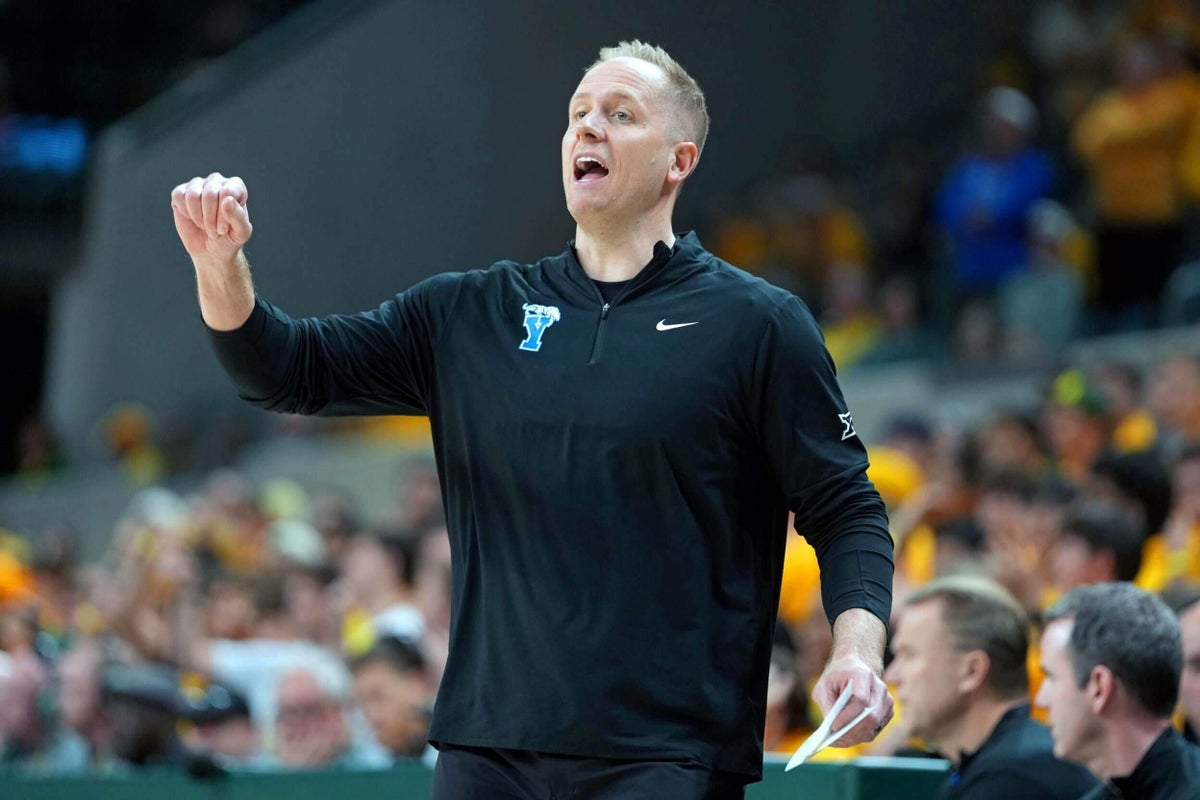
It sparked an impassioned postgame response from BYU basketball coach Kevin Young.
“I got four small kids at home. I’m a Mormon. When I get home, (my kids are) going to ask me about it,” Young said. “Same way they asked me about it last year at Arizona. There’s just too much hate in the world to be saying stuff like that. We’ve got enough problems in our world without going at people’s religion and beliefs, whether it’s en vogue or not.”
BYU coach Kevin Young said he heard some “F- the Mormons” chants during the #OkState game.
He wasn’t happy. pic.twitter.com/n1OVQS1K4o
— Eric Bailey (@EricBaileyTW) February 5, 2026
Most events feature a pregame announcement prohibiting offensive or hateful language, including Arizona, which ran a video message from men’s basketball coach Tommy Lloyd encouraging sportsmanship before an incident-free game against BYU this week.
At Texas Tech, men’s basketball coach Grant McCasland talked to student sections before a home football game against BYU about being respectful; football coach Joey McGuire returned the favor during hoops season, with no known issues either time. Like the Arizona video this week, it could be an example for other schools to follow.
At least one league school instructed its marching band to start playing if it heard any derogatory chants from the crowd, and schools are expected to actively issue warnings and remove offending fans from the venue.
“It does become a hivemind, it becomes a meme, it becomes drunk college kids or even adults chanting this at a game,” said Patrick Q. Mason, a professor of religious studies and history at Utah State University who is also the chair of Mormon history and culture.
The chants haven’t been an issue only in the Big 12. In December 2024, BYU was on the receiving end of them during a road game at Providence, a Catholic school administered by the Dominican Friars. The chant popped up during BYU’s years as an FBS football independent in games at USC (2021) and Oregon (2022). While over 98 percent of the students at BYU identify as Latter-day Saints, the most religiously diverse portion of the student body is in athletics. Two of BYU’s star players this year, A.J. Dybantsa and Robert Wright III, are not members of the church. BYU’s starting quarterback, Bear Bachmeier, is Catholic.
“I understand what we represent,” Young said. “I try to talk to our guys about being examples in the world.”
Mason said bigotry against members of The Church of Jesus Christ of Latter-day Saints has become an “acceptable prejudice” societally.
Mason said that Latter-day Saints members are easy targets, because while there are an estimated 17 million members worldwide and nearly 7 million in the U.S., many who participate in the chant have likely never befriended a member before. That, Mason explained, makes it more accepted, because it’s often easier to be cruel to a subgroup you know nothing about. Some people, Mason said, only know the church through media representations that include stereotypes.
“Minorities need allies — especially small minorities — because that’s the whole point: you aren’t big enough. You need allies to stand up for you,” said Mason. “I think that’s what Latter-day Saints are looking around and asking for.”
Former BYU center Eric Mika said his alma mater has been an ally to other Big 12 members in its short time in the conference.
Before BYU football’s road win in late November at Cincinnati, the LDS Church helped donate 27,000 pounds of food to the school food pantry for the holiday season. During BYU’s 26-14 win, some Cincinnati fans still unleashed the chant.
Before BYU’s regular-season meeting with eventual conference champion Texas Tech in early November, BYU fans helped raise nearly $175,000 for the Red Raiders’ team barber after his wife was in a serious car accident.
Mika is hopeful those stories will change the rhetoric.
“Eventually that kind of stuff just breaks through,” he said, “and I don’t think it’ll be an ongoing issue as the conference and the country gets to know us more.”
Mika said that during his days at BYU, he never heard the derogatory chant. The All-West Coast Conference center played two years at BYU before declaring for the NBA Draft in 2017. Mika said he remembers opposing students dressing up as LDS missionaries as a joke, but that was the extent of it. Schools getting fined, Mika said, clearly hasn’t slowed the pervasive nature of the chant.
“I know that stings the schools a little,” he said, “but it doesn’t sting those people in the crowd.”
After the chant at Oklahoma State, BYU athletic director Brian Santiago said he received an apology from OSU AD Chad Weiberg. It’s the latest in a long string of apologies relayed to BYU from school officials across the country.
“What we’re trying to do,” Santiago told The Associated Press this month, “is eliminate the behavior from happening and the apologies that come afterward.”