
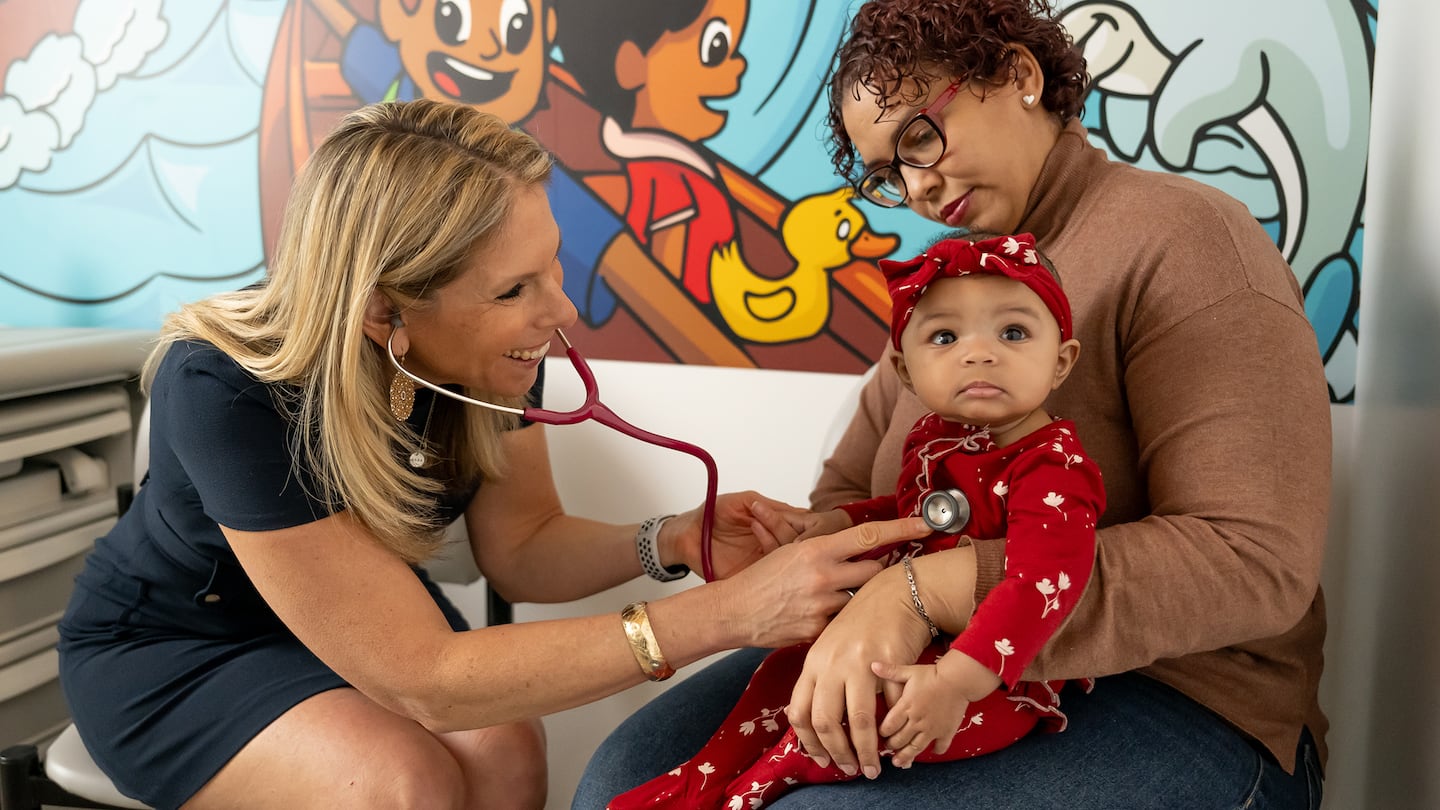
It serves a majority low-income, Latino, and Black population. Around 80 percent of patients have Medicaid, 40 percent are food insecure, and 20 percent are housing insecure, Riseberg said.
Get The Gavel
A weekly SCOTUS explainer newsletter by columnist Kimberly Atkins Stohr.
In addition to offering routine check-ups and sick visits, there’s a dental clinic and on-staff mental health clinicians. Families are offered food, clothing, books, diapers, and hygiene products. Patient navigators help parents find housing, apply for utility discounts or state benefits, and interact with schools.
The practice also runs new parent support groups and an annual school supply giveaway, Thanksgiving meal distribution, and holiday “shop” with donated presents.
The practice has 22 staff for 1,700 patients. New patients can get an appointment within a week.
At a time when health systems are facing low profit margins, primary care doctors are burning out, and patients struggle to get appointments, how does Boston Community Pediatrics survive? The answer is philanthropy. Of its $4.8 million budget last year, around one-third came from insurance reimbursements and two-thirds from philanthropy. That includes some public money from the state and city of Boston, plus a slew of charitable foundations and individual donors, with nonprofits that donate supplies.
Philanthropic-funded health care is nothing new, and philanthropists are playing an important role by sustaining Boston Community Pediatrics. But the problem with relying on philanthropy to provide a core service like medical care is it’s not easy to scale or sustain. There isn’t enough private funding to have a Boston Community Pediatrics in every needy community.
Additionally, in a country that spends around $5 trillion annually on health care, shouldn’t we be able to fund high-quality primary care using money that’s already in the system?
Wayne Altman, chair of family medicine at Tufts School of Medicine, who founded a primary care advocacy group, said Boston Community Pediatrics is an example of how pediatric primary care should be delivered but not how it should be funded. “We know the philanthropists for Boston Community Pediatrics are essentially subsidizing the insurance companies, because they’re paying what the insurance companies, the payers, should be paying for,” Altman said.
But without philanthropy, providing the services a low-income population needs is difficult. Codman Square Health Center in Dorchester offers similar wraparound services as Boston Community Pediatrics: a food pantry, behavioral health care, dental care, even a tax preparation clinic. Chief Medical Officer Renee Crichlow said the center relies primarily on insurance reimbursement, with a little philanthropy and some federal money.
That leads to thin operating margins, Crichlow said. But the biggest problem is a lack of access. The center has 25,000 patients and the equivalent of 35 full-time doctors and nurse practitioners (plus medical assistants and support staff). Since the pandemic, Crichlow said, new patients usually have to wait a year to get a primary care appointment.
Only recently was the center once again open to new patients because of a change in Medicaid, which now pays a set amount per patient per month, rather than fee-for-service. That change lets clinicians operate more efficiently — for example, medical staff can call a chronically ill patient, refill a prescription, and order labs without the patient coming in. Previously, the center would have made the patient book an appointment, or that work wouldn’t be reimbursed.
Helping more practices like Boston Community Pediatrics open without relying heavily on philanthropy would involve spending more insurance money on primary care. In 2023, just 6.7 percent of health care dollars spent by commercial insurers in Massachusetts went to primary care. Massachusetts’ primary care task force recommends the state set a target of doubling the current share or spending 15 percent of health care dollars on primary care, whichever is higher, without increasing total health care spending. The challenge, of course, is determining what type of specialty care would get less money to pay more for primary care and making sure that these specialized services are still paid enough to be sustainable. Eliminating administrative waste in the system could also free up more money for primary care.
The task force is also still exploring if alternative payment methods could improve care quality, potentially moving from fee-for-service to a population-based system, like the one Codman Square benefited from.
Altman is among those pushing legislation to create a single-payer system for primary care, where all insurers pay into a fund that would pay primary care providers a monthly per-patient fee. The fee would include adjustments for higher-needs patients and meeting quality standards, with financial incentives to do some procedures and provide services like integrated behavioral health, extended office hours, and longer visits.
Long term, Altman said, improving primary care saves money by treating problems before they escalate. But there is an open question of who would subsidize the fund until it is self-sustaining, without vast hikes to insurance premiums.
In five years, Boston Community Pediatrics hasn’t had a single physician leave, and a practice-commissioned survey found high levels of patient satisfaction. The practice illustrates what primary care could look like statewide — if only the funding were there to support it.
Shira Schoenberg can be reached at shira.schoenberg@globe.com. Follow her @shiraschoenberg.