
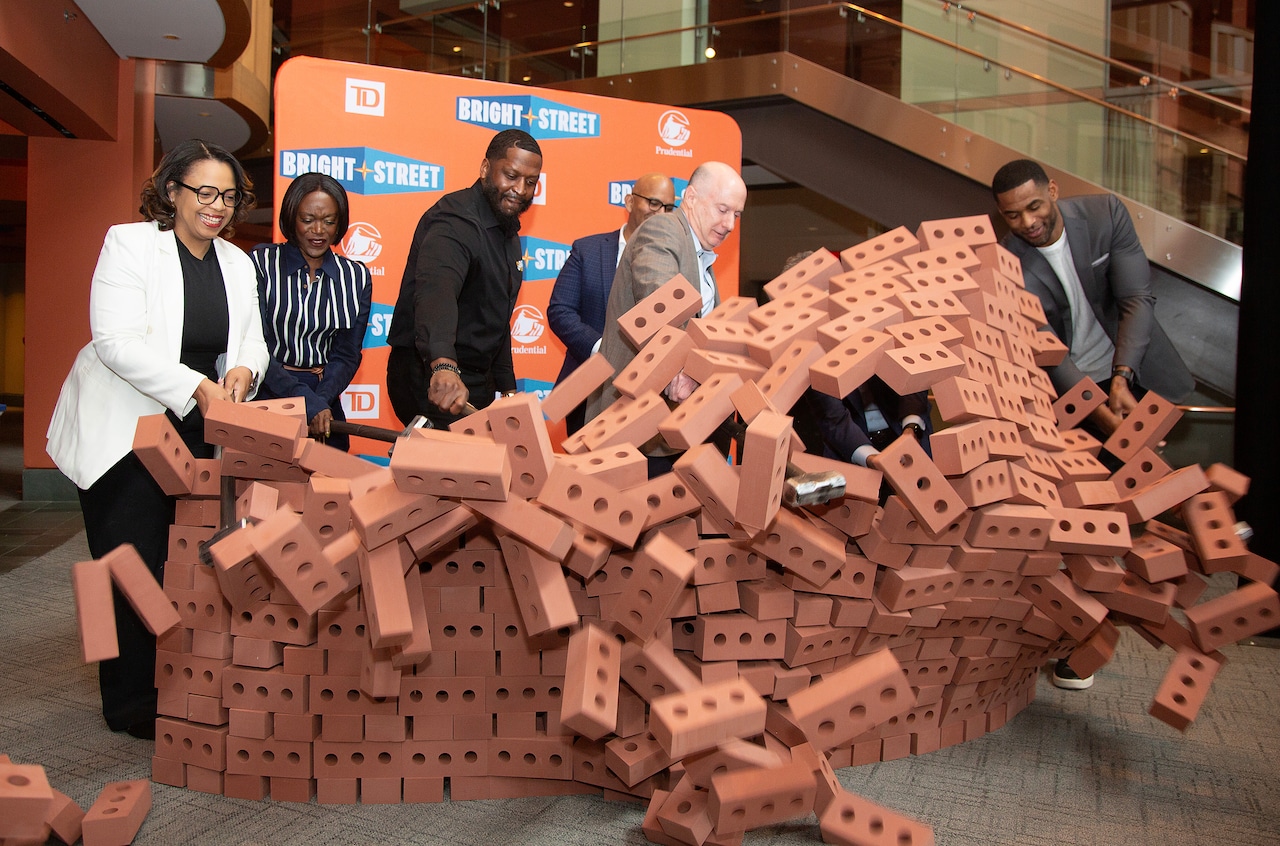
Former NFL standout and entrepreneur Marques Colston swung a sledgehammer to help knock down a 200-brick wall to dramatize the barriers many small-business owners face in Newark and beyond.
“For too long, talented small business owners have built their dreams on unstable foundations — not for lack of talent or work ethic, but for lack of access to fair capital, tools, guidance, and an ecosystem that believes in them before the numbers prove their success,” Colston told attendees gathered at the lobby New Jersey Performing Arts Center, where the faux brick wall once stood.
“That’s what makes today special,” he said.
The highly visual moment on Thursday morning marked the public launch of BrightStreet, a new nonprofit aimed at helping entrepreneurs who are often shut out of traditional financing.
Colston, a Super Bowl champion turned investor and business mentor, joined city leaders and founders in the symbolic demolition to underscore the organization’s mission: removing obstacles such as limited access to loans, technology, training and mentorship.
Micro-businesses — companies with fewer than 10 employees — account for roughly 95% of all businesses in New Jersey, New York and across the U.S., according to organizers. Yet they are denied funding at more than twice the rate of larger firms, and nearly half operate in low-income communities where capital and guidance are scarce.
BrightStreet plans to address that gap by offering affordable loans, financial education and hands-on support to startups, solopreneurs and micro-enterprises — particularly those historically excluded from mainstream lending. Three entrepreneurs in the nonprofit’s first cohort received oversized ceremonial checks at the launch event and shared stories of struggling to secure capital despite viable business plans.
At the launch of BrightStreet, several entrepreneurs were announced as early recipients of funding, including local business owner Undra Duncan and businesswoman Jennifer Lopez.
Al-Shakise Anderson was also among those receiving support, as BrightStreet begins its effort to provide capital to businesses that may not qualify for traditional loans.
Organizers said the funding will help them grow their companies, create jobs and expand their reach.
“This opportunity means everything to me,” said Duncan, the creative director of Undra Celeste New York. “This isn’t the first time I’ve gotten funding, but it is the first time I can visually see that funding and structure are in unison.”
Newark Mayor Ras Baraka, who during the event presented a proclamation to commemorate the creation of BrightStreet, showed his enthusiasm for the launch.
“Small and microbusinesses are the backbone of Newark’s economy — often started by hardworking residents juggling jobs and dreams without access to capital. So by providing the loans and grants they need to grow, Bright Street is not only fueling opportunity but becoming a permanent part of Newark’s history and future,” Baraka said during his proclamation. “We’re married now!”
Colston, who has built a post-football career investing in and advising startups, said his involvement with BrightStreet reflects a broader commitment to economic empowerment. He has frequently spoken about the parallels between sports and entrepreneurship — discipline, teamwork and access to resources — and the need to create pathways for founders from underrepresented communities.
The nonprofit, founded by Rob Falzon and backed by partners including TD Bank and Prudential, will provide capital and technical assistance that traditional lenders often decline to offer — a model they hope can be replicated in other urban centers.
As the last of the foam bricks tumbled to the floor, Colston paused to look at the scattered pieces before stepping back into the crowd of entrepreneurs.
“Talent thrives with the right support — responsible capital and mentorship that turn small businesses into lasting enterprises and strengthen entire communities,” Colston said. “BrightStreet is about making sure more entrepreneurs get that chance.”