
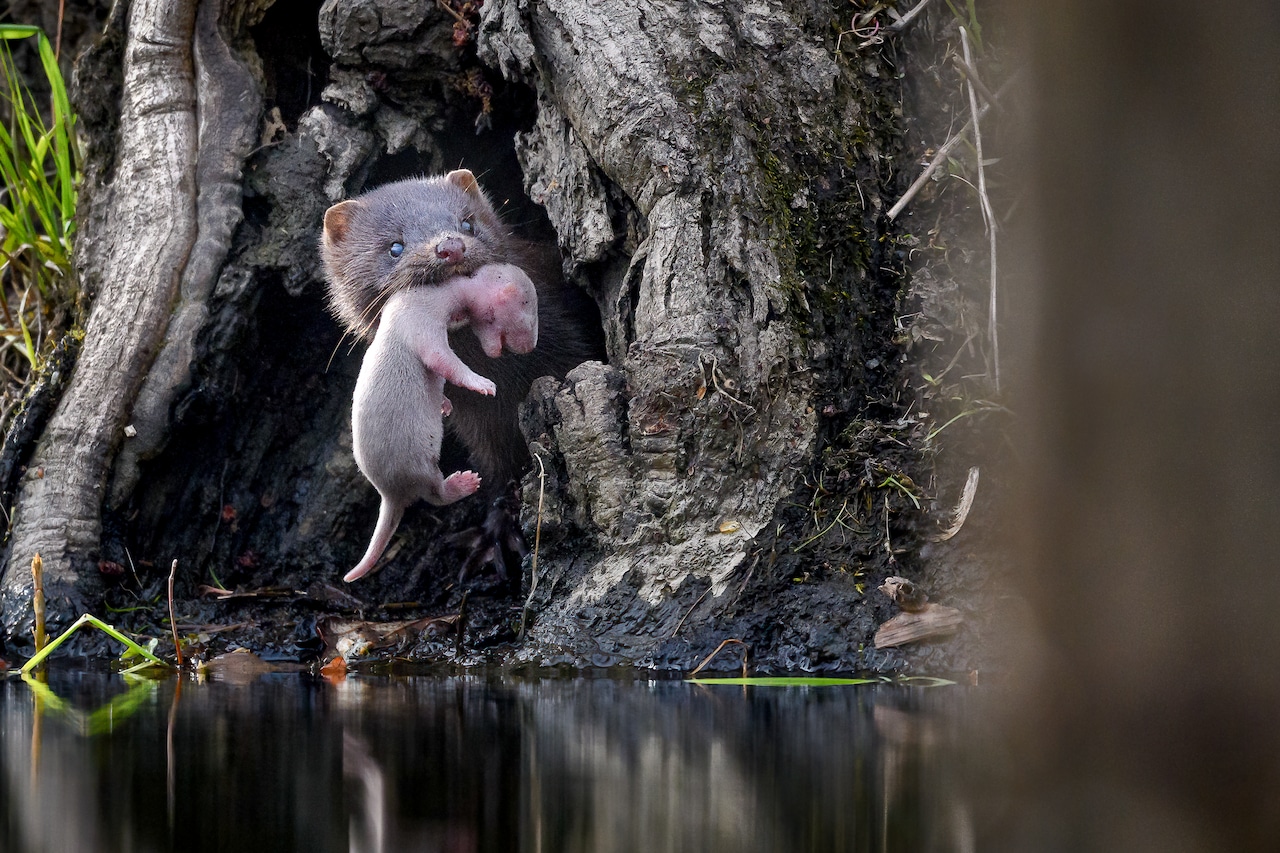
When people picture a mink, they often jump straight to fur — big, elaborate coats like Cruella de Vil’s in Disney’s animated 101 Dalmatians. They’re not wrong: the fur trade helped shape early Oregon history, and mink fur is still part of the story here today.
But Oregon’s mink isn’t just a fashion throwback. Oregon has the American mink — one of the world’s two living mink species — and it’s found throughout the state, especially around water. And yes, if you’re picturing the weasels from Disney’s Who Framed Roger Rabbit — you’re in the right neighborhood. Mink are mustelids, part of the weasel family: sleek, relentless hunters built with long bodies, sharp teeth, quick reflexes and a stubborn attitude. In Oregon, that family includes mink along with the American marten, fisher, ermine, long-tailed weasel, wolverine, American badger and river otter.
Like otters, the semi-aquatic mink is built for the water — not exactly the vibe for some of its landlubber cousins, like the wolverine. Think of them as little swimming machines, wrapped in a thick, water-repellent coat. They stick close to cover as they hunt along creeks, ponds and marsh edges, eating a mix of fish, frogs, crayfish, birds and small mammals they can grab near the waterline — and you’re most likely to catch one out after dark, since they aren’t strictly nocturnal but are most active at night.
To identify one, look for an animal bigger than a weasel but smaller than an otter or fisher — roughly 19 to 28 inches from nose to tail and about 1.5 to 2 pounds. In Oregon, that usually means checking shorelines and banks wherever there’s water. The clues you’ll notice are the dark, chocolate-brown fur, a bushy tail about half the length of its body — and, sometimes, a white chin, which Oregon Department of Fish and Wildlife carnivore and furbearer coordinator Sam Fino calls a key identifier.
When talking about the American mink, it helps to remember the only other kind – the European mink. While mink like the ones in Oregon are spread across the globe, the European mink is the opposite — scarce, critically endangered, and limited to tiny, fragmented populations. For example, France’s national plan puts the number in the wild at fewer than 250.
If mink had a superpower, it would be their ability to control the timing of reproduction. Like others in the mustelid family, after mating, a fertilized egg doesn’t necessarily implant right away. It can hit pause before it finally implants in the uterus later, which lets the pregnancy timeline stretch — roughly 40 to 75 days — so kits arrive in spring, when prey is plentiful and cover is thick. Mink also tend to ovulate in response to mating, not on a fixed calendar cycle.The result is a short breeding season, with births that can still land at the right time.
That flexibility only adds to the mink’s reputation as a tough, adaptable predator that can thrive in a wide range of habitats. Native to North America, American mink were shipped overseas during the early 1900s fur-farming boom — and escapes (and in some places releases) helped turn them into an invasive species in many parts of the world. Today, American mink are established across large stretches of Europe, including the U.K. and Ireland, Scandinavia, the Baltics, and parts of western and central Europe.
In Iceland, American mink escaped fur farms, spread across much of the lowlands, and became a new shoreline hunter — hitting vulnerable bird colonies hard and contributing to long-running concerns about lost biodiversity.
In South America’s Patagonia, American mink have also damaged native bird populations, especially ground- and shore-nesting species, by raiding nests and taking chicks in wetlands and along lake and river edges.
In China, American mink are now established in much of the northeast, and researchers describe them as one of the best-known and most widespread invasive species in the country.
And in Japan, mink were introduced for fur and later established wild populations in some areas — including islands such as Okushiri — where they’ve taken to the same environments they favor elsewhere: waterways, wetlands, and the edges of cover, preying on whatever is easiest to catch.
Long before people spread them around the world through fur farming, mink were a supporting player in the fur trade that helped drive early economic growth in Oregon. Europeans entered the Pacific Northwest Coast trade in the late 1700s, and sea otter pelts were the first big prize. As the trade moved inland in the early 1800s, beaver took over as the main target. Mink were still taken in real numbers, but they were usually folded into the mixed haul of “other” furs. Fort Vancouver records from an 1843 shipment list 7,671 mink out of 61,118 total whole skins — about 13%. That’s significant volume, just not the top prize.
Mink didn’t start becoming highly sought after until fashion demand shifted and commercial mink farming expanded. Fur farming began in North America shortly before the Civil War, and mink were the first American furbearer raised commercially — a change that eventually turned mink from “nice to have” wild pelts into a mass-produced, fashion-driven fur. Today, mink pelts make up the majority of pelts produced on fur farms, reflecting how central mink became once ranching scaled.
As mink farming grew, Oregon built a whole support system around it. Oregon State College (now Oregon State University) even ran an experimental fur farm and studied how to raise mink more efficiently — basically treating mink like any other livestock, with better breeding and better feed. On the coast, fishermen started catching large amounts of low-value fish to grind into mink food — tens of millions of pounds per year at its peak — and in 1951 the Oregon Fur Producers Association opened a processing plant in Astoria to turn those fish into feed. By the 1950s, state researchers found the mink-food catch had jumped so much that Oregon tightened fishing rules on what could be taken for mink feed.
By the 1970’s, Oregon mink farms had peaked, then the industry consolidated into fewer, bigger operations. Data from the USDA National Agricultural Statistics Service show 91 farms in 1970 producing about 197,000 pelts, versus 18 farms in 2006 producing about 283,900 pelts — fewer ranchers, more output per ranch. Census detail shows Oregon still had 49 farms with mink inventory in 1982, with farms clustered in a handful of counties. By the early 2020s, public reporting put Oregon at roughly 11 active mink farms, heavily concentrated in Marion County.
Mink farming faded in Oregon as fur coats fell out of fashion — they’re expensive, less practical than modern synthetics and are associated with animal cruelty. A full-length mink coat can take roughly 40–60 pelts. On top of that market slide, mink farms carry two problems that don’t go away: mink are escape-prone, and they can spread disease. That’s why Oregon mink farms wound up in the spotlight in 2020, when a COVID-19 outbreak hit a farm and an infected mink was found outside a quarantined facility — prompting advocates to urge the state to shut the industry down. Oregon responded with an emergency rule requiring SARS-CoV-2 vaccination and surveillance testing for captive mink.Then there are the wild mink outside the fur world — the ones slipping around creeks, sloughs and beaver ponds at night, sometimes capturing prey bigger than they are.
Sam Fino, ODFW’s statewide carnivore and furbearer coordinator, says the agency gets regular reports of mink sightings and doesn’t have reason to think mink are declining. Harvest data show relatively little pressure: ODFW’s annual furtaker reports indicate mink take has been low in recent years — 77 in 2016, 102 in 2019, 73 in 2020 — and it’s generally been well under 150 a year statewide.