
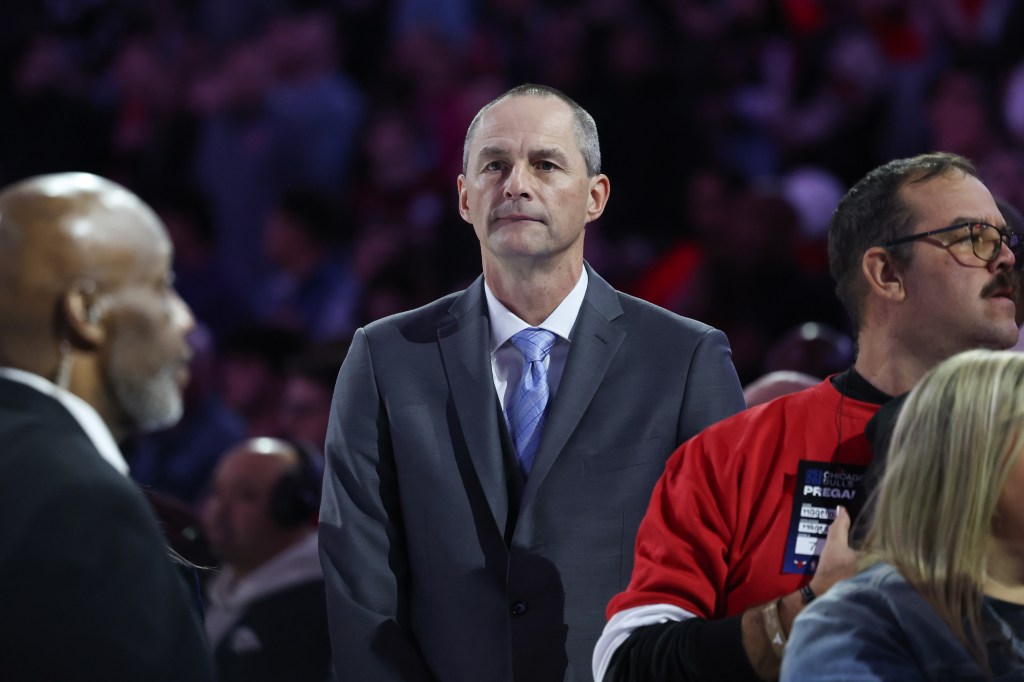
The Chicago Bulls are late.
Again.
It happens too often with this front office.
Executive vice president of basketball operations Artūras Karnišovas missed the window for every major trade he needed to make in the last three years. He took too long to move DeMar DeRozan. And Nikola Vučević. And Coby White. In the process, he missed out on the opportunity to secure a first-round pick in return for any of the team’s main core from the 2021-22 season.
Now, the Bulls are behind again. Karnišovas finally committed to tanking by shipping out every relevant expiring contract on the roster. The decision came two years late. The Bulls missed their chance for a shot at Cooper Flagg or any other prime pick in the stacked 2025 draft class. They also failed to begin their nosedive early enough to meaningfully compete for a top-four pick in the 2026 draft, whose prospects were tantalizing enough to encourage a slew of teams from to throw away this season.
Even though it came late, this was the right decision for the Bulls. The roster desperately needed improvements. To make meaningful change, Karnišovas needed to embrace the value of the draft as a talent-acquisition mechanism. Ultimately, it didn’t matter if it came months or years too late. If the Bulls ever were going to rise above mediocrity, they had to make this commitment.
And then, two weeks after the Bulls made the painful turn toward prioritizing the draft, the league decided to crack down on tanking. Commissioner Adam Silver delivered an edict on potential changes for the 2026-27 season to deter tanking as a whole during a general managers meeting Thursday, according to an ESPN report. Before the Bulls can even give tanking the ol’ college try, the mechanism might be rendered obsolete.
This shouldn’t come as a surprise. It’s simply the rhythm in which the Bulls live. A step slow. A second behind. Lagging behind the beat. Hesitation will always be the defining factor of Karnišovas’ tenure in Chicago.
Outliers exist, of course. The Bulls were on the front foot with the league’s recent trend toward up-tempo offenses, setting a pace in the 2024-25 season that ultimately matched the standard for the NBA’s current breathless style of play. But even that alteration lacked agency, existing as an artifact of necessity as the Bulls simply tried to survive with an undersized lineup at every position.
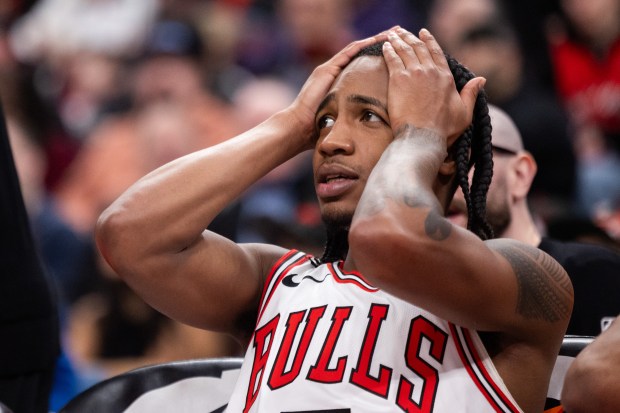 Bulls guard Rob Dillingham reacts on the bench in the second half against the Raptors on Feb. 19, 2026, at the United Center. The Bulls fell 110-101 for their seventh consecutive loss. (Josh Boland/Chicago Tribune)
The timing of this recent turn to tanking is just another example of the helpless, tireless tardiness that has plagued the Karnišovas era in Chicago. The Bulls can never do the right thing at the right time. And if the league follows through on its threats to deter tanking, they will be trapped in a half-baked plan without any exit routes.
Silver’s messaging is a harsh reaction to a building frustration throughout the league. Tanking isn’t new. The strategy has existed for decades, often operating as a necessity for small-market teams to acquire high-level talent that simply would not be accessible in free agency.
The novelty this season is the volume of egregious tanking. Arguably one-third of the league is jockeying to tumble as far down the standings — and up the draft-lottery rankings — as possible. The league already handed out six-figure fines to the Utah Jazz and Indiana Pacers for allegedly sitting players in the fourth quarter to throw games.
During his All-Star weekend news conference, Silver described this season’s tanking activities as “worse this year than we’ve seen in recent memory.”
“The league is 80 years old,” Silver said. “It’s time to take a fresh look at this and to see whether that’s an antiquated way. We’ve got to look at some fresh thinking here. What we’re doing, what we’re seeing right now is not working. There’s no question about it.”
The Bulls never have had the stomach to pull these elaborate stunts. Their current endeavor could be characterized as “ethical” tanking — a purposeful gutting of a roster to create a team that loses even as the players and coaches make a genuine effort to win. That doesn’t matter. When the tide turns, it carries everyone with it, regardless of intent.
According to the ESPN report, the league is considering a variety of options to curb tanking and encourage competitive play through the end of the season. These ideas include freezing lottery odds at the trade deadline; barring teams from picking in the top four in consecutive years; adding play-in teams to the lottery; basing lottery odds on a two-year span; or simply flattening the odds so that every team in the lottery has the same chance of landing the top selection.
Some of these scenarios would be more painful than others for the Bulls, who likely will sink next season into another losing endeavor — perhaps by choice, perhaps by the sheer reality of their roster’s lack of talent. Given their hesitancy to fully commit to losing, the Bulls could benefit from flattened odds and the exclusion of prior bottom-four teams. But any efforts to quell tanking in broad strokes ultimately would place luck at the rudder of draft positioning.
Luck has not favored the Bulls in recent years. That could change — as could the rules — as early as this summer. But the lesson remains for Karnišovas and company as they survey the shifting landscape of the NBA this summer.
Waiting only welcomes disruption. And in a league accustomed to rapid change, hesitation is the simplest way to get left behind.